The first film of the new year is always an exciting moment. Why this specific movie to kick off 2026? The answer is simple: Daisy Ridley. Despite being familiar with some of the previous work by filmmaker Zak Hilditch (1922), my interest in this feature resided 100% in the lead actress, as I’m a confessed fan of her talent, which is often undervalued. There’s something intrinsically magnetic about the way Ridley approaches her characters, and the curiosity to see her in a smaller-scale project, far from light sabers and spaceships, was immense.
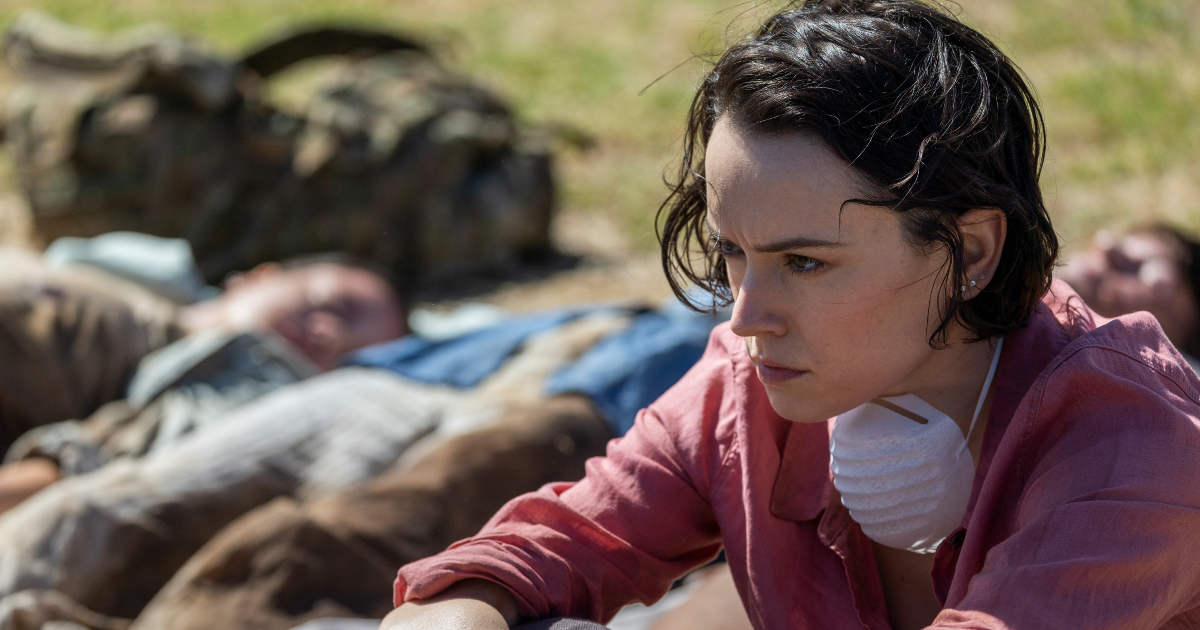
Written and directed by Hilditch, We Bury The Dead follows the story of Ava (Ridley), a desperate woman who joins a body recovery unit following a military catastrophe in an isolated region. What begins as a search mission for her missing husband quickly transforms into a descent into hell when the dead — or rather, those who haven’t found rest — start showing signs that their departure wasn’t definitive.
Ridley is, undeniably, the MVP of the film and the decisive factor that pushes it into positive territory. The actress delivers a complete performance, full of restraint yet charged with a powerful stoicism, releasing bursts of emotion in more than just a single standout scene. Her ability to demonstrate pain, sadness, grief, or anger without apparent effort is magnetic, evidencing a physical expressiveness far above average. It’s surprising to see her in these indie flicks — despite the controversial Star Wars trilogy, her acting was never considered a problem, quite the contrary — but on the other hand, after all that chaos generated by an extremely toxic fandom, perhaps it’s rewarding for the actress to dedicate herself to smaller, more intimate projects.
The primary engine of We Bury the Dead is the psychological torture of ambiguity. Ava finds herself stuck in a limbo that’s, arguably, worse than confirmed death. The narrative suggests that humans are willing to walk into the jaws of hell just to see a corpse because a body offers a sort of closure that an empty chair never can. By joining the recovery unit, Ava attempts to transform an abstract tragedy into a tangible reality. Hilditch explores the idea that hope can be a double-edged sword: it keeps us alive, but it also prevents us from starting the true healing process, delaying the inevitable.
Some truly interesting ideas mix, however, with more generic tropes. Hilditch presents a somewhat modest approach to the zombie apocalypse subgenre, focusing more on the symbolism of the dead as unresolved pain or lack of closure, rather than a spectacle of action and horror set pieces. The dead in We Bury the Dead aren’t just monsters to be feared; they’re symbols of unfinished business. Unfortunately, the movie ends up falling into the trap of choosing the safest route, returning to more formulaic developments typical of the “avoid the dead, fear the living” dynamic, which gave the film a certain tonal inconsistency as the narrative progressed.
Despite these narrative fluctuations, technically, it’s a gorgeous movie to watch. The cinematography by Steve Annis (I Am Mother) is nothing short of beautiful, utilizing the location of Albany, Australia, to its full extent. The camera captures incredible wide shots, both from a horizontal and eagle-eye perspective, demonstrating the scale of the zombie-affected regions, filled with fires and heavy smoke that suffocate the horizon. There’s a melancholic beauty in the destruction that Annis captures, creating a visual contrast between the vast nature and the characters’ intimate suffering.
However, it’s the sound design that steals the show. Although they aren’t “characters” in the traditional sense, the dead represent the persistent noise of trauma. The specific choice to make them grind their teeth — a sound associated with stress and subconscious anxiety — is a brilliant and quite unnerving thematic touch. The zombies are the physical manifestation of the grief that refuses to stay buried and a past that continues to “bite” at the living. Much praise should also be given for the focus on practical effects and creature design; this is why indie cinema is so vital, as it allows for the support of artists like Jason Baird (Elvis), whose work as a prosthetic designer confers a weight and texture to death that CGI rarely manages to replicate.
The pacing is adequate, although for some viewers it might feel a bit of a slog, given that the slow-burn atmosphere is very present. We Bury the Dead asks for patience, inviting the audience to sit with Ava’s discomfort before accelerating the pulse. However, the ending turns out to be a bit rushed and even messy, throwing too many things at once in a few minutes, leaving more interesting threads somewhat hanging and stumbling a bit until the final scene.
Still, the solid performances, atmospheric visuals, and short runtime helped me enjoy the experience. We Bury The Dead reveals itself as a competent entry in the genre, elevating itself above the average thanks to its protagonist and its technical execution, even when the script decides not to risk as much as it could.
Final Thoughts on We Bury the Dead
We Bury The Dead ends up being a positive experience, where technical excellence and a sweeping central performance try to compensate for a script that loses its breath and coherence in the home stretch. Although it doesn’t manage to keep the promise of its unique premise until the end, falling into conventions it sought to avoid, Zak Hilditch‘s film offers enough to deserve attention, especially for the way it treats horror as an extension of human pain. It’s a visceral reminder that the true battle isn’t against the monsters walking out there, but against the memories that refuse to let us go, proving that sometimes the only way to survive grief is to finally look it in the eye.
Rating: B-
We Bury the Dead is now playing in theaters.
Learn more about the film, including how to buy tickets, at the official website for the title.
You might also like…