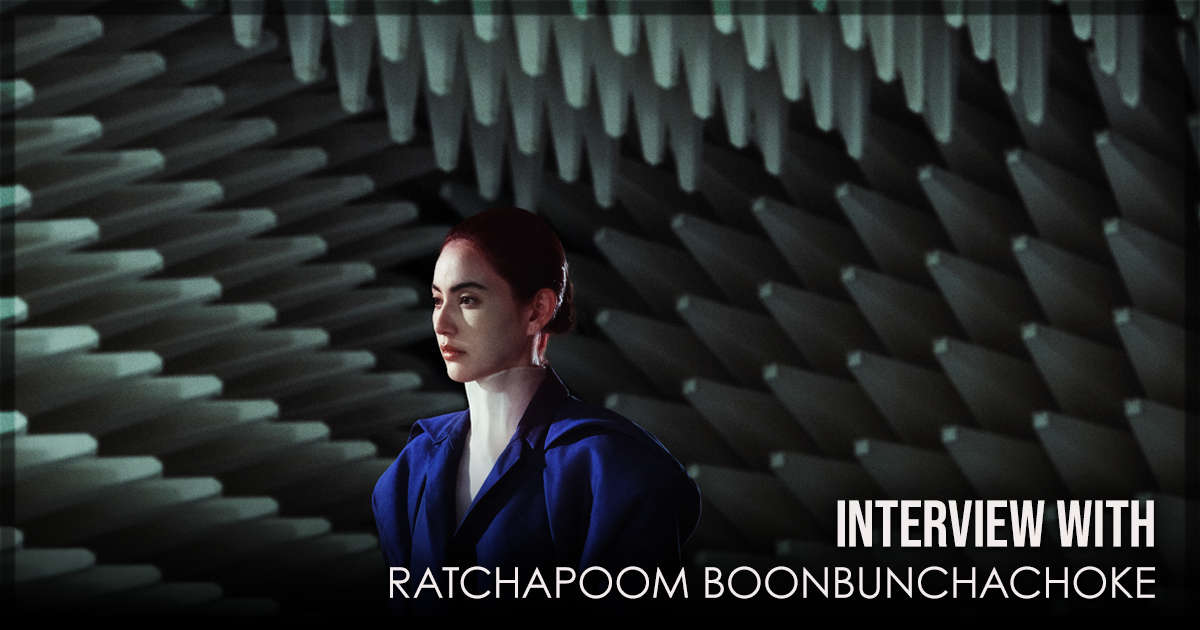
Ratchapoom Boonbunchachoke’s debut feature A Useful Ghost exhibits a hooky high concept, one that’s centered on a woman who dies of dust pollution and gets reunited with her grieving husband by possessing a vacuum cleaner, much to the chagrin of her in-laws. The director dresses this concept, essentially a loose adaptation of the mythical tale of Mae Nak, as a story within a story, allowing the film to be suspended between dream and waking reality. What results is part absurdist comedy and part silly poltergeist movie, one that feels just as weirdly inventive as the filmmaker’s trans banger Red Aninsri; Or, Tiptoeing on the Still Trembling Berlin Wall, winner of the Pardi di domani Prize for best international short film at the 2020 Locarno Film Festival. A Useful Ghost made its world premiere at the 2025 Cannes Film Festival as part of the Critics’ Week program, where it won the Grand Prix, and went on to be selected as the Thai entry for next year’s Oscar foreign film derby.
In the film, an impressive cast of Thai actors headed by Davika Hoorne, Witsarut Himmarat, Apasiri Nitibhon, Wanlop Rungkumjad, and Wisarut Homhuan, brings to life the director’s incredibly daring vision and his oneiric anxieties about the state of contemporary Thailand, whose cultural and political histories are electroshocked by censorship and crackdowns. In fact, Ratchapoom started working on the material in 2017, three years following the military junta’s takeover of the Thai government, eventually resulting in a series of massive pro-democracy protests in 2020 and 2021.
A Useful Ghost is a far more terrifying picture than it lets on. On the surface, it might be readily viewed as a story of romance and grief, but it is largely about the arcane arts of haunting and cheap labor and how they are harnessed not just for capitalist gains but as a tool of state surveillance and historical erasure. On one side are the spirits returning and taking over household machines as an act of protest; on the other is Nat, the titular character, who becomes part of a larger techno-fascist machine, one that makes her useful only insofar as she provides immediate labor—efficient in the repression of the already dead and disenfranchised; even in death, Nat is rendered powerless, discarded when no longer needed. Ratchapoom, then, deftly calls into question the insidiousness of exploitation and bureaucracy as well as the function of technology in the preservation and erosion of national memory—and does so with magpie curiosity, stark symbolism, bleak humor, and stylized composition. What remains is undeniably one of the year’s most compelling image-making.
Ahead of the movie’s Philippine premiere at the Asian Next Wave competition of the 2025 QCinema International Film Festival, I had a brief conversation with the director about the making of the film, spectral figures, and dreams.
The Interview with Ratchapoom Boonbunchachoke of A Useful Ghost
Lé Baltar: In most poltergeist movies, ghosts are often portrayed merely as vessels of fear and terror, but here they actually have real emotions and dreams and even carnal desires. How conscious were you of this kind of texture when putting the film together?
Ratchapoom Boonbunchachoke: Thailand is well-known for producing many ghost horror films. Thai ghosts are very scary in films. However, that’s also one of the reasons why I consciously tried to avoid depicting ghosts as such in my film. Generally, ghosts are expected to be scary and to frighten people, yet I wonder what ghosts would do if they didn’t need to be scary or vengeful all the time. What is left for them to do? For me, ghosts are something almost human but not quite. Sometimes, we hear them, but we can’t see them. Sometimes we see them as human, but they are not. They are almost human but not human enough. I’m fascinated by this paradox and want to play with that. The ghosts in the film are treated more like other human characters but not quite.
Lé Baltar: Initially, the viewer encounters the ghosts on neatly existential and supernatural terms, but, as the narrative unravels, they become more political, seen in the function of labor, state violence, and historical memory. How crucial is this shift in the vision you’re trying to make in relation to the state of contemporary Thailand. I know you wrote the material three years following the military coup in your country.
Ratchapoom Boonbunchachoke: I began writing the story in 2017 and finished the first draft in 2020, yet it wasn’t until 2023 before the shooting that I eventually had the final draft. So many things happened in the country during those times. Because of the nature of filmmaking, which takes a long time to complete, I was afraid that when the film is released, its story would lag behind reality, yet I was unpleasantly surprised how things in the country stayed the same or, even worse, regressed.
Regarding the shift, I suppose it was always my intention to play with the audiences’ expectation. When you think the film would go this way, it takes another direction. I always knew from the beginning that I wanted to explore the political potentiality of ghosts, but I just didn’t want to reveal that intention in the first few minutes of the film. I was more intent on drawing the audiences in with silly situations. And this would also broaden the film’s opportunity to dissect several aspects of spectrality.
Lé Baltar: A Useful Ghost also explores dreams and mind control. I’m sorry if this question feels intrusive, but I wonder, when was the last time you had a dream in a literal sense, and what’s it about?
Ratchapoom Boonbunchachoke: I rarely remember my dreams these days, the ones I recall would be my dream of anxiety.
Lé Baltar: On that note, and given how heightened present-day technology is, do you think it’s highly probable for dreams to be used as tools of state surveillance?
Ratchapoom Boonbunchachoke: During 2020, there were many protests against the military regime throughout the country. I remember how during that time, fears about state surveillance reached an all-time high. People were anxious about CCTV cameras at every skytrain and subway station, so they wore masks when they went to protests. Also, many activists were arrested by the police. There were several reports of officers inspecting their cellphones and reading through their private chat history. I found that very intrusive. A mother of one activist was brought in for questioning because she didn’t stop her son from going to the protests. I’m not sure if technology could become so advanced that it could monitor people’s dreams. That’s why they need ghosts to do it in the film. Perhaps psychological testing or evidence-collecting techniques could develop in unexpected ways in the future though.
Lé Baltar: Throughout the film, the absurd comedy is expressed in a more restrained way, but once it reaches the coda, it leans on a wackier or excessive register. Could you talk more about that artistic decision and why you thought the film had to end there?
Ratchapoom Boonbunchachoke: Since pre-production, I always envisioned the film to be poetic. However, my definition of “poeticness” might be different from the usual, popular perception. While people tend to think of poetic films as being infused with a sense of freedom, relying mostly on beautiful images like films by Tarkovsky, Kieślowski, or Jarman, for me, being poetic is more about restrained expression. As a Thai who knows little about Thai poetry, poems are something you can’t freely write, but you need to follow certain rules and metrical patterns—each verse has eight syllables, the last syllable of the first verse has to rhyme with the third syllable of the next verse, etc. What I mean when I say I want the film to be poetic is that I want to impose some arbitrary conditions on the whole narration—to create a certain universe that only makes sense within the film. So, that should explain the sense of restraint in the film.
Regarding the ending, actually, the earlier drafts had a darker, more grim ending where every ghost was forgotten. No one could save them and ghosts could not avenge themselves. But when I re-read it, I felt exhausted by the pessimism at the end of the story, as in reality, justice was never served. Those in power who are responsible for the deaths and disappearances of citizens never suffer the consequences of their crimes. They never go to jail. Most of them die peacefully of old age. When I thought about this, I felt discouraged at how we could not imagine a better ending than reality even in films. And I think that other films would also not choose to end their films this way as it’s too exaggerated. But I asked myself why we can’t have this conclusion where bad guys eventually get punished, even in fantasy. I think we need to start thinking of alternatives to real life so that at least we know how to imagine something else.
Lé Baltar: Lastly, as a Southeast Asian, a Filipino in particular, I like the idea that the film depicts ghosts or spirits as general facts of life; that they simply exist among us. Did that detail just feel natural or instinctive to you?
Ratchapoom Boonbunchachoke: As I mentioned earlier in the first question, I tried to figure out what ghosts would be, if they weren’t scary. Also, one of the scenes that stayed in the script through several drafts—from the first version to the final one which we see in the film—is the scene where Nat is stopped by the nurse from visiting March in the hospital. To me, this scene kind of encapsulates the film. It’s all about a ghost and the bureaucracy—how ghosts are not scary but are treated like lesser citizens in modern society.
A Useful Ghost recently played at the QCinema International Film Festival.
Learn more about the film at the QCinema site for the title.
You might also like…
