
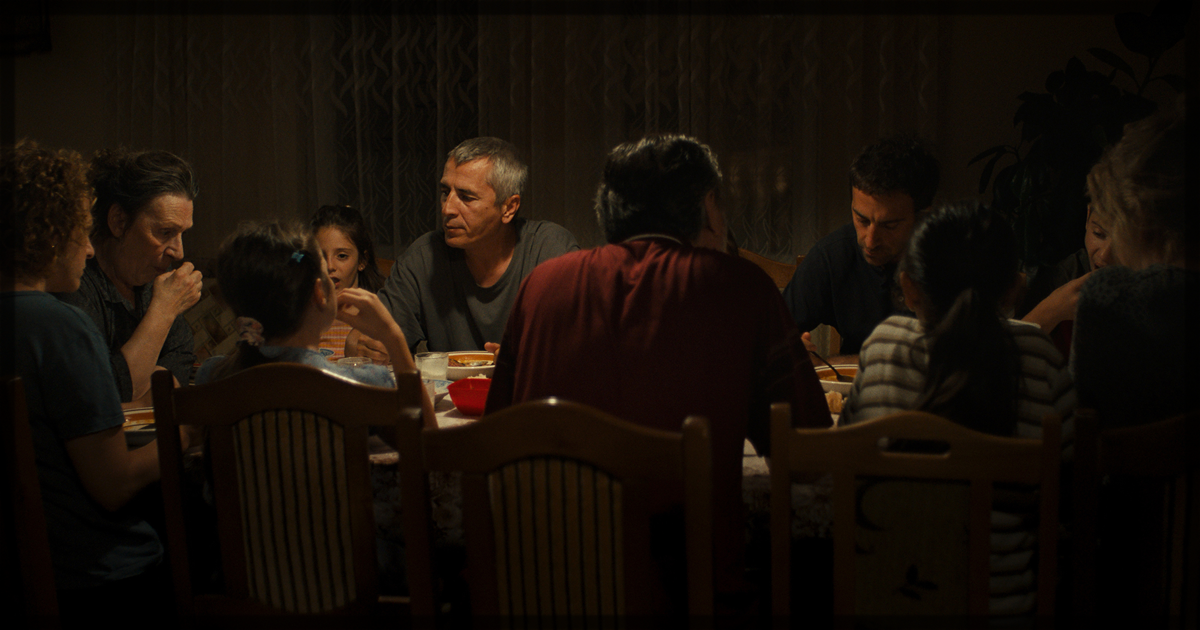
Hard work should always be enough, and yet we all know it never is. The excellent Shame and Money makes it clear what we lose when that’s not the case. Late in the film, about an ethnic Albanian family’s financial struggles in Kosovo, there’s a street scene in downtown Pristina which prominently features a statue of Bill Clinton. It’s there to make a point about how much and how quickly life in Kosovo has changed. The exploration of how a decent family tries to hang onto their decency in the face of the modern world isn’t flawless, but it’s so sympathetic to their struggles that its kindness more than makes up for its flaws.
Shaban (Astrit Kabashi) and his wife Tixhe (Flonja Kodheli) live with their three preteen daughters on the family farm run by his mother Nana (Kumrije Hoxka). Both of Shaban’s brothers also live on the farm; the older one is a teacher with a family of his own and the younger, Liridon (Tristan Halilaj), is trouble. When the entire family individually and collectively refuses to bail Liridon out of another mess, he disappears not only with a chunk of his mother’s hidden life savings but also Tixhe’s cows, rendering his family destitute. This means Shaban and his women have no choice but to move to Pristina and go to work for Tixhe’s brother-in-law Alban (Alban Ukaj), a successful businessman who owns a nightclub among other things.
Unfortunately this new family dynamic is nowhere near as straightforward as Tixhe and Shaban thought it would be. Tixhe’s sister Lina (Fiona Gllavica) is an unpaid carer for her parents-in-law and Alban tightly controls her access to money, so while Tixhe gladly helps out around the house Lina insults her with the kind of little gifts and tips you leave the hairdresser and not your sister. As for Shaban, what had been described as full-time work in Alban’s club is only afternoons three days a week. When Shaban starts going for day labour to make up the difference Alban gets first embarrassed, then angry about it, without offering Shaban any extra work or even an introduction to anybody. An apartment tenancy collapses over a bad misunderstanding over the security deposit, and Tixhe and Shaban don’t have enough to pay the rent on another place. Alban, Lina and his parents live in a huge, luxurious house, but both Nana and Shaban refuse to sleep in there on principle. They still have their dignity and they will cling to it for as long as possible, which Tixhe understands. But their precarious living situation means the girls don’t have an address to register for the new school year, and summer, and the rest of Nana’s savings, won’t last forever.
Director Visar Morina, who co-wrote the script with Doruntina Basha, show how Shaban and Tixhe go around the city, asking for cleaning jobs, asking for any work at all, and while they are always treated politely, it’s still completely humiliating. But as Tixhe tells Lina, shame is a luxury. They are ready, willing and able to work and prepared to swallow their pride. But in this modern world, without an education, without certificates and connections that you don’t get working on a farm, and especially without the assets Liridon stole, a good work ethic and a kind heart isn’t remotely enough. What’s worse is that Alban is not so much a bad man as one who’s succeeded under a completely different set of rules from the ones Shaban learned on the farm. It slowly becomes clear that Shaban is the one who must knuckle under, or disappear himself.
Last year’s At Work did similarly strong work of showing the routine humiliations of the gig economy, but not since the German Head-On from 2004 has there been such a subtle trigger for such explosive violence. The early scenes of Tixhe and Shaban uncomplainingly handling the hard and relentless physical labour of the farm made it palpable just how kind and decent they are. The movie’s sympathy for their plight is about the only thing that makes it bearable. The trap they are in is not their fault, but it is their responsibility, and they can’t catch a break. And yet, we all know life under capitalism is rarely kind, and if you don’t have €300 (approximately $350) every month to rent an apartment and pay for your mother’s medicine that’s nobody’s trouble but yours.
Unfortunately the choices made towards the end to demonstrate the pressure Shaban is under don’t always work and are confusing as well as unpleasant. The subtitles also don’t clarify the at-first complex interpersonal relationships in a way simple for non-Kosovars to understand; thanks to Tixhe calling Nana ‘mother’ the whole way through it needed the first shot of her in bed with Shaban for me to realise she was his wife and not his sister. But these are minor quibbles, and clearly not serious enough to prevent Shame and Money from winning the World Cinema Grand Jury Prize at this year’s Sundance Film Festival. This is a major achievement that will enable Shame and Money to be seen by audiences all over the world, where its message is sure to resonate with people from far too many cultures.
Shame and Money recently played at the Sundance Film Festival.
Learn more about the film at the Sundance site for the title.
You might also like…