Writing about the Scream saga is, personally, a nostalgic task that involves a constant reassessment of what horror represents in popular culture. After Scream (2022), one of the best sequels in the franchise, positioning itself right behind the original for me, and Scream VI that, despite some flaws, still managed to keep its momentum in a refreshing urban setting, my expectations for this new chapter were filled with apprehension. The production troubles are well-publicized, with cast and crew departures dominating headlines, but I’ve always said that cinema should be judged by what reaches the big screen and not by its backstage drama. I entered the theater completely ignoring the external noise, wishing only to be surprised by a good story that honored the legacy of Wes Craven. Unfortunately, I left with the feeling that the Ghostface mask should, finally, rest in the museum.
Scream 7 is directed by Kevin Williamson (Teaching Mrs. Tingle), who returns to the director’s chair for only the second time in his career and for the first time to take the reins of his own creation, with a screenplay also handled by himself and Guy Busick (Ready or Not). The film brings back Sidney Prescott (Neve Campbell, The Lincoln Lawyer), now living a seemingly peaceful life with her family, including her daughter Tatum (Isabel May, 1883). Alongside her, Gale Weathers (Courteney Cox, Cougar Town) and the siblings Chad (Mason Gooding, Booksmart) and Mindy Meeks-Martin (Jasmin Savoy Brown, Yellowjackets) return. The narrative focuses on a new wave of murders that seems to utilize cutting-edge technology to torment Sidney, forcing her to confront ghosts of the past that refuse to stay buried.
The body of this new chapter tries to balance itself on two extremely contemporary thematic pillars: artificial intelligence (AI) and toxic nostalgia. However, the exploration of these concepts ends up being too superficial, resorting to predictable tricks and cameos that serve more to satisfy a momentary fan desire than to serve the narrative coherently. The central mystery is, from its introduction, a situation without a satisfactory creative exit: either a certain previously deceased character is found to be alive, creating a series of highly problematic retcons, or it’s merely an AI simulation, removing any emotional weight from the confrontation. Scream 7 opts for paths that strip away the satirical bite that has always defined the series, transforming into a generic slasher where social commentary is just an accessory rather than the engine of the action.
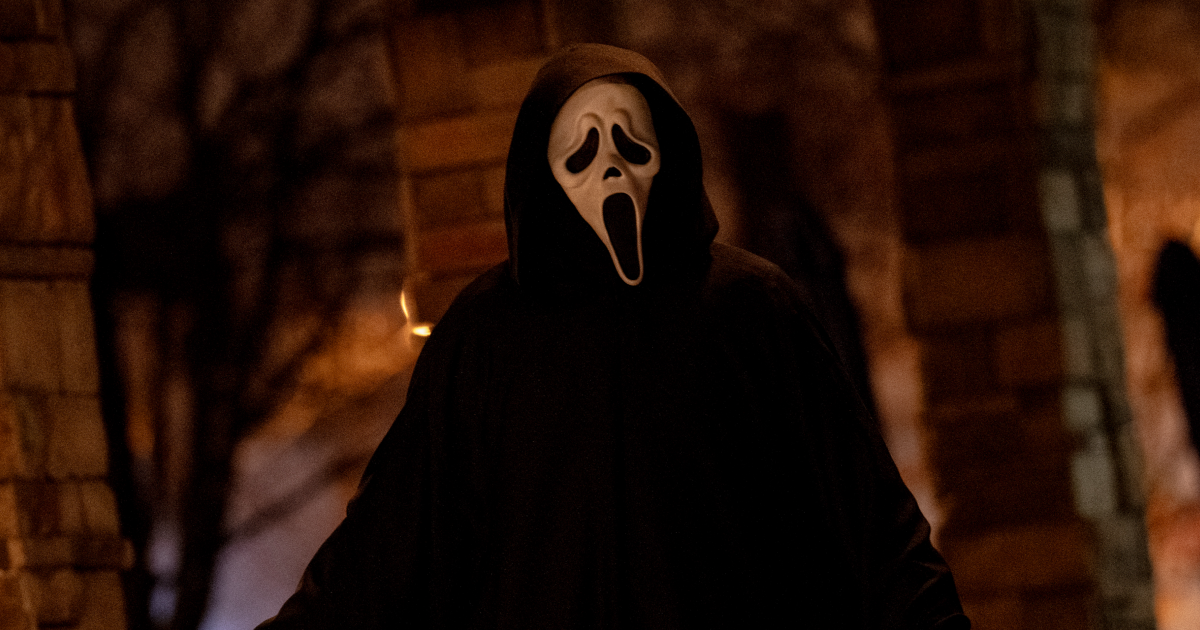
The lack of creativity also extends to the most visceral aspect of the genre: the kills. With the exception of an initial murder on a theater stage, there isn’t a single death in Scream 7 that truly stands out. The chase sequences and the fights with Ghostface are incredibly repetitive, looking like copies of each other without the inventive choreography seen in the previous two movies. Where Scream VI utilized the New York setting brilliantly to create a different kind of tension, Scream 7 culminates in a final set piece so uninteresting and poorly utilized that I found myself checking how much time was left to make sure that this was, in fact, the climax of the film.
Furthermore, some problems that I already had with the previous sequel become even more unsustainable here. The famous “plot armor” of the protagonists — and even secondary characters — reaches truly absurd levels, where it seems that nobody actually dies unless they’re decapitated. Where Scream (2022) had the courage to eliminate important characters, Scream 7 seems afraid of serious consequences, transforming the survivors almost into zombies who resist dozens of stabs and gunshots without any lasting impact on their physical integrity. There’s also a lack of care in the script during the second act, where certain characters completely vanish from the story, only to reappear in the climax, while those who should be worried about them simply forget their existence for the sake of plot advancement.
Even more serious is the almost total absence of the meta-atmosphere that became the DNA of the franchise. Scream 7 doesn’t try to subvert expectations or play with genre conventions in an intelligent manner. Instead of being a reflection on the current state of cinema, the dangerous evolution of AI in the industry, or how nostalgia can quickly turn into a toxic element, the movie is closer to being a product trying to survive by riding the coattails of its brand. The essence of the saga disappears, stifled by competent yet soulless direction. Although the motives of the killer(s) are minimally interesting at a conceptual level, they’re disconnected from the central discussion around AI, which ends up being just a technical tool for cheap scares instead of a thought-provoking debate about truth and memory.
Not everything is negative, though. The cast, although reduced and surrounded by controversy, delivers solid performances. Campbell and Cox know these characters like no one else and their dynamic remains captivating, even if they don’t go through any significant transformation or arc. May is the great revelation, managing to make Sidney’s daughter the most interesting and empathetic figure in Scream 7, demonstrating enough talent to deserve a more robust script. The score (Marco Beltrami, The Hurt Locker) also deserves a mention, managing to evoke the necessary tension and honor the classic themes effectively. There are moments when the film is very close to saying something relevant about how technology can be used as a modern mask, but the lack of a counter-argument or a deeper analysis prevents those scenes from reaching another level. There are a few other actors deserving of praise, but I fear bringing a spotlight on any of them may softly indicate who might be the killer(s), so I’ll refrain from doing so.
Final Thoughts on Scream 7
Scream 7 reveals itself as a disappointing sequel in a saga that has never failed so evidently, demonstrating a glaring creative exhaustion. It’s an exercise in nostalgia that, by trying to criticize the dependency on the past through AI, ends up becoming a victim of its own lack of vision and originality. When the mask falls and the motives are revealed, what remains is only the image of a franchise that seems to be fighting against its own obsolescence without knowing how to truly reinvent itself. Without its ability to satirize the real world and shock through genuine creativity, this seventh chapter gets lost in its own references, forgetting that for a story to stay alive, it’s not enough to just replicate the echoes of what came before.
Rating: D+
Scream 7 is now playing in theaters.
Learn more about the film, including how to buy tickets, at the official website for the title.
You might also like…