The duo of directors Hélène Cattet and Bruno Forzani is known for their approach to genre cinema, especially the giallo, an Italian sub-genre of slasher films marked by its distinctive visual style. They are back with their latest film, Reflection in a Dead Diamond (Reflet dans un diamant mort), a clear homage to the 1960s European spy films and the Italian slasher that made them famous. Their previous features, Amer (2009), The Strange Color of Your Body’s Tears (2013), and Let the Corpses Tan (2017), are more direct homages to the style of Mario Bava and Dario Argento. Meanwhile, in ‘Reflection‘, the directors construct a spy film that draws influences from the 1960s and pulpy comics. The film narrates the journey of John Diman (Yannick Renier/Fabio Testi), a secret agent whose mission is to protect Markus Strand (Koen De Bouw), a billionaire in the petrol business.
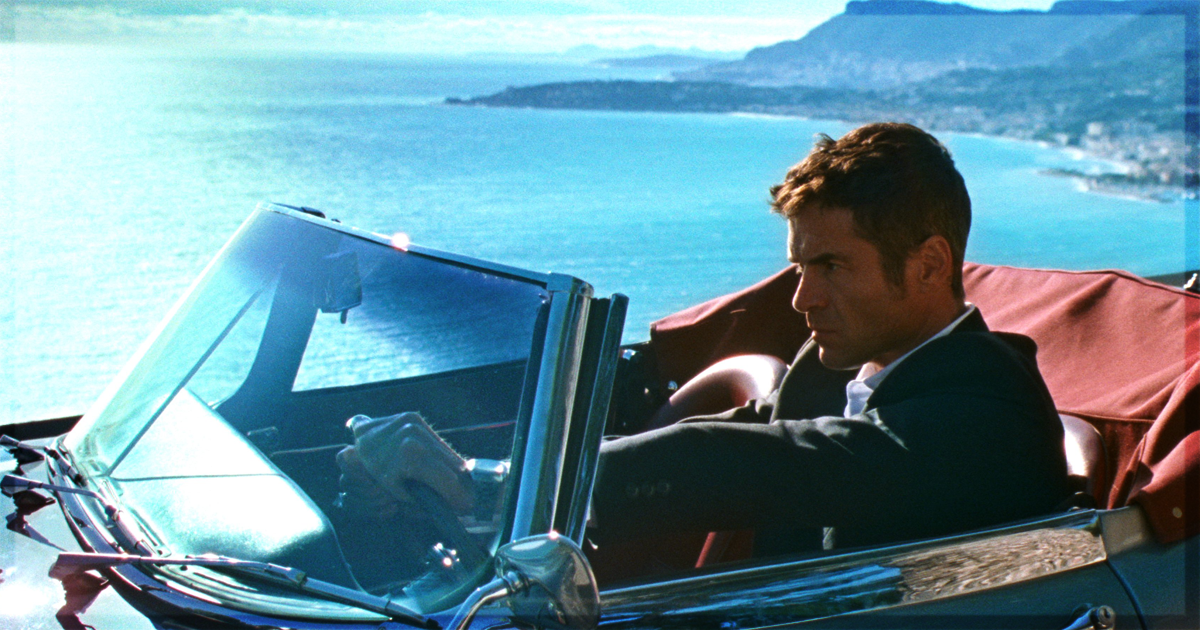
It is noteworthy that the directors, who also penned the script, focus more on the visual substance than the usual screenplay structure to tell this story. The film constantly shifts through different eras, the past, in which Renier plays the agent, and the present, with Testi as Diman. The story revolves around the spy and his stay in a seaside hotel, where he admires the beautiful women tanning under the sun and the sea breeze. However, in the room next door, Diman senses a danger that resembles his old days, where he would coerce his enemies with an eye ring, and the hurtful nature of diamonds. In this sense, the directors spend time developing elements that allude to his past: the models, jewelry, and death. Hence, they establish a sense of routine for the retired spy; he is enjoying life while remembering his past adventures.
Therefore, Cattet and Forzani fast-forward and throw back to cover Diman’s mission to protect the oil tycoon. Notably, the action scenes and interactions are more vital for the film than a traditional narrative. The script glimpses the encounters of the agent with his enemies, usually gorgeous women in leather suits. The directors look forward to efficiency in their visual compositions; hence, the duo uses different cinematographic techniques to implement their style. Nipple piercings transition into a briefcase with multiple diamonds of unknown origin, and a rhinestone gown transforms into a weapon by pushing a necklace. They are constantly using visual rhymes to provide rhythm to the agent’s mission, an example of which is the comic strips’ transitions that surge during a fight. Consequently, there is a magnetic nature to the imagery; each frame is a feast for the spectator.
An evident reference to this film is the 1970s James Bond pictures, especially the idiocracy present in Roger Moore‘s era, such as in Moonraker and The Man with The Golden Gun. Cattet and Forzani merge the absurdity of the 007 flicks and the violence of the giallos. A perfect example of this combination is the bar fight scene, where a mysterious woman wearing a leather suit appears. The sophistication in their directing delivers a kinetic scene, where violence and the brutal come together with inventive camerawork and editing. Accordingly, the film finds in the violent moments a visual catharsis through the colors and the texture of Manuel Dacosse‘s 16mm cinematography work. He uses close-ups to transition from scenes, such as framings of eyes, to shift from one scene to another. Therefore, the bright red contrast with the shiny diamonds provides an elegance to the film, a crucial element to the genre. It is an extravagant and luxurious piece of work, using the passages of the beautiful coast to provide scale and danger to the mission. The Strand mansion exemplifies this, a large and extravagant venue where corruption and brutality coexist with the architectural beauty.
The film is a fresh homage to sub-genres that have merged with excessive seriousness lately. The horror, especially the slashers, is more aligned with the new generation structure of the genre, where it justifies its existence in allegories that allude to reality. Meanwhile, espionage films engage with the reality post-war on terror, which requires a moral compass for the adventures of modern spies. Thus, Hélène Cattet and Bruno Forzani defy the logic of modernity, a utilitarian philosophy of explaining each creative choice. They gather techniques of editing and visual composition to create a tribute to the 1960s spy films and the violence of Italian cinema in a post-neorealism period. Thus, Reflection in a Dead Diamond is a creative exercise in genre cinema, exploring the possibilities of cinema to bring back a different type of filmmaking.
Reflection in a Dead Diamond (Reflet dans un diamant mort) recently screened at the Fantasia International Film Festival.
Learn more about the film at the Fantasia site for the title.
You might also like…