
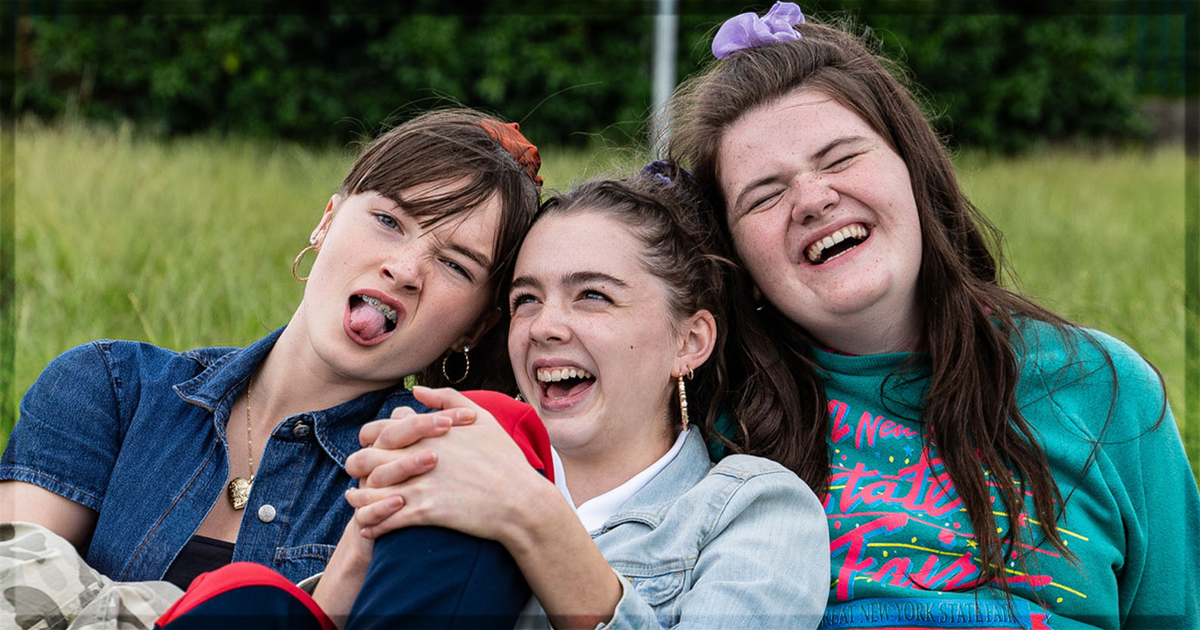
Ready or Not tackles a difficult topic – very young teenagers playing very adult games – with a level of sympathy for their misadventures which makes the tough subject easy to watch. Writer Lynn Ruane and director Claire Frances Byrne talked at the Irish Film Festival London screening I attended about the importance of centering working-class stories, and it’s true, all the kids in this film are trapped in their Dublin neighbourhood in ways which people with more money could find hard to understand. These kids are unlikely to be able to physically flee from their problems so they’ve got to figure out how to live with them, whether they want to or not. This is Ready or Not’s greatest strength and greatest weakness.
It’s the late 90s and Katie (Ruby Conway Dunne, who carries the whole movie with an elegance that belies her young age) has just turned 13. She has two sets of best friends: girls Danni (Molly Byrne) and the slightly older Sarah (Alicia Weafer), and boy Steo (Alex Grendon). Katie and Steo treat each other like siblings because they are the only only children in their entire busy neighbourhood of two-parent families living in comfortable homes that to American eyes don’t look like a project, though it certainly is. Steo (short for Steven) and Katie have been besties for so long everyone assumes they’re going to start dating now they’re old enough. Katie doesn’t want to be known as frigid, but when her awkward experiments with Steo become common knowledge she’s suddenly now a slut. This brings her to the attention of Steo’s awful older cousin Byrner (Lewis Brophy, who impresses) and Byrner’s much cuter friend David (Dane Whyte O’Hara). All three girls attend an unsupervised party, where Katie’s short skirt and Danni’s incautious drinking brings them unexpected trouble: Byrner presumes Katie is asking for it, while Danni wakes up in the bathroom to find her underwear in her jeans pocket. So the issue is not just what Byrner did to Katie, but whether or not anything happened to Danni. And the immediate concern for Steo is if Katie doesn’t get over it, he’s going to have to make an impossible choice between his cousin and his best friend.
Jordanne Jones’ narration as Katie looking back does a lot to frame the story as a learning experience instead of a cautionary tale, though the accents are so thick and the Dublin slang so pervasive American audiences will almost certainly need subtitles and a glossary. The opening scene of the kids playing at karaoke while using Danni’s mother’s ‘massager’ as a microphone also expertly sets a light-hearted, raucous tone. But it was hard to hear Ms. Ruane talk about how she didn’t want her script to demonise the boys and how essential it is to treat their mistakes as only that. Never mind the violence the girls experience, or its consequences (all of which is filmed by Philip Blake without the slightest hint of exploitation, which is a relief; it’s very clear Ms. Byrne was very protective of her young cast). We get so much unpleasantness in life it’s hard to see it replicated in art, no matter how well-meaning or thoughtful its creators are.
The minimising of consequences for boys is also not as exclusively a working-class thing as they seem to realise. Wealthy boys are allowed to act out because their futures shouldn’t be compromised. Less wealthy boys are allowed the same because their sense of place is too important. All the girls must see Big Byrner (Donncha Tynan), Byrner’s even more horrible older brother, every single day, with only their wits as a defense against his gross behaviour. Byrner gets it much worse than they do, but that doesn’t help anybody. In fact not even the parents, who are present, attentive and loving, could help against Big Byrner, since he goes with the neighbourhood. He’s just something that has to be put up with and that’s all there is to it. But seeing the kind and thoughtful Steo keep his eyes down and mouth shut as Big Byrner harasses and threatens Katie is the thing which will break their friendship, not that either of them realise that yet. And while the movie’s moral that you have to figure out how to cope with this stuff is sadly realistic, it’s very depressing this is as high as the movie allows itself to aim.
That being said, the saving grace for the girls is the Irish frankness about the body and its needs. The big mystery is able to be solved because Katie does something for Danni which is one of the wildest acts of friendship ever put on screen, an expression of intimacy and gleeful curiosity not too many people of any age would be prepared to do even for their BFF. Gleeful curiosity is indeed what will help girls like this to survive, but there’s no awareness here that such gleefulness does burn out. It’s not fair to complain that Ready or Not doesn’t have a clever answer for the issues of consent, misogyny and violence it’s brave enough to address, but life isn’t fair, so art should be.
Ready or Not recently played at the Irish Film Festival.
Learn more about the film at the IMDB site for the title.
You might also like…
‘Aontas’ Film Review: Irish Language Thriller Is Worth Watching