Expectations were low. My relationship with this saga has been, I admit, troubled: mixed feelings regarding the original film and manifestly negative regarding the second chapter. Despite being aware that this third entry, Now You See Me: Now You Don’t, has received the warmest reception of the entire franchise so far — which also means little — I remained reticent. It’s possible this enthusiasm is due to the fact that it’s been nine years since the last adventure, or perhaps because the landscape of critics on the usual platforms has changed drastically, but I entered the theater with palpable skepticism.
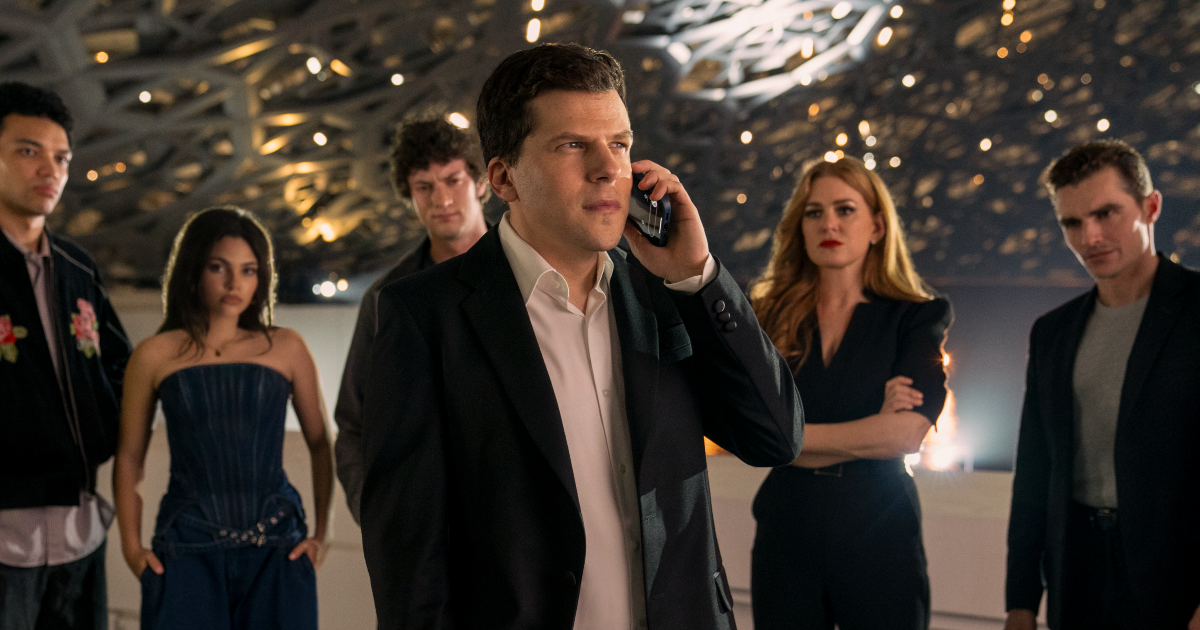
This time, directing duties fell to Ruben Fleischer (Venom), who takes the helm of a screenplay written by a heavyweight committee: Seth Grahame-Smith (The Lego Batman Movie), Michael Lesslie (Macbeth), and Paul Wernick & Rhett Reese (Deadpool). The narrative brings back the infamous Four Horsemen: J. Daniel Atlas (Jesse Eisenberg, The Social Network); Merritt McKinney (Woody Harrelson, Zombieland); Jack Wilder (Dave Franco, Together); and the returning Henley Reeves (Isla Fisher, Wedding Crashers) reclaiming her spot. The group is forced to collaborate with a new generation of illusionists — Charlie (Justice Smith, Dungeons & Dragons: Honor Among Thieves), Bosco (Dominic Sessa, The Holdovers), and June (Ariana Greenblatt, Barbie)—under the watchful and mysterious eye of Thaddeus Bradley (Morgan Freeman, Se7en). Together, they face a new threat: Veronika Vanderberg (Rosamund Pike, Gone Girl), a diamond heiress with obscure connections.
The truth is, yes, Now You See Me: Now You Don’t is superior to its predecessors. However, it’s important to note that this bar wasn’t exactly high to clear. Many edges were smoothed out, and there was a genuine effort to correct the errors of the past, but unfortunately, I can’t say I’m convinced by the Horsemen’s universe. The magic happens, without a doubt, but the final trick still leaves something to be desired.
Narratively, there are undeniable improvements. The story feels more focused and less tangled than the confusion that haunted the previous works. One of the saga’s cardinal sins was always the excessive reliance on forced verbal exposition, where characters spent half the time explaining to the audience what was happening. Here, although the climax inevitably falls into that “trap” to unveil the grand illusion, throughout most of the runtime, this vice is attenuated. The movie manages, in several moments, to explain tricks convincingly through visuals only, respecting the golden rule of cinema: show, don’t tell.
In the technical departments, the evolution is equally palpable. Anyone who remembers the previous films will recall the nightmare that was the action sequences: chases and fights diced up by frenetic, choppy editing, with little to no visible choreography, which only contributed to a general sense of disorganization. Now You See Me: Now You Don’t breathes differently. Fleischer allows the camera to slow down, offering longer shots that let us appreciate the geography of the scene in question. From well-executed parkour moments to fights choreographed with competent doubles and stunts, we’re facing, generally speaking, a better-shot, better-directed movie with infinitely superior editing (Stacey Schroeder, Popstar: Never Stop Never Stopping).
Another area to praise is the cast. The introduction of new members complements the original ensemble in an organic, interesting manner. I’d go as far as to say that the chemistry between the old guard and the newbies is stronger than the original dynamic of the Horsemen. We’re looking at the classic formula of “legacy sequels” that Hollywood loves so much these days: gathering the original group to appeal to nostalgia while injecting new blood to capture the younger audience. The trio composed of Smith, Sessa, and Greenblatt stands out with charisma and energy, not letting themselves be overshadowed by the veterans. Smith, in particular, carries surprising dramatic weight as the brain of the new operation. On the returning side, Eisenberg seems more comfortable and polished, delivering a performance that substantially improves upon his previous iterations of the arrogant Atlas.
Truth versus illusion and the concept of found family are the thematic pillars of the film. There’s an attempt to give emotional weight to the narrative, suggesting that revenge and social justice are the engines uniting these two generations of magicians. However, this is where the script’s fragilities are exposed. Despite the actors’ magnetism, the characters remain frustratingly superficial. Their development is done through cheap info dumps, where pasts and individual motivations are “vomited” out in expository dialogue, as if the actors were reading their characters’ biographies. There’s no real depth, neither thematic nor emotional, to sustain the movie’s dramatic ambitions. The creation of family bonds feels artificial when we aren’t given time to see those relationships grow naturally.
Another persistent problem is the visual inconsistency of the magic. Now You See Me: Now You Don’t continues to commit the capital mistake of mixing practical magic and credible sleight of hand with digital sorcery and excessive CGI. Suspension of disbelief is stretched, once again, to the breaking point. At various moments, I heard tired sighs in the theater — and I admit I let out a few myself — when the film asks the viewers to accept certain digital feats as “stage tricks.” This reliance on visual effects strips away the tactile charm that a movie about illusionism should have.
Irony of ironies: a film that delves into unpredictability, deception, and the unexpected ends up being, as a whole, quite predictable and formulaic. The twists, which should be the trump card, feel more implausible and contradictory than genuinely shocking. The big final reveal, while attempting to recontextualize the entire narrative, ends up creating more plot holes than it tries to plug, reaching the end of another chapter — not of the saga, as a fourth entry has already been announced — that once again fails to conquer the heart of this magic fan.
Final Thoughts on Now You See Me: Now You Don’t
Now You See Me: Now You Don’t undoubtedly asserts itself as the most solid entry in this trilogy, raising the technical bar and finding new life in the reinvigorated dynamic of its cast. However, all the superficial shine and aesthetic improvements fail to hide a script that confuses complexity with complication, delivering characters that function merely as pieces on a formulaic board. It works as light entertainment, but it’s insufficient to fully justify its return to the big screen. It invites us to look closer, but unfortunately, the closer we look, the less we see the depth it promises, leaving only the fleeting glow of a well-rehearsed trick, yet empty of true magic.
Rating: C+
Now You See Me: Now You Don’t is now playing in theaters.
Learn more about the film, including how to buy tickets, at the official website for the title.
You might also like…