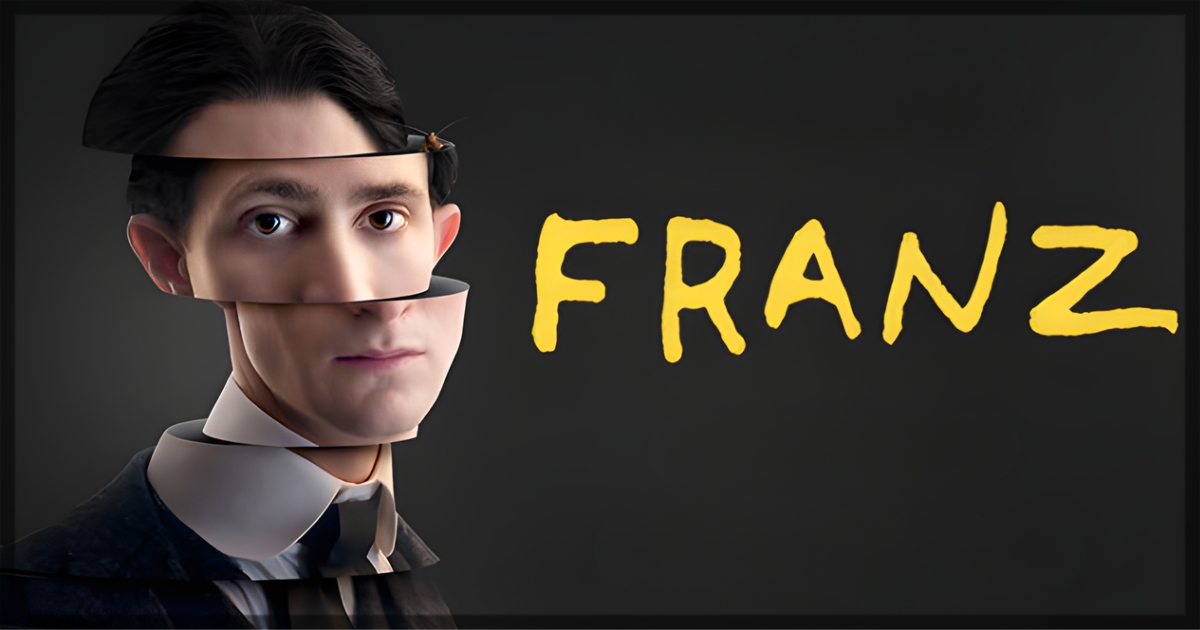
Few authors from the 20th Century are more influential than Franz Kafka. The Czech writer did not receive the recognition he deserved throughout his life, as detailed in the introductions to his books. Each new edition of his masterpieces, such as Metamorphosis, gets a deep explanation of how Kafka’s success came after his lifetime. His other books, novels, and poems were published through his family, which organizes the work left by him, as well as the letters that trace the nature of his relationships, predominantly with the women he engaged; however, Kafka was engaged four times, but never married. Hence, the veteran Polish director, Agnieszka Holland (Green Border & Secret Garden), attempts to draw a biography of a literary genius. In Franz, the director avoids the typical structure of a biography; there is no chronological sequence from birth to death. Yet, the script by Marek Epstein flows between multiple moments in his history, using modern sequences to weigh on his impact, and juxtaposing his past.
In this sense, Holland and Epstein search for the essence in his personality; the traces that made him legendary. It is where the script contrasts Franz (Idan Weiss) and his father, Hermann (Peter Kurth). Throughout flashbacks, we learn about the death of his two brothers, leaving him as the only man among three sisters. Hence, Franz is the heir to the Kafka’s shop, a man who must protect the family’s wealth and reputation. Consequently, Hermann is portrayed as an angry man who expects too much of his only son. In these moments, Kurth’s performance relies on overachievement, an excessive use of screams and a high-pitched voice to assert authority. Yet, it exposes the lack of development of Hermann, who is an unidimensional abusive father, screaming in eighty percent of his scenes.
Furthermore, the father’s presence symbolizes the contrast between the perception of his work. Hermann’s opinion was similar to that of most of the Czech literary scene: they would consider his work too graphic and unorthodox, a style that is not as refined as it should be. Yet, his sisters represent the post-death rescue of his geniality, a reputation built by scholars and the hundreds of studies on his style, ideas, and symbolisms. Metamorphosis is one of the most crucial works of the 20th Century and probably, of all time. Hence, even within his own family, Franz’s work would get different perceptions, reactions, and support. When one has read the 1915 novella, one does not expect a bureaucrat to have written it. The style and fascinating world construction have a similar background to the author’s life: he spent his time in the Department of Workers’ Protection and was constantly hearing voices in his head.
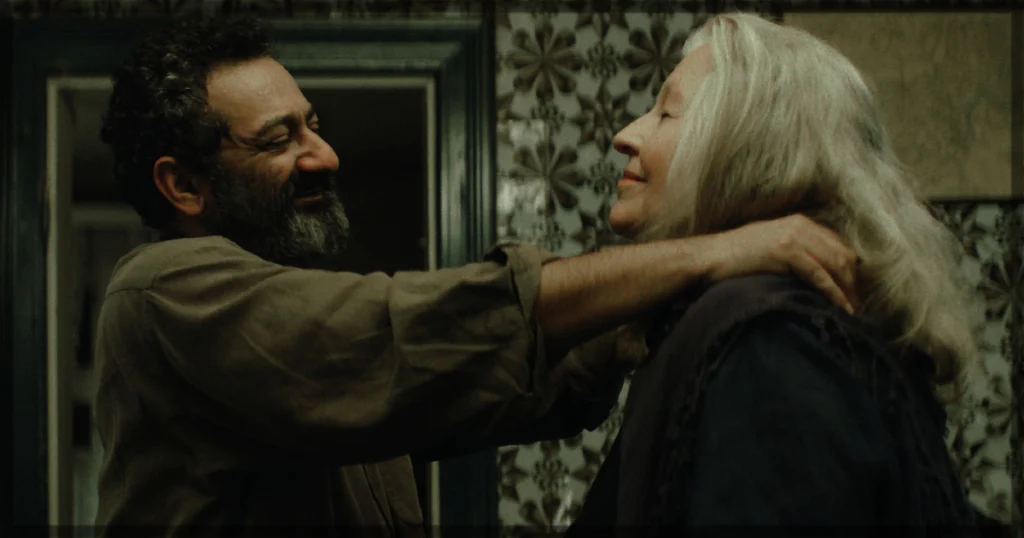
Likewise, Holland attempts to escape the biographical genre’s repetitive, uninspired trope. In a sense, she thrives on adapting elements of Kafka’s literary work to the screen, such as the drawings on his pages that are projected onto the walls during his hallucinations. Yet, the experimentation with the chronology’s order confuses the audience, who learn a lot about events in his life but receive an infinitesimal amount of development. Consequently, a few of those moments land the necessary emotional impact to engage with this film. At times, the director throws punches at the cash-grabbing guided tours of personalities’ lives, such as Kafka, jokingly showing tourists lunching at the ‘Kafka Burger’, where he used to buy the best vegetarian combo in town.
However, the film uses a variety of narrative tools to innovate, such as breaking the fourth wall and interacting with the past on museum walls. Still, it lacks consistency in telling this story. Idan Weiss delivers a solid performance as a confused literary genius, surrounded by social pressure and emotional inconsistencies. Regardless, he does not have much to work with, missing a thread of dramatic construction. Weiss‘ highlights in segments that delve into Kafka’s complex personality, such as his sexual drive, which is fascinated by the intimate moment, delivering poetic scenes that explore the lead actor’s finest traits. Nevertheless, it gets lost amid the complicated, confusing structure, which drags the rhythm and diminishes the overall impact.
Despite the importance of an alternative storytelling layout to an overworked genre, Franz fails to explore the possibilities of playing with non-linearity and the multiple resources to pull the more fascinating aspects of the biography of a legend, one of the most influential writers ever. Hence, Agnieszka Holland delivers a frustrating follow-up to her impactful Green Border. Although attempting to explore the possibilities of directing to design something new, she never reaches that goal and adds another mediocre biopic to the canon, filled with hundreds of them.
Franz recently played at the Toronto International Film Festival.
Learn more about the film at the IMDB site for the title.
You might also like…