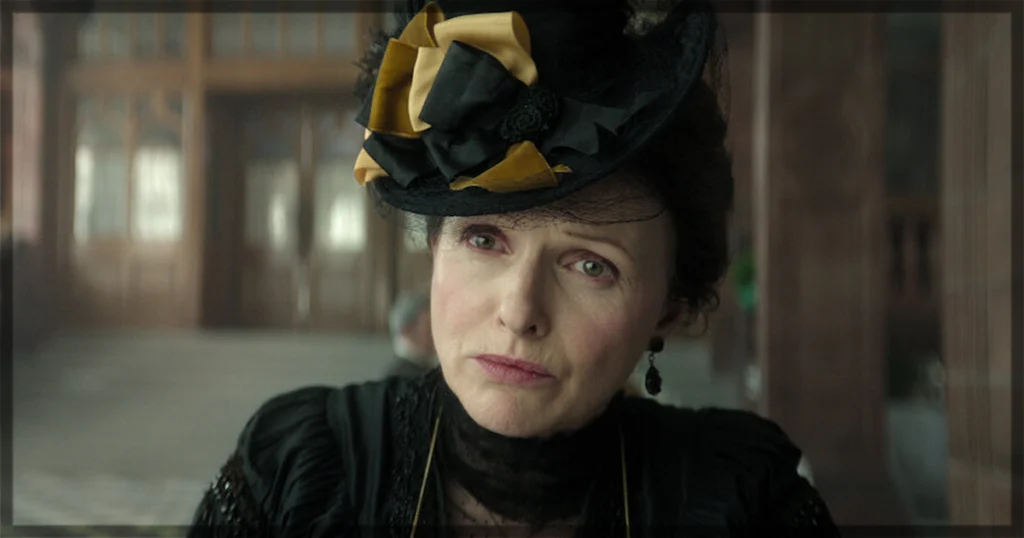

Forty-four minutes into Magellan, we see the eponymous Portuguese navigator at the film’s center, deftly portrayed by Gael García Bernal, sitting still inside a 16th-century tavern, his mind drifting elsewhere. He grips a walking cane on one hand, then an oversized hat on the other. Lit candles beside him quietly flicker and reflect on his face, whose mournful register contrasts the joyous dancing around the room, ennobled by the lively music played on the violin. It’s an interstitial juncture the audience would likely overlook in a film that exhibits a stunning array of desaturated yet painterly still frames almost as a visual default, tableaux that locate us into the enduring legacy of colonial carnage and exploitation it seeks to interrogate. It’s the only scene in the film in which writer-director Lav Diaz resorts to diegetic music to motor the dramatic proceedings, before abandoning the filmic device completely. Apart from strategically excluding the Italian explorer Antonio Pigafetta and projecting the Mactan leader Lapulapu as a fictitious figure in this mytho-historical deconstruction of Ferdinand Magellan’s mighty image, the near-lack of music is one of the movie’s radical omissions—a sentiment I further fixate on the more I revisit the material, another entryway of sorts.
In lieu of music and score is a soundscape—speech, ambient sound, sound effects, and so on—that not only extends the film’s narrative the dirge-like atmosphere it needs, but, more crucially, renegotiates our relationship with the art of sound vis-à-vis cinema. It’s not a groundbreaking observation that any cinematic experience readily favors the visual, and sound (a term loosely used here) is necessary only insofar as it affirms the verisimilitude of the thing being seen. (Why do you think every review of Magellan focuses on its stately image-making?) We feel the creaking of the galleon not only because the camera goes unsteady but largely because of the audio component of that very creaking. We feel the harshness of the weather because of the sound of the relentless rain and rough wind. We believe the beheading of a ship captain “guilty of forbidden sexual acts” because of the sound of the axe being swung and the thump of the detached head slamming onto the ship’s deck, even as the film refuses to show the brutal punishment onscreen. Early in the movie, we absorb the anguish that craters the soul of Enrique, caged and rendered a slave in Malacca, through his plea to Apo Laki: “In the place where we live, where are you? Where are you? Apo Laki! Help us, Apo Laki!” Sound, as we’re often taught, must heighten the logic of the mise en scène. But what if we watch a film that features entirely blank, empty frames, say Peter Kubelka’s Arnulf Rainer (1960), or a film that slowly zooms in on a single image but nevertheless offers a rich bombardment of sounds and sonic manipulations? What if a film’s visuals defy narrative logic? Can we still treat sound as something secondary? Can we still call it cinema?
Since Diaz’s leap from commercial filmmaking to independent and arthouse filmmaking, it has been his dramaturgical default to use music sparingly in his films, save for the historical musical Ang Panahon ng Halimaw (2018). It is partly because his marathon cinema evokes a no-frills aesthetic approach: He lets the violence built into his narratives and his characters’ descent to madness fester and unravel onscreen. In Magellan, he does the opposite: The audience is denied access to the totalizing spectacle of the carnage, and exposed only to its unsettling aftermath, and yet the weight of the brutality never once feels relegated to the backdrop. This is where the work of sound designers Emmanuel Bonnat and Cecil Buban, who also worked on the sound design of Diaz’s Historya ni Ha (2021) and Kapag Wala Nang Mga Alon (2022), becomes undeniably significant. Sure, we still see the cruel images of colonial conquest, the bodies so casually discarded and deserted, but it is the brilliant sound design that places us in its very horror, in the Philippines’ fractured past. We hear the indifference of the forest through its waterways, the constant murmur of the flora and fauna it shelters. The sound of fire still snapping might as well be a sign of foreboding. We hear the proclamations of the conquistador “to suffocate the entire world” and usher in “the second coming of Jesus Christ.” We hear the screaming defiance of the Indigenous refusing to be beholden to the promises of the settler. We hear the gunfire, the prayers for salvation, the sorrows of mothers in search of a cure for their ailing children. Even the intervening moments of near-dead silence in the film is a marvel of soundcraft. In many respects, it is the sound design that gives the film its history, texture, and context. It is the sound design that unmakes, rather than reinforces, the fixities of the beautiful frames we are conditioned to afford insight and meaning. It is sound that forces us to attend elsewhere and more closely, or even anxiously, to be more flexible in “reading” that which we do not see. It loosens the visual’s leash. Which is to say that Magellan, a work of hypnotically uncompromising vision, is also a fascinating reintroduction to the art of cinematic sound.
Magellan is set to screen at the 63rd New York Film Festival, starting October 9.
Learn more about the film at the official NYFF site for the title.
You might also like…