Writer-director Shahad Ameen begins her movie with the last thing you’d expect from a story set in Saudi Arabia: snow. The message of this image is clear: if stereotypes are all you know then you know nothing at all. And as we follow three people on a secret, dangerous journey, it becomes clear how useless a little knowledge can be. Hijra is about a society of two layers. That is to say, in this world there is a layer of appearances, which conceals the layer of how things actually are. As one young girl learns to walk the fine line between those layers, Hijra reveals itself as an unusually kind and thoughtful film.
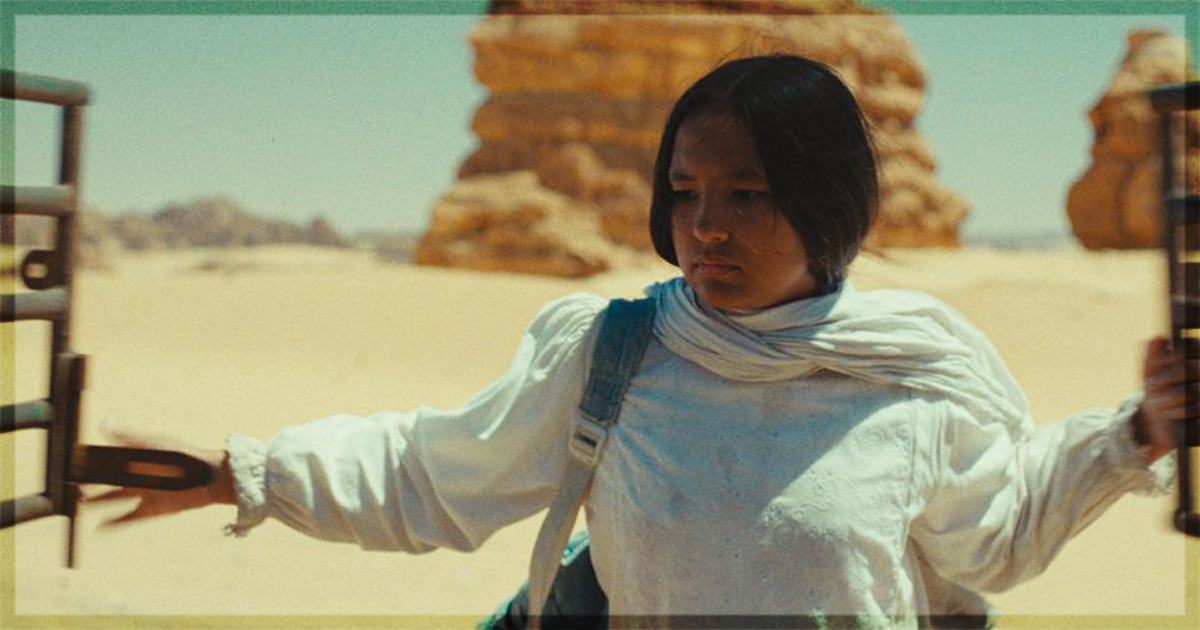
In spring 2001 a grandmother (Khairia Nazmi) is taking her two granddaughters, older teenager Sara and the younger Janna (Lamar Feddan), on the pilgrimage to Mecca which has been her life’s dream. But at the first stop, Sara waves goodbye to Janna, who is eleven or so, and runs off. This is a nightmare, not least because the girls’ father – the legal guardian of all the women in the family – is a violent man who must not learn that Sara has a boyfriend. Even Sitti the grandmother, a fearsome and fearless woman, is afraid of her son. The pilgrimage must therefore be abandoned so that Sitti and Janna can retrieve Sara at any cost. In some panic Sitti approaches passing vehicles in search of a ride to the next big town, and a chatty wheeler-dealer named Ahmed (Nawaf Al Dhufairi) agrees to take them. It is rapidly obvious the women are safe with him; for the most part other women and their harsh judgements are more dangerous. But Ahmed is not a licensed taxi driver, meaning they must pose as a family whenever the truck goes through a checkpoint, and when Sitti thinks she is witnessing something wrong, she is incapable of keeping her mouth shut.
The little group’s adventures in their hostile environment make this an interesting companion piece to another film from the festival, the Romanian film Milk Teeth, another period movie about a young girl in a controlling society whose older sister goes missing. But here the lessons the young heroine learns can be summed up as the difference between the laws and the rules. Janna is still young enough to believe that families belong together and that having a blood responsibility means you will always do the right thing. But she is also old enough to understand the danger her father represents, and lies to him without hesitation every time he calls. Janna is also wise enough not to wonder why every official expresses surprise that a woman who looks like Sitti holds a Saudi passport, but naïve enough, when Ahmed confides that he is an outlaw, to trust that he would never hurt her. In fact she is a little disappointed that he is a not a murderer. The friendship that springs up between Janna and Ahmed is a great surprise to them both. Ahmed might indeed be an outlaw, but he is also a good guy, willing to put his battered Toyota at their disposal for a reasonable price and happy to teach Janna Bob Marley songs. (Whether or not the lyrics are exactly correct is another thing.) It slowly becomes apparent that Sitti and Ahmed are much more alike within this unforgiving society than they would like to think, and the search for Sara becomes a question of whether or not they all might be able to save each other.
Despite that mawkish description there’s no schmaltz, but there is a great joy in seeing the laws and the rules of this society both become surprisingly clear. Mr. Al Dhufairi manages to display a sharp knowledge of human nature inside Ahmed’s laid-back personality; all his tricks and manipulations were clearly learned the hard way and frustrate a core decency. At one point, after a setback, he kicks the dusts and tells Allah he doesn’t want a different life, just more kindness in this one. The wry laugh that rippled through the Venice Film Festival audience made it clear how much we understood. The recurring metaphor of the camels is overdone but otherwise there’s hardly a false note in the entire film.
Ms. Feddan’s curiosity and courage – Janna never complains even when they walk for hours without water, and Ms. Feddan makes her stoicism believable – is matched by how Ms. Nazmi carries the entire film in her pinched mouth. Pinched because she, like many women whose lives have been spent under coercive control, knows in the bones that only her silence will save her. Sitti has a complex and unhappy history and the ways in which the search brings Sitti back to herself is very thoughtfully handled. But unless they can recover Sara, her disappearance will ruin even the little freedoms they previously enjoyed. Ms. Ameen has made a wonderful movie that opens up the secrets and lies people tell themselves to cope. And because Hijra shows how one young woman learns how to navigate the world, it should be able to get broader distribution and show the world a little more of Saudi Arabia.
Hijra recently played at the Venice Film Festival.
Learn more about the film at the Venice site for the title.
You might also like…