Good Luck, Have Fun, Don’t Die takes the worst nightmares of the current moment and turns them into comedy, but the kind of comedy where if you didn’t laugh you’d cry. This is done in the lighthearted comic blockbuster style best described as a mash-up where 1990s French horror-comedy Delicatessen meets the 2010s comic-book superhero genesis story Into the Spider-Verse. That is to say the ragtag allies creeping through the underbelly of a dirty city in makeshift protective gear here have a different cannibal enemy to face: the concept of artificial intelligence. Good Luck, Have Fun, Don’t Die very nearly completely pulls off a gonzo thrill ride; it botches the ending but until then its deranged take on our current stupid moment will leave you gasping in shock.
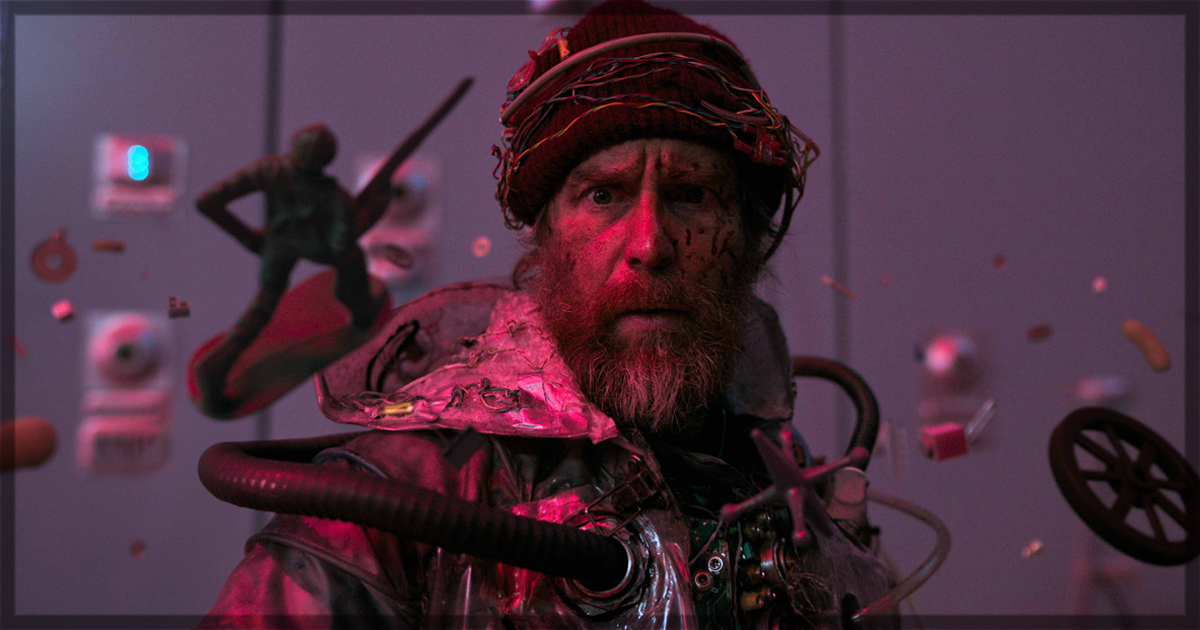
A man (Sam Rockwell, whose wild yet sincere energy hasn’t been this well served in a while) bursts into a Los Angeles diner, declares he is from the future and that some of the diner patrons are the only people who can help him save the world in the next hour. After a bravura introduction that establishes the basics and that the man from the future has indeed heard of Groundhog Day, some volunteers are assembled, most importantly Uber driver Scott (Asim Chaudhry), married teachers Mark (Michael Peña) and Janet (Zazie Beetz), grieving mother Susan (Juno Temple) and sullen princess Ingrid (Haley Lu Richardson). As they rush around the city, with police violence used as a punchline and avoiding a complex array of traps (Millions of rats! Homeless guy with a machete! Men with pig masks and machine guns!) that the man from the future sometimes but not always knows how to defeat, we are given flashbacks to most of their lives. It transpires that Mark and Janet are unable to teach because the zombified teenagers in their classrooms refuse to look up from their phones. It further transpires that Susan’s teenage son was recently killed in a school shooting and afterwards she is consoled by a group of mothers surprised that this was her first time. Scott is left out, which is an injustice. Finally we also learn that Ingrid is so severely allergic to cellphones and wifi she bleeds from the nose whenever she is near any of those – hence her career as a generic princess for kids’ birthday parties, because there’s still a chance little kids are safer for her to be near – causing another character to remark it’s like being allergic to air.
The bleakness here is so very bleak – for example, the support group Susan attends for parents in her position has some of the most outrageous comic lines in quite some time, mostly because how close they are to unremitting horror – but succeeds because of how well writer Matthew Robinson and director Gore Verbinski have grasped the difference between the lives of those who can remember a time before the internet, and those who were born into it and molded by it. Anger here is not only at the passive way which most people spend their free time ignoring or opting out of the world around them, but also how so-called artificial intelligence can only copy things which were made before with limited accuracy and no heart. Of course, this is an American movie, so the only thing which stops the scroll is violence: the man from the future can only get the diner patrons to look up from their phones by claiming he is a suicide bomber. And the way in which Susan is pushed to use artificial intelligence after the loss of her child becomes an appalling manifestation of what such inhuman intelligence can never, ever replicate. It also includes advertising, which is the final insult.
Mr. Verbinski hasn’t made a movie in a decade – the bomb A Cure for Wellness, unseen by this critic – but back in 2013 he made the surprisingly good but even bigger bomb The Lone Ranger, a wild blockbuster about the trauma of surviving in the Wild West (sunk by appalling production setbacks as well as the casting). Looking at his body of work his focus is how we survive a violent, brutal, mostly uncaring world through human ingenuity and knockabout physical comedy. This is a very good match of creator and material. All six of the main actors are splendid – Mr. Rockwell gets us on side immediately in that monologue in the diner, Ms. Temple’s pinched anxiety works perfectly here, Ms. Beetz and Mr. Peña bring out the worst in each other in the best possible way, Mr. Chaudhry will hopefully hit the international big time after this, and Ms. Richardson manages to provide a level of weariness that keeps the cross-town chase hijinks grounded.
The real trouble starts is when the main villain appears. Good Luck, Have Fun, Don’t Die falls into the same trap as most movies about AI: how on earth do you give this concept physical form. At least it wasn’t Scarlett Johansson this time, but the whole finale is a combination of several other big blockbuster finales in ways we have unfortunately seen before. On the one hand, this is a failure of imagination. On the other, AI is so [very, very, very long string of expletives deleted] pointless and boring that maybe this kind of expression of it is in fact the best our best creative minds can do. But at least it’s ours! The press tour has been explicit that not a drop of AI was used in making the film, and that’s becoming such a rare attitude under the studio system it’s delightful. We can do bad all by ourselves! If Good Luck, Have Fun, Don’t Die had managed the ending it would have been an exceptional reminder of the value of human life and human art. As it is Good Luck, Have Fun, Don’t Die is just a pretty damn entertaining one.
One final thing: if you don’t laugh at what happens to the teenager taking a selfie with the kitten monster you should probably watch a lot more movies.
Good Luck, Have Fun, Don’t Die is now in theaters.
Learn more about the film, including how to get tickets, at the official website for the title.
You might also like…
‘Wuthering Heights’ Film Review: A Stone Cold, Smoking Hot Banger