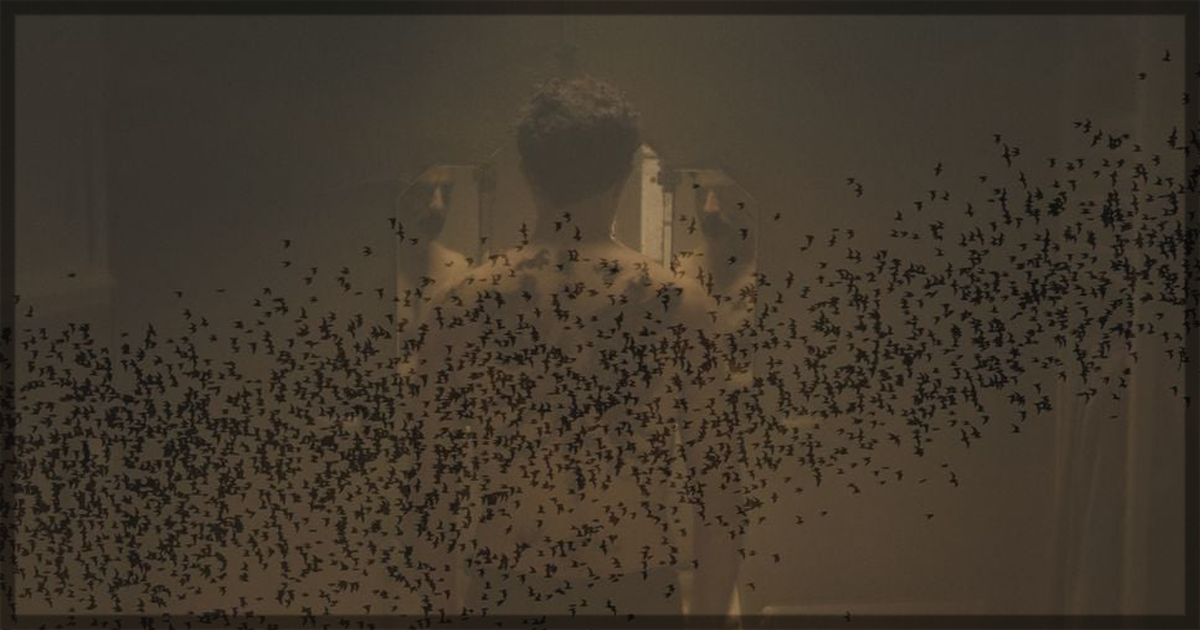
Following his 2021 Filmmakers of the Present debut Streams, Tunisian director and screenwriter Mehdi Hmili made his return at this year’s Locarno Film Festival, with the out-of-competition title Exile, which functions as part revenge thriller and part grief and social drama stylized in a way that evokes visual poetry and a surrealist touch. Clocking in at a little over two hours, the latest feature from the filmmaker who is part of the Tunisian new wave is undeniably one of the better-looking visions at Locarno, a vision that flirts with a host of genres: neo-noir, slow cinema, and body horror. Languid and almost static in its pace, Exile steeps us in an atmospheric emotional landscape that visually burns with its subdued yet stunning mix of sepia, mud yellow, and concrete gray. It is the kind of movie that takes a sudden pivot halfway through its narrative, which allows what is initially a story of grief to become one of rage and descent into madness, of repressed identity and emasculated sadism.
The movie’s protagonist is Mohamed (played with strong command by Ghanem Zrelli), a worker in a multinational steel factory now on the brink of collapse and about to be privatized. Noticeably, the factory only hires male workers, who endure low wages and poor working conditions, including a presumed accident that tragically takes the life of a co-worker named Adel, the closest friend and closeted lover of Mohamed, who also sustains a serious head injury during the accident, leaving a metal shard inside his body. The crew swiftly mourns Adel’s death and continues their routine lives except for Mohamed, who’s obviously racked with pain and grief. And it doesn’t help that the company’s management refuses to conduct a proper investigation and, worse, puts the blame on Adel, who, despite his gambling problem, is never late and has never made a single mistake at work. Mohamed suspiciously finds it rather convenient for the factory’s top brass to dismiss what happened as a failure on Adel’s part to follow protocol, one that incidentally melted his entire body and cost his life. Post-hospitalization, Mohamed is soon asked to transfer from working the furnace to being a watchman, which doesn’t help either.
Determined to uncover the truth and seek justice for his lover, Mohamed begins to play detective, following all possible leads and interrogating his co-workers, who aren’t that much of a help. Later on, he’s joined by Adel’s widow (Maram Ben Aziza) in this relentless quest that slowly hardens his soul and turns his body into rust, as Hmili is bent on physicalizing the film’s central metaphor and his protagonist’s moral and psychological decay. The director immediately establishes said metaphor in the opening frame, which depicts the horrid majesty of the industrial world with so much texture and tactility in a way that you could practically smell the stench from the overworked bodies and rust from the collapsing factory. This feeling also suffuses the soundscape, as sound designer Ismail Abdelghafar highlights, on the one hand, the urban and mechanical din—the harsh grinding and the constant hammering—and, on the other, the hallucinatory sounds of anguish and screams that torture Mohamed’s shifting psyche, with a musical score from Amélie Legrand that’s persistently harrowing.
Once Mohamed learns that the perceived accident is tied to the factory’s privatization and that the enterprise actively tries to cover its tracks, he starts to lose himself and takes matters into his own hands, assuming the roles of both judge and executioner. It’s easy to read this psychological shift as a function of grief, but, as the narrative expands its scope, it’s becoming more apparent that it’s also a manifestation of not just thirst for vengeance but of violent masculinity, paralleled by the film’s use of heat and fire as visual motifs, which doubles as an evocation of a proletarian inferno sustained by the cruel machinery that is capitalism and corporate bureaucracy. Exile offers a visceral portrait of the subtle and systemic injustices of the industrial and capitalist world and the lives that it forces to resort to extreme measures, their humanity be damned.
However, what prohibits its articulations about labor, identity, and masculinity—and what I find repulsive not just on an ideological level but on a story level—is the film’s depiction of women. It’s rather frustrating that its female characters function not even as objects of desire but only as sexual figures. In Hmili’s script, they don’t have active roles to play; if anything, they merely play foil to the protagonist; they are tacked-on features in the film’s hyper-masculine landscape, never afforded inner lives or their own sensoria.
Beyond this, the director’s stunningly bleak and phantasmagoric vision, towards its final stretch, starts to collapse and lose the powerful resonances of its allegory by becoming rather procedural and unsure of how it wants to meaningfully interweave its many layers or simply come up with a proper coda.
Exile recently played at the Locarno Film Festival.
Learn more about the film at the Locarno site for the title.
You might also like…