
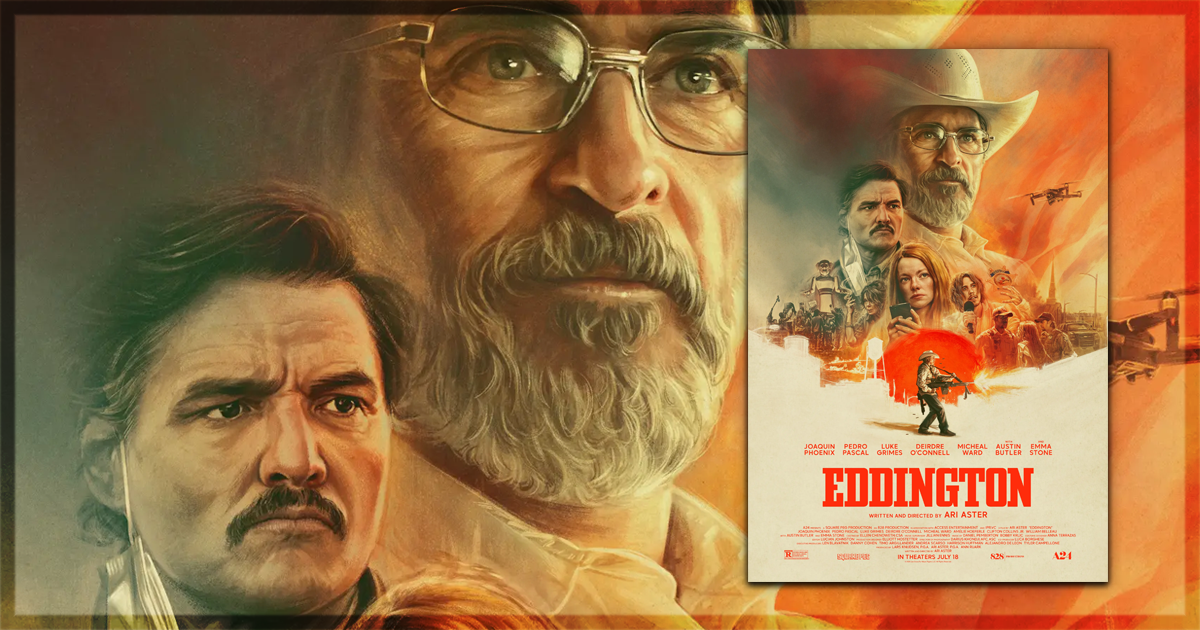
Over the last few years, my relationship with Ari Aster’s filmography could best be described as a rollercoaster ride. Hereditary is one of the defining works of modern horror and among my favorite films of the century. In 2019, Midsommar captivated me with its fusion of visual beauty and psychological discomfort, even if it didn’t quite reach the heights of its predecessor. Beau is Afraid proved to be a challenge in both density and tone, walking the fine line between a positive experience and a frustrating one. So, my hope for Eddington, written and directed by Aster himself, was that it wouldn’t continue this worrisome downward trend.
Set in May 2020, in the middle of the COVID-19 pandemic, the story unfolds in the small town that gives the movie its title, where tensions between Sheriff Joe Cross (Joaquin Phoenix, Joker) and Mayor Ted Garcia (Pedro Pascal, The Last of Us) escalate amid an atmosphere of uncertainty and fear, fueled by a turbulent election campaign.
The first half of Eddington plays as a satirical portrait of the pandemic, focused on collective fear, paranoia, and the impact of public health measures on everyday life. Aster opts for a sociopolitical study that doesn’t always reach the depth or precision the subject matters demand. Since the pandemic, numerous films and series have explored the terrain of misinformation and social panic with sharper bite; here, despite the clear intent, there’s a certain lack of freshness and provocation to push it beyond the obvious. The campaign between Cross and Garcia works as a metaphor for heightened polarization, where the clash of ideas quickly delves into manipulation, exploitation of weaknesses, and incendiary rhetoric, reflecting the fractured, complex reality of the time.
Then, in a shocking and unexpected shift, the movie pivots entirely. Eddington stops being a contained satire and morphs into a violent, fast-paced thriller – almost as if Aster decided the pandemic alone wouldn’t be enough to sustain a full feature without falling into redundancy. This abrupt transition is bound to be one of the film’s most divisive aspects: on one hand, it injects energy and urgency; on the other, it creates a fragmented structure where scattered ideas compete for space, diluting the clarity of the message. The streak of dark irony running through certain moments suggests Aster doesn’t expect everything to be taken literally, leaving ambiguity to hang in the air and challenging viewers to decide what is serious and what is satire.
The decision to embrace violence in the second half might seem like an arbitrary stylistic choice, but I see it more as an analogy for the breakdown of democratic and social mechanisms – when desperation leads to armed confrontation and physical escalation. This spiral – violent, chaotic, and unpredictable – mirrors the American reality, marked by heated debates over guns, protests, and the radicalization of opinions. In that sense, Eddington becomes a grim examination of a country unable to unite, even in the face of a common, invisible enemy.
Still, it’s undeniable that Aster’s vision remains bold and distinctive. The genre blending – from noir to western, thriller to satire – is executed with an intentionality that, despite its scattershot nature, gives the movie a unique identity. The dusty town and charged character dynamics evoke the spirit of classic westerns, reimagined for a contemporary setting where the “enemy” isn’t a stranger from out of town, but a neighbor, a familiar face… the ideological opponent – a reflection of the social polarization fueled by social media and fear.
Joe Cross’ arc is the throughline of Eddington. Phoenix delivers a powerful, multi-layered performance that captures the psychological erosion of a man torn between public responsibility and personal collapse. Cross is impulsive, manipulative, and emotionally volatile – a protagonist oscillating between fury and silence, between the urge to control external chaos and the slow implosion within. Phoenix brings these contradictions to life with subtlety, avoiding caricature and revealing the contradictory humanity of his character.
Emma Stone (Poor Things) and Austin Butler (Elvis) round out the main cast, though both – like Pascal – feel underutilized. Darius Khondji’s (Mickey 17) cinematography shines especially in the second half, with action sequences marked by immersive, surprising shootouts and chases. The score by Daniel Pemberton (Spider-Man: Into the Spider-Verse) and Bobby Krlic (Blue Beetle), along with the sound design, plays a crucial role in building the film’s mounting tension.
That said, the overall moral ambiguity may frustrate some audiences. There’s no clear message or definitive conclusion. This narrative silence is both a strength – resisting easy simplifications – and a source of discomfort, leaving an ending that feels abrupt and unresolved, depending on the viewer’s willingness to embrace uncertainty.
Final Thoughts on Eddington
Eddington is an intense portrait of pandemic-era life and its social repercussions, exploring themes of leadership, polarization, and community collapse, anchored by a standout Joaquin Phoenix performance as a man slowly unraveling. Ari Aster takes risks by fusing genres and radically shifting from sociopolitical satire to violent, chaotic thriller midway through – a choice that both energizes and fragments the story. Even so, the combination of formal ambition, thematic relevance, and strong performances makes it a provocative, memorable work.
Rating: B
Eddington is now playing in theaters.
Learn more about the film, including how to buy tickets, at the official website for the title.
You might also like…
