After making its premiere in the Orizzonti competition at this year’s Venice Film Festival, Ali Asgari’s latest feature Divine Comedy is set to make its Philippine debut as part of the 13th edition of the QCinema International Film Festival, running November 14 to 23. The film, which takes a metatextual approach to articulating harsh truths about cultural production in contemporary Iran, unfolds as a spiritual sibling to the Iranian director’s Cannes 2023 satire Terrestrial Verses, co-directed with Alireza Khatami, a project that prompted the Iranian regime to ban him from travelling abroad and directing other movies for nearly a year. The ban, though, only resulted in the making of the 2024 hybrid documentary Higher Than Acidic Clouds, wrestling with the censorship’s absurdity. This artistic and political restriction is not unique to Asgari, as most Iranian directors, who dare to be subversive, very well know. You’d reckon that after such attempts at intimidation, Asgari would temper. Instead, he comes up with Divine Comedy, which deftly interrogates the insidiousness of the Iranian Ministry of Culture as an institution and the inherent injustices of its legal procedures. For obvious reasons, the film would likely be prohibited from being screened in the country.
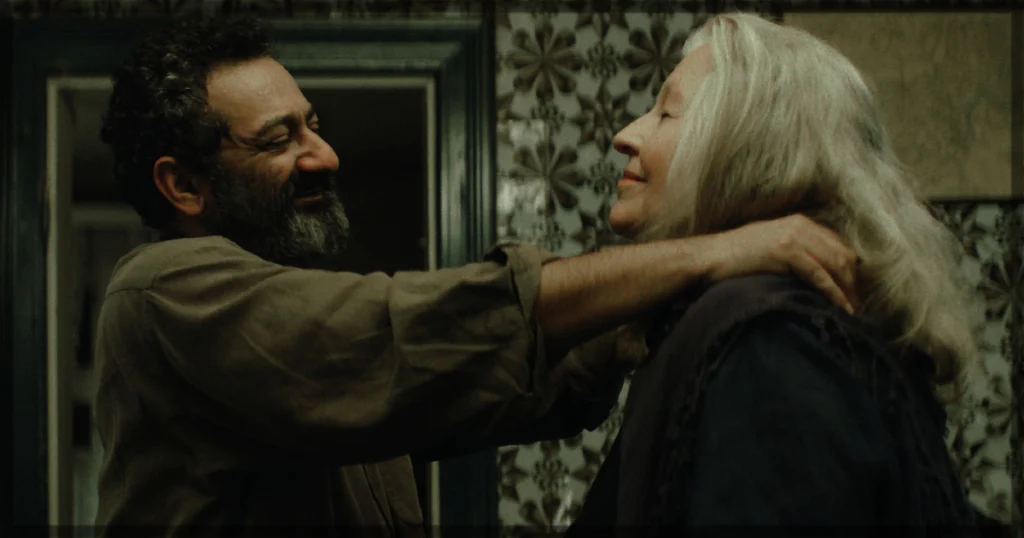
At the center of the movie is Bahram (real-life filmmaker Bahram Ark playing a fictionalized version of himself, alongside his twin brother Bahman Ark), a movie director in his 40s whose body of work revolves around making arthouse films in the Turkish-Azeri language, all banned from public viewing in Iran. Bent on screening his latest film, Bahram attempts to secure the necessary permit from the Iranian censorship board, initially depicted as a faceless figure, who agrees to screen his film provided that he edits out a scene featuring “dog sympathy” and reshoots the entire thing in Farsi instead of Turkish. “Cinema is all about imagination,” the censor tells him. “You don’t need to make everything realistic.” Bahram protests the absurd demands and, with the help of his edgy, blue-haired producer and romantic interest Sadaf (Sadaf Asgari, also portraying a version of herself), proceeds to organize a guerilla screening despite the odds. What results is an off-kilter yet high-spirited road movie, set over a course of a day, that compellingly explores not just the vexing state of cultural expression and production in Iran but also the violence of state surveillance in everyday life, the kind that makes you bolt awake in the middle of the night.
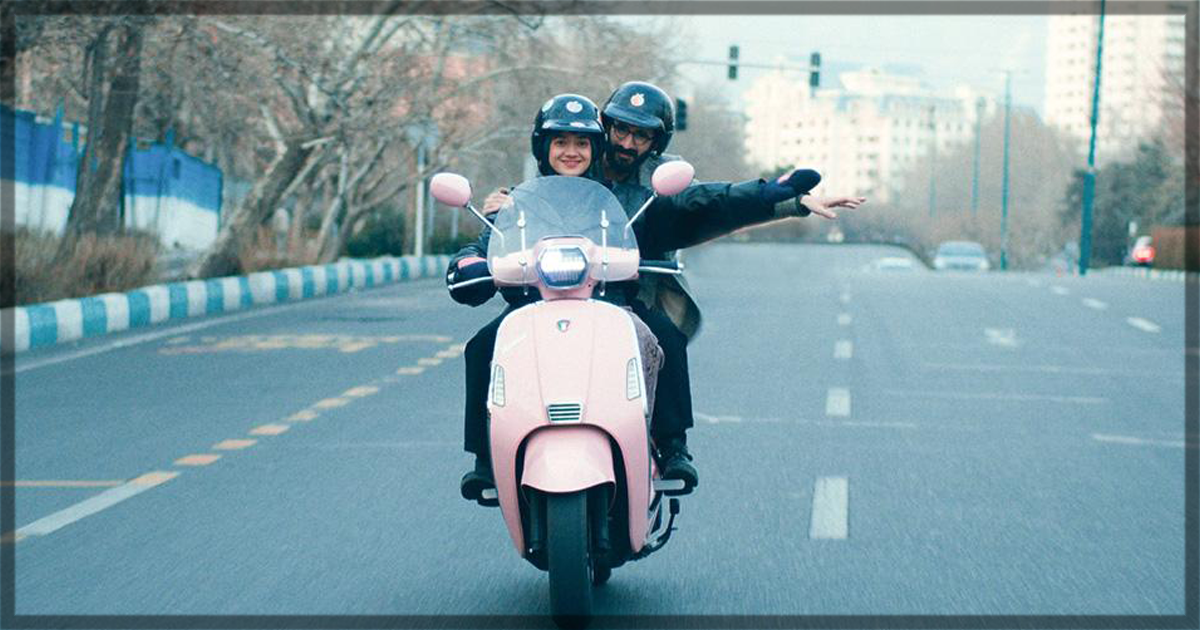
The journey—propelled by the visual motif of the protagonists joyously making stops and detours in a pastel-pink Vespa against a warm, almost fantastical score—sees them dealing with an eccentric group of people: a theater owner who has a proclivity for crowdpleaser comedies, a stranger claiming to be a prophet, a coked-up and cocky actor, an affluent animal rights activist, and an intimidating censorship board official presenting himself as “a friend who wants to help.” Amin Jafari’s camerawork here leans on static, locked-down compositions to depict the Iranian regime as a control freak, obsessed with micro-managing its people’s every action and decision, though the mounting still relaxes, particularly in sequences in which the protagonists tour the urban corners of the country’s capital.
Divine Comedy is essentially a work of political cinema, a satirically shrewd examination of the significant role that cultural work plays in sustaining the status quo, craft as an agent of control and surveillance. Owing to the provenance of its title, the movie pulses around the evocations of Dante’s allegorical poem, in that Bahram’s story mirrors the poet’s philosophical travels through inferno, purgatory, and heaven. Undoubtedly, it is its metatextuality that gives the movie real heft. Throughout its lean runtime, it makes a load of movie references, from The Matrix to Rocky, which double as a way to evoke how cinema could be both transformative and complicit, but also to call into question the persistent dichotomy between mainstream filmmaking and independent cinema. There’s even a brief juncture towards the film’s final 20 minutes in which it turns into an anecdotal essay, highlighting how cinema shaped the lives of the twin brothers, complete with black-and-white photos of the directors growing up together and simultaneously discovering the magic of the celluloid, even as this discovery eventually takes them to opposite paths. Making Asgari’s collaborators, many of whom appeared in Terrestrial Verses, portray themselves also heightens this self-commentary. Sadaf Asgari’s character, for instance, is often barred from entering certain premises in the film for dyeing her hair blue and refusing to don a hijab, which mines more texture in the context of the acting ban against Sadaf in Iran following Terrestrial Verses. The twin directors similarly faced censorship from the regime in the past.
Throughout the movie, we never really get to see the film Bahram desperately wants to play for an Iranian audience. Instead, what we access is the brief reaction of that audience upon watching the picture for the first time, the screen’s glow reflecting on their faces, only to be cut abruptly by a disgruntled dog and the arrival of the state censors. In the end, what the audience witnesses is a stream of news reports about the overthrow of Bashar al-Assad, Syria’s dictator and Iran’s longtime ally, following the Syrian civil war. Political reality insists on itself way faster and crueler than Bahram could commit his version of it to celluloid immortality. Fact and fiction bleeding into one another. In many respects, Divine Comedy highlights both the possibility and futility of artistic expression in a time of heightened terror and complicity. This is a movie about the immense power of trying past the creative sense. It may be light on the surface, but its implications are strikingly urgent and crushingly real.
Divine Comedy played at last year’s Venice International Film Festival.
Learn more about the film at the IMDB site for the title.
You might also like…