
In Bona (1980), Filipino auteur Lino Brocka tacitly reckons with his country’s fascination with idle worship and swift salvation through his signature melodrama and social realism. The film was not among the triptych of landmark movies that redefined Philippine cinema and catapulted the director to the international scene. Those titles—Tinimbang Ka Ngunit Kulang (1974), Maynila sa Mga Kuko ng Liwanag (1975), and Insiang (1976)—were released much earlier, when Brocka re-introduced himself as a filmmaker through a foray into arthouse cinema following a two-year, self-imposed hiatus from commercial filmmaking, chiefly triggered by a dispute with a producer and the quality of works he had been directing at the time. Yet, Bona remains as one of Brocka’s major works, an underseen masterpiece that premiered at the Directors’ Fortnight of the 1981 Cannes Film Festival, where its digitally restored version made its return last year as part of the Cannes Classics section. In early July, Bona, alongside the action thriller Cain at Abel (1982), became the latest addition to The Criterion Channel’s collection “Lino Brocka: Legend of Philippine Cinema.”
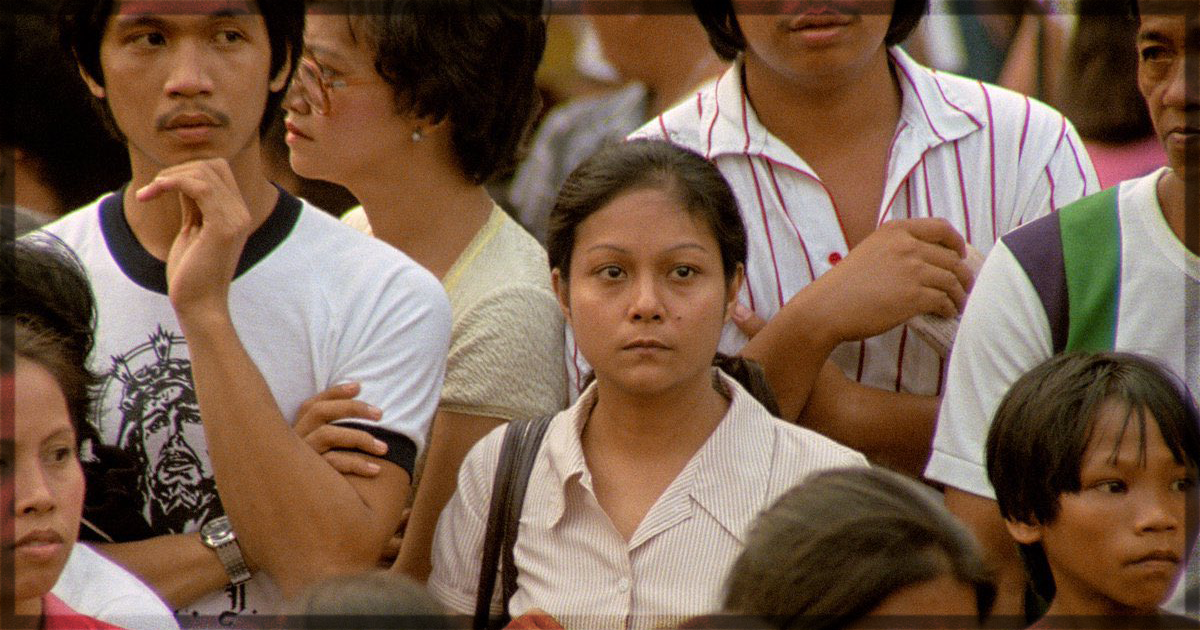
For the uninitiated, the material for Bona first aired as an episode of the television drama anthology Babae, starring Laurice Guillen and Ruel Vernal. Brocka put the episode of the same title to the big screen, reworked the script, and cast Nora Aunor, who also produced the movie under her film company NV Productions, in the titular role. What results is a feverish character study that examines the curious textures of idol worship culture, gender politics, and patriarchy against the backdrop of the Marcos dictatorial regime. It features a central portrayal that might as well rival Aunor’s performance in Ishmael Bernal’s Himala (1982), often regarded as her best acting work. Though vastly different in scale, Himala echoes the thematic corners Bona seeks to map, so it’s hard not to see these pictures as spiritual siblings. In fact, Brocka readily draws parallelism between celebrity and religious worship in the film’s opening sequence, which depicts stunning, high-angle vistas of Black Nazarene devotees, mostly barefoot, swarming the streets of Quiapo, Manila to participate in the annual Traslación. Overwhelming the screen are thousands of pilgrims aggressively tugging at the wheeled carriage bearing the dark wooden statue by its two large ropes, and tossing towels at the replica for its supposedly miraculous powers. Glimpsed among the crowd is Bona almost indifferently witnessing the procession unfold, then cut to another scene which finds her in a movie shoot, chasing after another idol with palpably more enthusiasm. Her object of obsession is Gardo Villa (Phillip Salvador, a staple in Brocka’s cinema), a narcissistic bit actor in low-budget movies still waiting for his big break.
And what better way to evoke the film’s powerful implications than with Aunor, who the director once described as “the only star I know who could silence a crowd.” Famous for playing roles the common Filipino could resonate with, Aunor was the first dark-skinned Filipino actress to become a movie superstar during the so-called second golden age of Philippine cinema, a meteoric rise that established her legions of fans, the Noranians. Aware of this metatextuality, Brocka turns Aunor’s stardom on its head. The superstar now becomes the star-struck spectator, effectively calling into question our relationship with fandom and martyrdom.
But beyond the sense of servility that persists in the film, Bona is likewise a story of capitalist labor and its inherent injustices. Once given an autographed picture of her idol, Bona actively follows Gardo in his shoots and leisure time, offering him snacks and soda, never mind if she ditches school, ignores house chores, or comes home late. When Gardo is badly beaten up by a gang of thugs due to his womanizing under a sudden downpour, Bona nurses him and spends the night at his place, her whereabouts unknown to her strict parents. The next day, Bona’s father (Venchito Galvez) lashes out at her and whacks her with a belt; Bona impulsively runs away, moves in with Gardo, and plays house with him, as if to assume the role of a pseudowife, only to realize much later that it’s hardly the case. Bona is more of a servant and maternal figure to Gardo than any suggestion of being his lover. She’s practically an unpaid all-around domestic helper in Gardo’s shanty in the slums of Manila, regrettably far from the comforts of her middle-class upbringing. She cleans the house, prepares food, and patiently lines up in the community tap to fetch water for when Gardo needs a bath. (The latter detail alludes to the time when the actress used to sell water for a living; water, then, ripples as a visual motif throughout the movie.) Bona even scrubs and soaps Gardo herself or gives him massages. On the side, she also gathers and sells scraps and empty bottles. Most of all, she puts up with his very short fuse and drunken, carnal whims. It’s hard to pin down the source of this self-imposed devotion. One might say that Bona is a masochist yet to some extent she’s also a master manipulator, in that she strips Gardo of his bravado and keeps him under control, though not totally, by keeping him pampered and cared for the way a child needs a mother’s attention. Acts of service as a means of surveillance rather than a lexicon of love. Bona, in turn, finds kinship with the people in Gardo’s immediate environment—including Nilo (Nanding Josef), who initially attempts to court her—the kind of kinship that perhaps her own family could not provide.
Visually, Bona is every bit as gritty and vibrant as Brocka’s previous movies. He and cinematographer Conrado Baltazar draw us in with the allure of cinéma vérité—heightened by the presence of nonprofessional actors, on-location shooting, and onscreen choreography that owes to the director’s theater acumen—which ultimately allows for some shrewdly realized mise en scène. The frequent collaborators so pointedly capture Manila’s proletarian social geography with casual cruelty and tenderness, with visceral texture and rawness that you could almost feel the grime and congestion and smell the decay. The metropolis, then, becomes a character on its own, as Brocka is keen on depicting the precarious living conditions of the urban poor in the eighties. It’s a visual palette that’s rendered more lived-in by the persistent use of harsh light and shadow, which readily softens and sophisticates when the camera focuses on the object of obsession at the film’s center. The soundscape, for its part, highlights neighborhood chatter and the city’s noise, as well as a score strangely dominated by bongo drums.
Gardo inescapably becomes a symbol of desire, a beautiful babe with refined muscles and smooth skin pictured in varying states of undress, just as Salvador was at the prime of his career. Yet Gardo is also vain, abusive, delusional, and incredibly patriarchal; he’s an absolute manchild and a walking red flag. Salvador delivers a performance so strikingly honest and charismatic, as though he wears his character’s vanity as second skin. Aunor, meanwhile, is rarely afforded the kind of sophistication given to her counterpart. She often figures in Brocka’s trademark long takes, readily reserved for the film’s most melodramatic impulse (There’s significant dragging and chasing somebody out in the film, but it never lapses into sheer histrionics), and Aunor fascinatingly towers over such moments, despite her small stature and despite the camera’s intentionally unfavorable placement. Aunor’s presence and ever-evocative eyes—rendered most powerful in the film’s closing minutes in which Bona, after coming to her senses, baptizes the self-centered Gardo with scalding water—not just brings a kind of quiet intensity to the protagonist’s tacitly shifting psyche but also elevates Brocka’s dramatic proceedings in such a way that refuses to present Bona the character neatly as a “perfect victim” and Bona the film as a mere tale of romance or revenge. Could it be that Bona simply sought for an escape? To what extent do we attribute her suffering to the function of agency? What do the men in her orbit reveal about that very agency?
Like Brocka’s sharpest visions, Bona plays as both a social exposé and dramatized political allegory. Once thought lost and only recently rediscovered and scanned, restored, and color graded in 4K, it’s beyond symbolic that the movie finds its way back to the Filipino audience over four decades later, just as our populist leaders, who have successfully exploited the repercussions of our biblical attachment to greatness and empty deliverance, make their return to power. We’re not just watching the superstar and the metatextual implications of her own iconicity here; we’re inevitably watching ourselves onscreen. Until now, we’re still as cursed and confused as Bona.
Bona is now playing on The Criterion Channel.
Learn more about the film, including how to watch, at the Criterion website for the title.
You might also like…
‘Cain and Abel’ Film Review: A Brocka Tale At Once Biblical And Brutal