In the history of cinema, the Anglo-Saxon perspective has been the most prominent in mainstream filmmaking. As society seems to include and understand diverse ethnicities, different ethnicities may develop their own viewpoints of reality. Unfortunately, the Palestinian history told by its people took plenty of time to get an opportunity, most recently, due to the ongoing genocide in Gaza. Despite prominent voices, such as Hany Abu-Assad and Elia Suleiman, a broader range of Palestinian artists are releasing their takes on the aggression against them that has lasted since the British colonization. One of those artists is Cherien Dabis, an American-Palestinian director with an extensive television career. She has credits in shows such as The L Word, Ramy, Ozark, and Only Murders in the Building. Parallel to writing and directing these shows, the director released Amreeka and May in the Summer, features that premiered at the Sundance Film Festival. Twelve years after her last full-length work, she presents All That’s Left of You, an epic about a family on three generations of colonial violence.
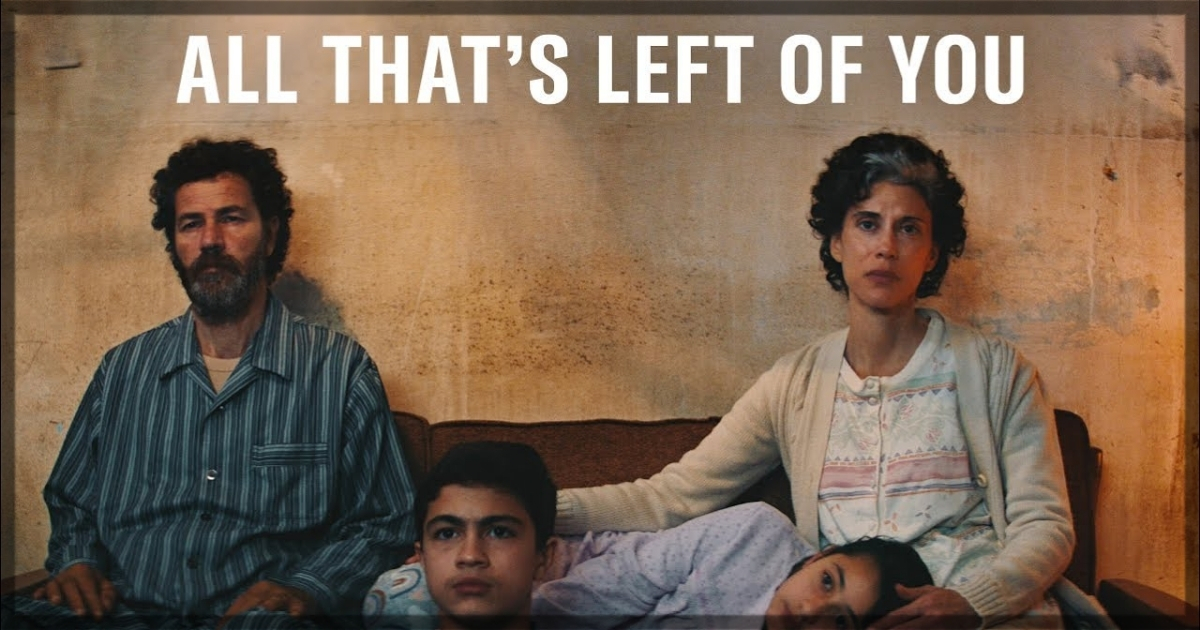
In a media res introduction, we follow a rebel teenager who, through the wandering of his village, ends up at a protest against the Israeli army. After a shot at a window, we cut back to 1948, in Jaffa, where a little boy named Salim (Saleh Bakri/Salah Al Din) grows up with his family in a large house with an orange plantation. Suddenly, all of the villagers get evicted from their land; it is the Nakba. After that, we follow that family in 1978, when Salim has grown and has a son named Noor (Muhammad Abed Elrahman), who changes his behavior after a violent incident at an Israeli checkpoint. Finally, time jumps to 1988, when Noor is a teenager, and participates in that protest. In its central structure, Dabis, who also wrote, produced, and performed as Noor’s mother, condenses three generations of a family suffering from Israeli violence.
Similar to another 2025 film about the Apartheid state in the Middle East, Palestine 36, All That’s Left of You is a dive into the past to understand the ongoing situation, the escalation of brutality that has occurred for decades. Both films by Dabis and Annemarie Jacir reconstruct a bygone landscape of Palestine in terms of infrastructure and societal organization. Bashar Hassuneh, the film’s production designer, builds massive sets that draw the scale of the lands that Israel took from the Palestinian population. In the first decade, 1948, the family house was a welcoming and warm place, full of life, particularly because of the red-ish rugs and the shelves full of books. Yet, the last one, 1988, illustrates an improvised structure, where wood and shelves add storage for a family of five to live in a condemned space. Furthermore, Christopher Aoun’s cinematography captures the scale of the aggression, particularly when the camera pans over the dozens of families in small tents.
On another note, the director divides her epic story into two halves: the first, the journey of Noor’s family up to the day of the protest; the second, the aftermath of that day. The first part is the melancholic journey of living at home to survive, Salim’s father’s resistance to leaving the country, and the fight for the family’s house. Throughout each time jump, we understand how each male figure influenced the following generation. Salim loves poetry because of his father’s influence, who would recite it at the dinner table. Nevertheless, Noor’s distress comes from his grandfather, who tells him about the land displacement, and worsens through the actuality of violence. Dabis studies the melodramatic structure in the second half, presenting her lead character with Sophie’s choice, a moral dilemma that reflects on the epilogue set in 2022.
In this sense, the American-Palestinian director creates a work that resonates with the eighty years of settlement following the Nakba and the moments before the first Intifada. Yet, All That’s Left of You refers to the people martyred in the fight for the Palestinian land, and the ground that the ethnostate has not taken yet. Besides not portraying the ongoing genocide, the ethnic cleansing of an entire population by the colonizer, and the complicity of its political allies, Dabis’s film makes us reflect on the materiality of a genocide that has lasted for almost a century. It is a highly emotional ode to those who fight for the land, those who do not bend to the violent practices of an authoritarian regime, and its interests in the natural resources of the land.
All That’s Left of You is a study of the effects of Israeli colonization on a family, which weighs the poetic beauty after the brutality, the strength of resistance that has lasted for eighty years, and the need to go on to protect their homeland.
All That’s Left of You has recently played at a number of international film festivals.
Learn more about the film at the official site for the title.
You might also like…