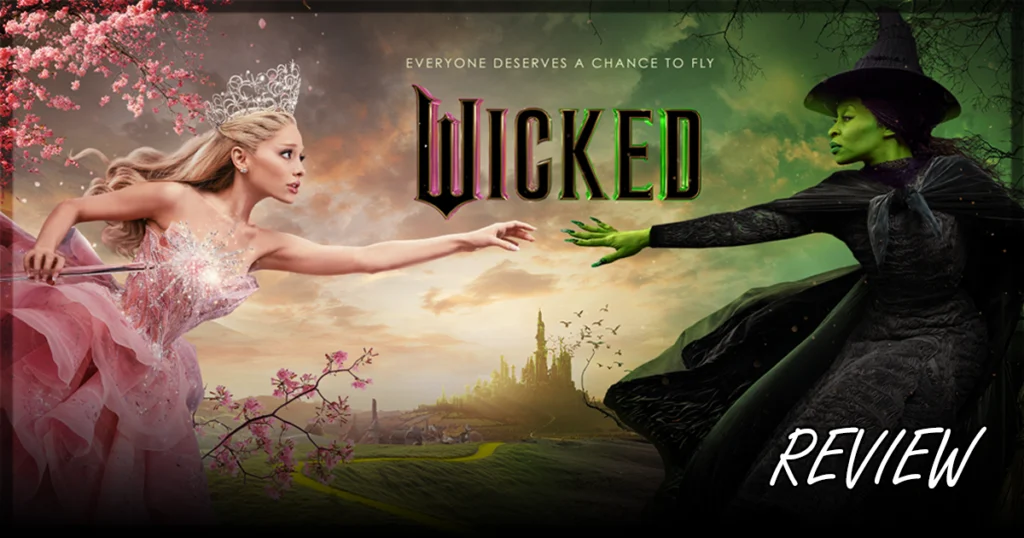
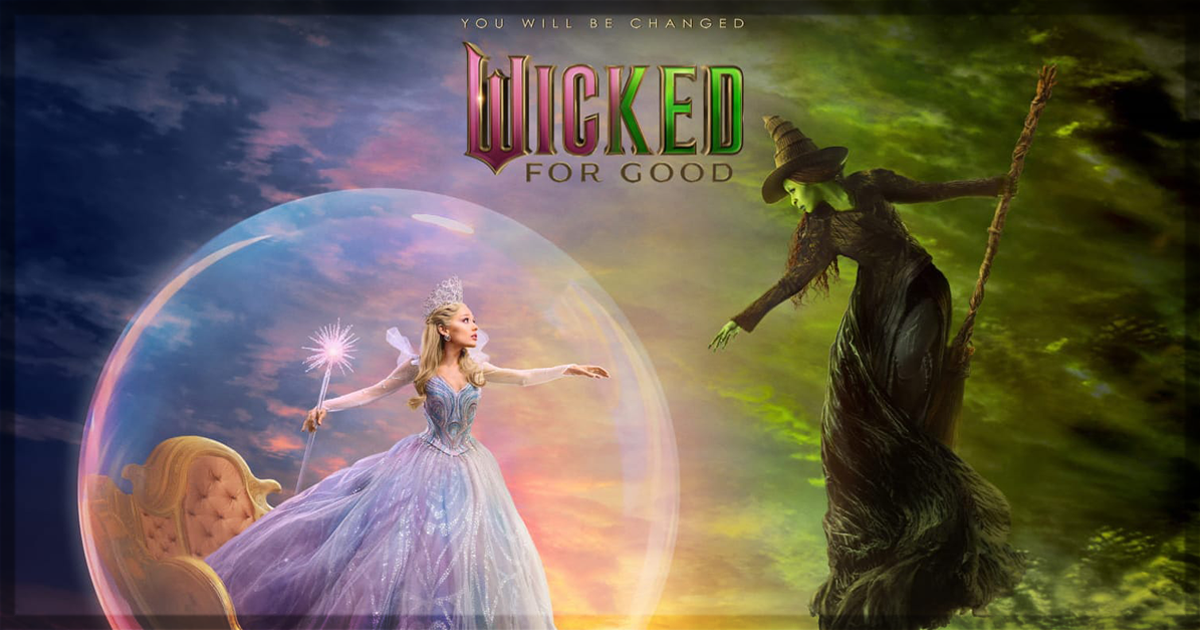
In November 2024, the film version of the 2003 Broadway musical Wicked finally hit theaters. The Broadway musical from Stephen Schwartz and Winnie Holzman is an adaptation of the book of the same title by Gregory Maguire. The film by Jon M. Chu (Crazy Rich Asians & In the Heights) brought together the millions of fans from the musical, which has had plenty of local versions, impacting those fans for more than two decades. The result was a massive success – the most successful Hollywood adaptation of a Broadway show ever. It earned ten nominations at the year’s Academy Awards, including Best Picture. Because the show had such enormous scope, it required a two-part film, the first act in 2024, and the final one on Wicked: For Good, which is finally reaching theaters to conclude the story.
[Editor’s Note: There are some spoilers ahead.]
The second effort of the Oz saga picks up where the first part left off. The wizard (Jeff Goldblum) is chasing after Elphaba (Cynthia Erivo), the Wicked Witch of the West. Meanwhile, Glinda, the Good (Ariana Grande) is a token from Oz’s administration to manipulate the masses. Hence, it is a conventional clash between good and the evil, with Elphaba being the one responsible for exposing the truth to the citizens, while the wizard lies. In this sense, the first sequence is an action-packed confrontation between the Witch and the guards who are exploiting the animals, the ones blamed for the wrongdoings of the kingdom. They are building the iconic yellow brick road, the same one that is an iconic piece of the 1939 Wizard of Oz. Nothing better than starting the final chapter of the film with a sequence on such a relevant aspect of the L. Frank Baum’s work. However, from the first sequence, For Good exposes the flaws of the first film.
Obviously, both parts were shot as one, but finalized and released as separate efforts. Yet, the pale and anemic color grading of the predecessor repeats itself here throughout the erratic work by Alice Brooks. Similarly, the cinematographer looks for wide shots that encapsulate the immensity of the combat and this universe; however, the lightning offers unbalanced flares and diffuse light. The result is a fantasy film that leans towards the realism brought by digital filmmaking, which diminishes color and imperfections. The central problem in the universe building is the visual composition; despite the brilliant costume design by Tony Winner Paul Tazewell, which incorporates the character’s opposing personalities in each detail of his works, the opaque color palette baffles it. It occurs in the same way as the production design by Nathan Crowley and art direction by Ben Collins, impressive and gigantic works that lose their grandeur through the manner in which the camera depicts them. One of the most iconic scenes in cinema history, Dorothy’s arrival in Oz through the tornado, results in an unappealing sequence, where the house’s walls are pale and worn out.
The visual unattractiveness is not mitigated by a sympathetic world-building and charismatic interactions, as seen in the former film, particularly in the initial part, where the most energetic songs are featured. Wonderful and For Good are highlights of a mostly bland group of songs, which does not feature any sufficiently engaging scenes like in Defying Gravity or Popular from the first film. The film’s two original songs, No Place Like Home and The Girl in the Bubble, were both written by Schwartz; however, they do not significantly contribute to the emotional depth of the story. In this sense, Wicked: For Good suffers from a less engaging narrative structure and sequences that lack emotion in this tragic story. Yet, Cynthia Erivo brings a complex approach to Elphaba, someone who lost family and everyone she loved, by attempting to shine the light on the truth about the wizard. And although she is the scene stealer in Wicked, Ariana Grande has considerably less to work with in this project. The same applies to the supporting cast, such as Jonathan Bailey and his Fiyero, while Michelle Yeoh is overly operatic and off the wavelength in her villainous arc.
The long-awaited conclusion to one of the most beloved Broadway musicals in history is lackluster. Jon M. Chu’s film suffers from the same problems as the first part. The story’s structure does not benefit from classic songs and passionate performances. Chu’s inconsistent directing and the erratic cinematography of Alice Brooks diminish the marvelous works by the arts department. Arguably, the unattractive visuals from an adaptation of celebrated works in popular culture deliver a disappointing conclusion to the grandiose journey of Glinda and Elphaba.
Wicked: For Good will be in theaters on November 21, 2025.
Learn more, including how to buy tickets, at the official website for the title.
You might also like…