Since seeing Trad I’ve been trying to remember another coming-of-age movie about a teenage girl in which she doesn’t come to the tiniest bit of harm. I can’t, making Trad so rare and unusual that only this fact makes it a must-see. If that wasn’t enough, it’s about a young woman’s relationship to her own skills – in this case, her ability to play the traditional Irish music which gives the film its title – and how she comes to understand her talent. It’s incredible to have a movie about a young girl be so safe and so understanding and with such genuine musicianship at the center. It’s an enormous achievement.
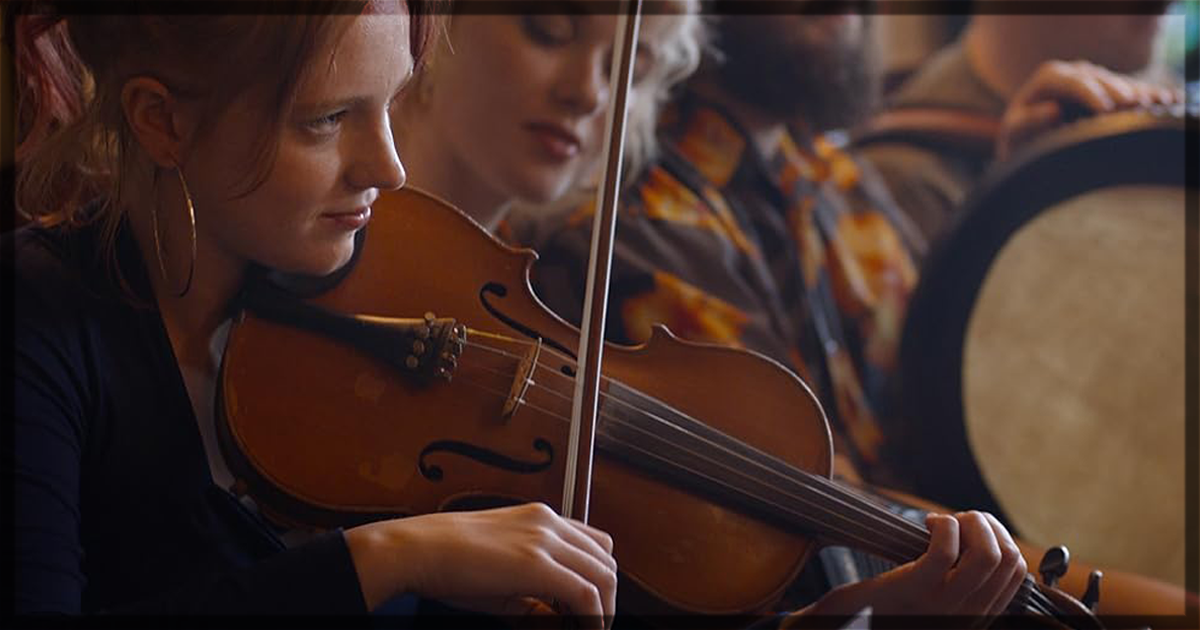
Shona (Megan Nic Fhionnghaile, who clearly does all her violin playing herself) has just turned 18 and lives with her parents (Sarah Greene and Peter Coonan, very charming) in an Irish-language home devoted to traditional Irish music and dancing. Shona and her sparky 11-year-old brother Mickey (Dallán Woods having a whale of a time) are obviously sick to the back teeth of it. The relationship between Shona and her mother is unhappy and aggressive – they openly talk about hating each other, and at one point the mother damages Shona’s beloved scooter with her car without stopping – so when a van full of off-grid neo-hippies arrives in their little town in the west of Ireland Shona can’t help but be intrigued. The neo-hippies are all young, with the exception of their leader Harky (Aidan Gillen doing his amiable best, knowing his presence will help the film find international distribution), and most of them are musicians too, though none with Shona’s skill.
Harky dresses like a yeti at the beach, in a long white puffer coat, pink sunglasses, and a pointy rabbit-fur hat with earflaps, and his merry, harmless band are all huge admirers of traditional music. When they realise Shona and Mickey are the real deal they sweep the kids along with them. Shona is happy to stay gone and even nail her phone to the dashboard of their van to teach her mother a lesson, and Mickey tags along to make sure no harm comes to his sister. It wouldn’t, these people are cool if exhausting, but it’s smart to be careful. The siblings therefore get to use their Irish as a secret language in front of all the others, who are jealous of it. Mickey’s an agreeable kid, excited to hang out with these kind weirdos, but with enough presence of mind to keep his own phone hidden, enough confidence to call Harky “Smelly Hat” to his face, and enough self-esteem to understand when the party’s over and it’s time for him to go home.
Meanwhile Shona is intrigued by “the sexy one with the banjo,” the slightly older Frode (Henry Zaga) while at the same time intriguing Ray (Cathal Coade Palmer), a middle-class guitarist her own age with a mouthful of braces. They all camp on beaches and fields or in a strange property Harky owns in the middle of nowhere, and finance their adventures by busking for cash. The neo-hippies’ appreciation of Shona and Mickey’s talent and knowledge of Irish culture starts Shona considering her own feelings towards what their parents taught her and what she can do. The ways in which music brings people together, especially in Ireland where many people can play at least one instrument and there’s huge pride in the old songbooks, has rarely been so accurately reflected in film.
Director Lance Daly, whose previous film Black ’47 was a revenge fantasy set during the famine, here uses the ways in which Shona plays her fiddle as the arc for her character. Her choices of songs, the ways she works with Ray or the others as they play, and the shifting dynamic between the players as they perform is how she works out her thoughts. Miss Nic Fhionnghaile had never acted before this movie but her excellence as a violinist more than makes up for any weakness there; her feelings are perfectly expressed through her music. Mr. Coade Palmer’s playing is also excellent and he gives a fine performance as a naïve young man who’s smart enough to let his body language do most of his communicating. It is so unusual to see musicians playing in real time onscreen that you can just sit back and enjoy the performance as if it was happening at the next table over in the pub. Considering that recent American blockbuster Sinners also hinged on traditional Irish music, there’s evidently a growing appetite for authenticity that also manages to swerve cliché. Trad’s finale, which involves about forty people closely packed together in a busy pub, is as carefully choreographed as any fight to the death, but not how you might think: it brings together several different plot points without dialogue.
Because Trad is really, despite the diddley-aye music, a cliché-free zone. The plot is not about Shona and Frode (her explanation of their situation is genuinely delightful to hear coming out of a teenage girl’s mouth), or whether Shona and her mother can resolve their differences, or even Shona and Ray, who is besotted with her if not quite mature enough yet to do much about it. There are no villains here, even if fairly serious disagreements happen, and everyone means well even if they can be infuriating. The real question is between Shona and herself, and whether she’ll be able to grow up through this adventure or in spite of it. Suffice to say Trad is such an unusually positive and uplifting experience you’ll go dancing out of the theatre.
Trad recently played at the Irish Film Festival.
Learn more about the film at the IMDB site for the title.
You might also like…