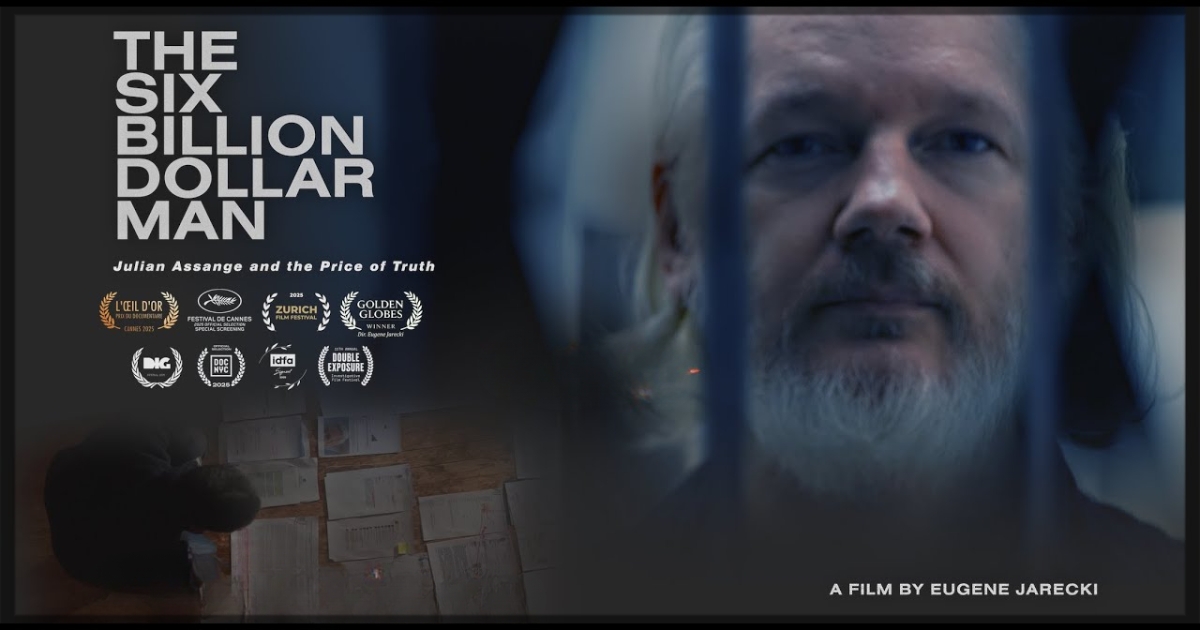
During the peak of the internet’s spread in the early century, the media and the world were still coming to terms with the reach of this new medium. One of the questions and a new understanding related to information access: shifting from the concentration of it in selected vehicles and media to a multipolar focus on the internet, allowing users to access data from anywhere in the world. Hence, at the end of the 2000s, WikiLeaks had become an unprecedented phenomenon. Through the persona of its founder, Julian Assange, the website would release classified government files, exposing the truth about major events and administrative operations. In 2009, they leaked the footage of an attack by the U.S. army against civilians and journalists in Iraq. The shift in public opinion became one of the reasons why Barack Obama left the country after the Bush/Cheney war on terror following 9/11. After that, Assange became a wanted figure. The veteran documentary filmmaker, Eugene Jarecki (The House I Live In & Why We Fight), documents his journey in The Six Billion Dollar Man.
Firstly, the director divides the film into three parts. The first one, ‘How It All Began,’ is a combination of the website’s impact when it first launched. It tackles the publication of the video that brought American fury upon the site and its founder, as well as their central effort: the release of the U.S. Diplomatic cables. It was a 250,000-file compendium that published the American philosophy regarding their diplomacy, which included spying on allies and fomenting local conflicts. The posting of those classified documents created public chaos for the United States administration. Ultimately, it became a problem when access to those documents became public through a book, in which the author printed the password and instructions for accessing them. Suddenly, the long process of hiding the names in the files was exposed in full by a British journalist’s investigation. Parallel to that, Assange suffers accusations of allegedly exposing two Swedish women to HIV and refusing to take a test. They denounced him to the Swedish police, which opened up a rape investigation against him, leading him to get a prison warrant, and he went to the Ecuadorian embassy in London.
In this sense, the ending of part one is the most famous part of his history to most people. The journalist spent fifteen years in a small room in a diplomatic office in London, harassed by the police and media, and later in a prison in the United Kingdom. Jarecki spends an extensive time covering his years in the embassy and the paranoid cycle he goes through. Consequently, Assange spends a considerable part of his life confined to a room, surveilled by cameras in the top corners of each space. Yet the director constructs an uneven, oddly developed film that feels too broad in the end. Ironically, the titular subject appears to be talking to the camera only in the first sequence, after which it is replaced by archival footage and the stories of others. The talking-head elements assign a dated element to the film, making it feel like watching something that happened decades ago. However, it is particularly due to the high volume of information in this century; each new data fragment is rapid and easy to absorb.
Even though it feels too long ago, the second and third chapters, ‘A Safe Place’, ‘The Delivery of Julian Assange’, encapsulate his experience with the pressure of the American government passing through administrations from Obama to Trump and then Biden. Jarecki’s film is so dense that it stretches through two decades of information about this case, which is essential to defending the integrity of journalism. Yet, there is too much in the final project that exceeds the necessity of information. A few conversations are less fundamental to the film than others, and the director does not extract the best from each interview. Still, the case is engaging on its own, despite its bureaucratic structure.
Funny enough, the director pulled the film from the 2025 Sundance Film Festival to finalize it; around that time, Assange struck a deal with the Department of Justice under Joe Biden and went home to Australia. Nevertheless, the additional footage is not very long, including a few shots of him looking out the airplane’s window. In a sense, it is a form of the director exposing the sweet freedom he has acquired after fifteen years. Still, it is a beautiful moment to close out an overly dense and not always effective film, but it effectively remembers the journalist’s fight for the right to work and tell the truth.
The Six Billion Dollar Man is not currently available for streaming. It recently played at the DOC NYC festival.
Learn more about the film at the IMDB site for the title.
You might also like…