Shown in a moment of global and political strife, one cannot fault an audience who might be wary of another immigrant drama like Souleymane’s Story, especially when a white filmmaker is behind it and considering how Hollywood and other major studios have depicted and taken advantage of such narratives. Even more so when the film’s story is inseparable from the conditions of its making: Abou Sangaré, who plays the title character to great critical acclaim, left Guinea and settled in France at the age of 16 and has been seeking legal status to be allowed to work in the country as an auto mechanic and shoulder the medical expenses of his mother, who deals with epilepsy. After four attempts, French authorities finally granted Sangaré a one-year work visa in early January this year. In many ways, the role he plays onscreen mirrors the life he has long been living, though the resulting picture isn’t exactly biographical. French director Boris Lojkine, who shares writing credits with Delphine Agut, pieces together a movie that is never cloying or condescending in its depiction of the immigrant and working-class experience — one that garnered top prizes at Cannes 2024 in the Un Certain Regard section.
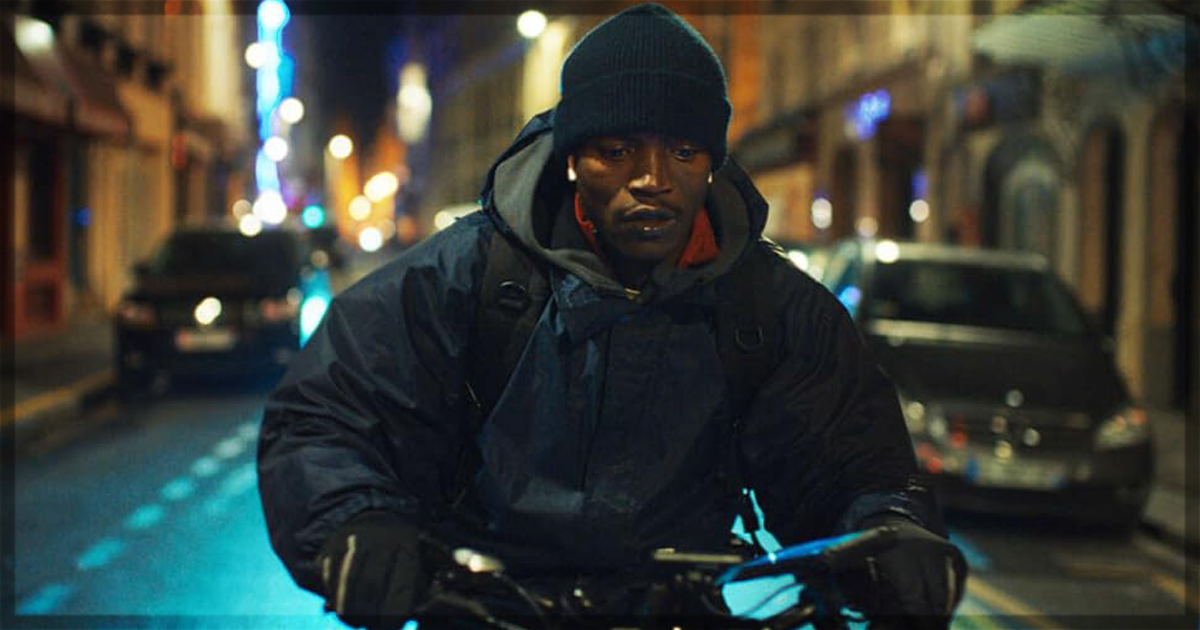
The movie opens with a visibly bruised Souleymane, a Guinean refugee hoping to gain asylum in France, lining up and awaiting his turn for an in-person interview at the immigration office. He seems exhausted and disoriented. When he’s about to enter the evaluation room, the movie abruptly cuts the scene. Lojkine only returns to this plotpoint late in the runtime, after revealing the context and the gruelling events leading to it. As it turns out, Souleymane barely makes a living as a food courier, intensely biking through Parisian traffic as he picks up and drops off orders, asking for codes from customers to proceed with another delivery. The thing is, he actually works off the books; his delivery account is owned by Emmanuel (Emmanuel Yovanie), who charges him exorbitantly and whose facial features are necessary for the platform’s relentless security checks. The demanding job involves a whole lot of waiting and arguing, and, at worst, getting into accidents that he has no choice but to brush off to complete his deliveries, before hastily running after a shuttle bus that takes refugees like him to homeless shelters, whose spots for bed and shower need constant rebooking, lest Souleymane ends up spending the night outdoors.
All this, while rehearsing in detail the fabricated story he learns from Barry (Alpha Oumar Sow), who profits from coaching undocumented immigrants and furnishing them with forged papers for asylum applications. The fictional account’s selling point is that Souleymane is a Guinean political detainee forced into exile by President Alpha Condé’s violent regime, whose anti-poor demolition policies led to a series of widespread protests in 2019, one of which saw Souleymane’s arrest and eventual torture. The refugee searches for photos of demonstrations and the prison where he was supposedly incarcerated to corroborate his story and dispel possible inconsistencies. But while he’s eager to secure a life free from fear of deportation and exploitative labor, he reckons that being genuinely true to his lived experience might just give him that long-desired permit, provided that the French state, alongside its unforgiving bureaucracy, deems him worthy of legality and integration, which means condemning other asylum seekers like him to a scrappy existence of state surveillance and heightened precarity. So goes the moral and ethical dilemma at the narrative’s center.
Over the course of the movie, we see Souleymane panting and speeding through the bustling city, which parallels what happens behind the scenes as Lojkine and cinematographer Tristan Galand track Sangaré while riding bikes themselves. The method results in immersive, handheld medium shots, rendered more piercingly by Xavier Sirven’s frenetic and almost uneven editing, which enunciates not just the protagonist’s anxious disposition and fragmented sense of self but also the French bureaucracy’s sweeping demand for coherence more than the truth in the stories of the immigrants it views as expendable — in this logic, the means to attaining one’s survival hardly matters when the police state already discriminates. The coda echoes this sentiment: Even as Souleymane ends up telling his truth before the modest immigration officer, there is no guarantee that his asylum appeal will be approved; if anything, it is more likely that his appeal will only serve to magnify the hostile structural forces already bearing down on him. The film, beyond this, makes a damning, slice-of-life argument on the state of the Parisian metropolis in a late-capitalist period, which is presented to us through hazy lights, urban din, and constant movement, steep in shades of blue.
Lojkine rarely extends us visual access to Souleymane’s backstory, though it isn’t exactly to the movie’s detriment. It is only through phone calls that we learn of the situations of his ailing mother back home as well as his lover, Kadiatou (Keita Diallo), who informs him of a marriage proposal from another man of good economic status. In Guinea, Souleymane doesn’t have much, save for the people he treasures and sacrifices for. In France, where there is heartbreak at every turn, he stands to lose even that which keeps him going. But there are also brief moments of reprieve in the people he encounters on duty and in the temporary shelters, offering him some sense of home a thousand miles away from home.
All the biting pathos and political urgency Souleymane’s Story evokes, though, would probably collapse or feel dishonest if it weren’t helmed by a performer like Sangaré, a newcomer but already a star. Winner of the Best Performance prize at Cannes alongside other acting prizes elsewhere, Sangaré inhabits the grinding physicality of the role with real gruffness and make-or-break energy, and its emotional aspect with pained yet moving softness. While it helps that his lived experience offers the film and his character a metatextual dimension, rarely do you encounter an actor that is able to convey entire histories through sheer soulful countenance. What remains is a portrayal that feels so incredibly raw yet assured in a movie that teases out the humanity of an often dehumanized population to stunning effect.
Souleymane’s Story is now available on digital and in limited theaters.
Learn more about the film, including how to watch, at the official site for the title.
You might also like…