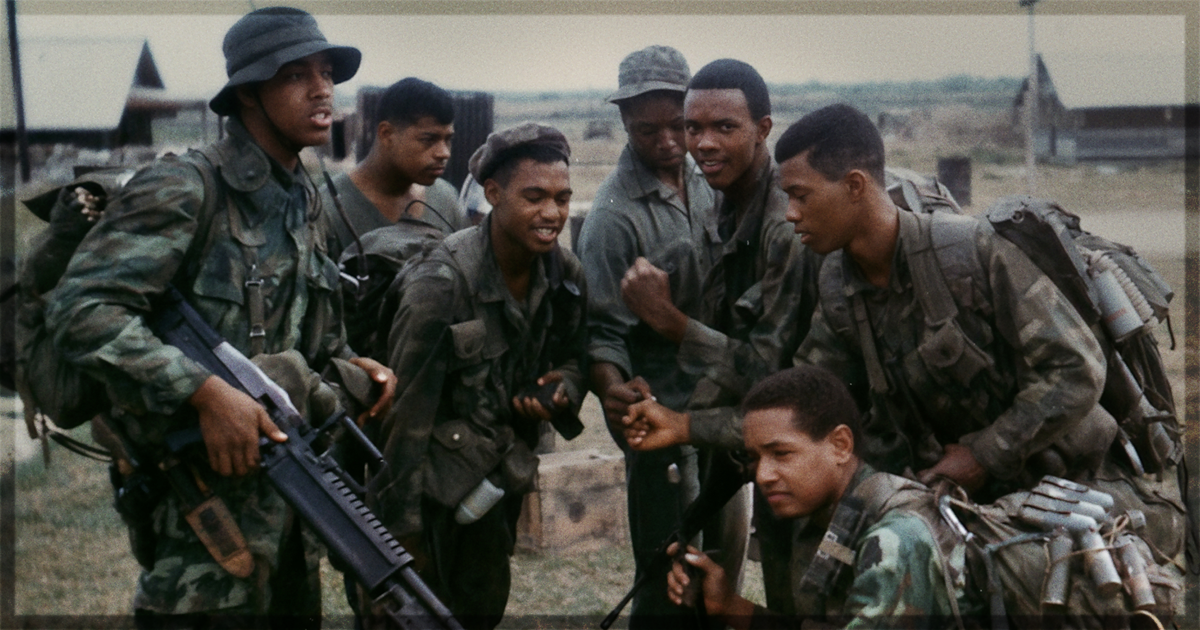
Soul Patrol’s depiction of the Vietnam War combat experiences of a group of young black men is designed to restore their place within the military history of the American war machine, which at the time was still segregated as well as frequently openly racist. A great deal of the footage is actual Super 8 film shot by some of the featured soldiers themselves, who had their cameras with them in country though not out on patrol. Within this framework Soul Patrol is a great success. But despite it winning the directing award for US documentary at this year’s Sundance Film Festival, Soul Patrol does not truly succeed because it utterly fails to examine the bigger picture.
Before we go any further I should mention that my father briefly fought in Vietnam, though in the Navy and towards the very end of the war, and he did not retire from the military until I was an adult. There is also a brief appearance of the military base where I was born, some years after the events depicted here. I obviously cannot speak for any black experience but I do know quite a bit about military ones. This documentary is based on the memoir of the same name by Ed Emanuel, who as a teenage soldier in Vietnam was a LRRP – a long-range reconnaissance patrol officer, or one of a small team of scouts that operated independently behind enemy lines for days at a time. ‘Soul Patrol’ was the nickname for the at-the-time highly unusual all-black teams that Mr. Emanuel belonged to. Director J. M. Harper does a good job of contextualising what 1968 felt like for these young men (the youngest had faked his birth certificate to enlist, and the oldest was not yet 23), and how they each ended up in Vietnam over the objections of a great many other black people. The footage shot by soldiers John Willis, Willie T. Brown and Lawton Mackey Jr. as well as Sylvia Pinckney and Mr. Emanuel adds a valuable layer of insight to their stories and discussions of the mood of the time and the individual choices that led all of them into the army. But this context makes it clear this is only an elegy for these men, some of whom have passed since the reunion at the heart of the film was staged and recorded, instead of a broader reckoning.
How clear is it? One thread of the film involves Mr. Emanuel in a Piggly Wiggly, enacting what is meant to be a PTSD flashback, seeing versions of his young self and his friends prowling the cereal and candy aisles in uniform with their guns and telling their thoughts to the camera. This is a childish way of demonstrating the lifetime impact of going to war. That is not said to minimise the double resentment Mr. Emanuel and his colleagues express because of the double injustice they experienced returning home. Not only was their Vietnam experience dismissed by civilians who deplored the war and those who fought in it, but also by racists who couldn’t imagine that black men served in combat roles. (This might be why the warning about gazing into the abyss is mentioned twice, too.) So this reunion and the discussion of their experiences was valuable closure that, for some of them, was the only therapy they’ve ever had. But dwelling on how every soldier needed to learn for himself that war is hell is exhausting, and the unbreachable gap between the arrogance of young soldiers and the lifetime price veterans pay for that arrogance has been explored many, many times before.
The choice to focus only on this team’s experience of soldiering while black also means there’s no attempt to answer the mystery at the core of their story. The event was so traumatic several of the men express disbelief they remain alive, nearly sixty years after the fact, and at least one says that his soul died that day. It feels unkind to point out that there may well be people who could have answered that question, and that the internet and telephones exist in Vietnam, but the total absence of Vietnamese people in this film is a major surprise. American racism was (and still is) an enemy, but in this case it wasn’t the only one.
The general sanitising of things here is made most obvious in the glancing references to a week’s R&R (rest and relaxation) the soldiers took in Bangkok. My dad usually, but not always, has kept his true war stories from the tender ears of his daughters, but if he was unburdening himself for posterity I wouldn’t expect such modesty to be allowed to pass without comment. But since it was, we must accept Mr. Harper designed Soul Patrol to benefit its participants over its audience. Watching such a well-done therapeutic exercise does indeed have some value. But limiting itself to that purpose prevented Soul Patrol from being a truly great documentary.
Soul Patrol recently played at the Sundance Film Festival.
Learn more about the film at the Sundance site for the title.
You might also like…