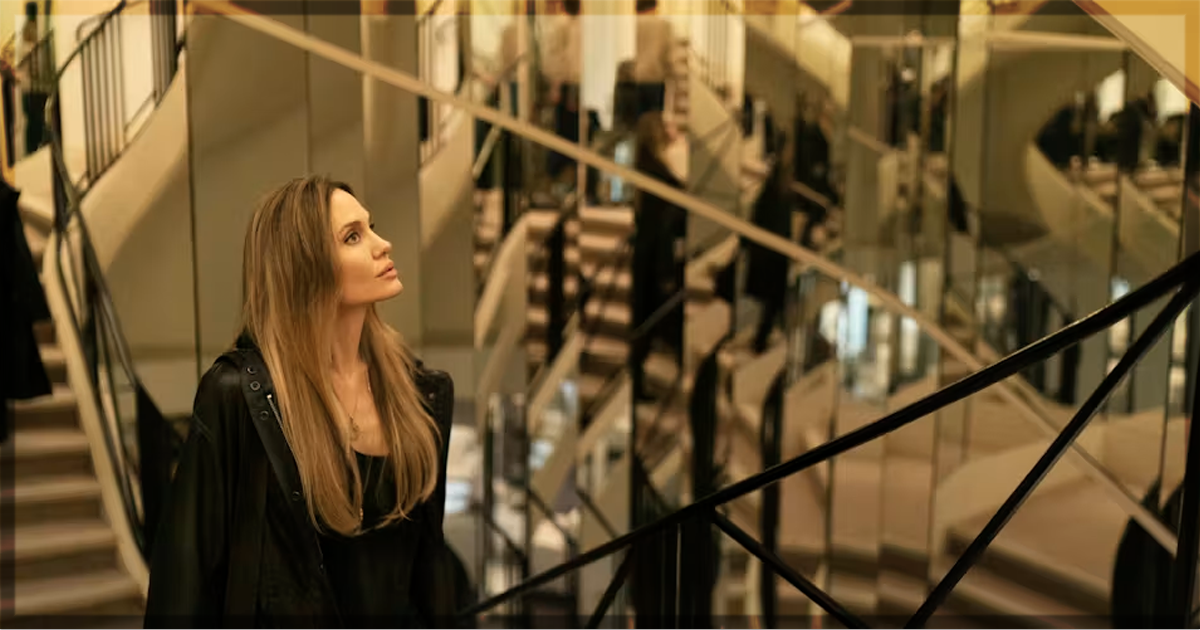
Say what you will about the French, it seems like everyone in that nation possesses savoir-faire. That is to say, they know the correct way to behave in any scenario. Whether it’s supporting a colleague having a bad day, mopping up bodily fluids without making a big deal about it, or being propositioned by Angelina Jolie, the French have a knack for knowing the right thing to do. What is fascinating about Couture is that this savoir-faire applies to the needs of the body without making a fuss about it. An American movie would handle this topic either with disapproval or as a creep, but fortunately Couture is French. Writer-director Alice Winocour keeps the female body the centre of this calm and kind film, and while it doesn’t flawlessly handle its issues, it’s a beautifully thoughtful examination of the body at work.
Maxine Walker (Ms. Jolie) is a film director prepping a low-budget horror film, which she is financing through a job making a Fashion Week promotional film for an unnamed major fashion house, though this is the first fictional film that has ever been allowed to film inside Chanel’s atelier. Maxine speaks pretty good French thanks to a French mother so she moves through this world in two languages. In the atelier and on the set she meets three young workers: Christine (Garance Marillier), the seamstress who has been given the honour of making the first dress for the upcoming show, Angèle (Ella Rumpf), the kind and observant freelance makeup artist who knows everybody’s secrets, and Ada (Anyier Anei), a 18-year-old model from South Sudan who is the fashion house’s ‘new face.’ That means she will wear Christine’s dress and Angèle’s makeup to open the catwalk show, and is also starring in Maxine’s film about the season’s line. But everybody’s got problems: Ada’s father is unaware of her modelling career, which she herself is not so sure she wants, and she doesn’t know how she fits in with the other models. Christine is hand-sewing her dress, including every single sequin, and might not be finished in time. Angèle, who carries a suitcase full of supplies from job to job, is treated with little respect, and while she is writing observations of her career in attempts for publication, people (read: men) don’t believe her stories.
For her own part, Maxine, who is in the middle of a divorce and therefore extra worried about her teenage daughter in Los Angeles, gets some tough medical news that puts her in more contact with Dr. Hansen (Vincent Lindon) than her tight professional schedule allows. Fortunately she has a close working relationship with cinematographer Anton (Louis Garrel, who must surely win some prizes for the deadpan expressions he maintains here), who covers for her with the fashion house, personified by Grégoire Colin as the image director. Anton is the only person who notices something is very wrong with Maxine, but what she is going through is so tough she doesn’t dare open up about it. For one thing, if she did talk about it that would make it real. For another, then she’d have to risk her career and her relationship with her daughter to do something about it. But there is a lovely little moment in a waiting room where another lady, Anne (Aurore Clément) and Maxine, are so kind to each other that it’s clear there’s plenty of hope. Anton’s kindness and decency makes things easier, too.
Writer-director Alice Winocour clearly designed the part of Maxine with Ms. Jolie in mind, as it draws on parts of Ms. Jolie’s life and body that she’s openly discussed, but with a frankness before the camera that’s unusual from such a giant star. But it must be emphasized that this is a story about the body. The fashion house makes money from the body’s need for pretty dresses, but the body also needs care and attention in a thousand other ways. Angèle knows how to use makeup to cover blisters, carries tampons in case of emergency, and has a gift for self-effacing listening that makes her everybody’s confidant. As Ada prepares for her first catwalk show, other models pile into the hotel hallway to demonstrate how they walk – it’s nowhere near as easy as you might think – and offer her thoughtful tips. (Miss Anei is a rising model herself, also raised in Kenya by a South Sudanese family.) And of course if Christine isn’t clever with her needle, everyone else’s hard work will come to nothing. The amount of work needed for all this is brilliantly apparent, it is so unusual to see work centered on the human body, and it is more unusual still for the nude human body to be shown on screen without being sexualised.
But then again, this is a French film, which means it has been made with savoir-faire. André Chemetoff’s handheld camerawork gets very close to everyone without ever feeling inappropriate, and the editing by Julien Lacheray and Lilian Corbeille makes us feel included in all the action. At one fitting the seamstresses realise Christine’s dress doesn’t perfectly fit Ada’s body which means the measurements must be corrected, through tears of frustration, before anything else. The workers come from all over the world, are generally thrilled they’re lucky enough to be here, and are mostly friendly with each other. Pascaline Chavanne also must have had a wonderful time with the costumes, which range from the highest of high fashion to the most casual grunge without ever making the fashion an inappropriate center of attention. The casual attitude to nudity in the fashion workplace – the more experienced models barely care if they have clothes on or not – has an interesting counterpoint in the nudity in the hospital, where the medical professionals must consider the requirements of Maxine’s body. Ms. Jolie has never exactly been coy onscreen, but the way she uses her body here is a very deliberate choice. There is also a distinct contrast between when Maxine is inhabiting her body at work or in the hospital as a patient, and when she is using her body for sexual pleasure for and with someone else. There’s also footage of Maxine in the shops and walking down the street, which you can hardly imagine Ms Jolie being able to do in real life.
Couture is not perfect: the pacing isn’t great and we don’t see enough of the seamstresses in the atelier. The fact the only villain is the time pressure of the fashion show means there’s an odd falsity here, which is also weirdly unrealistic – panicky work deadlines are real and the stresses around them are genuine, so we could have seen a little more of how everyone copes with that. But these are quibbles, and it’s lovely to have a movie where everyone more or less wants good things for each other and is broadly working to the same goal. It’s also worth reflecting that it is almost impossible to imagine a male movie director being this respectful of the workers and the bodies at the core of this story. But fortunately Couture exists to make us feel happy and for the body to look beautiful, and on that front it is a complete success.
One final thing: in 2016 Ms. Rumpf and Ms. Marillier starred as sisters in Julia Ducournau’s horror film Raw, which has another distinctly unusual attitude to the human body, and if you haven’t seen that already it’s strongly recommended.
Couture recently played at the Glasgow Film Festival.
Learn more about the film at the GFF site for the title.
You might also like…
‘Nuisance Bear’ Film Review – Prizewinner Deserves its Crown