Usually, the cinema portrays tragedies that occur as incidents or natural disasters, if we call them that. The seasonal ones do not get representation on the big screen. Some regions are more susceptible to tornadoes, natural fires, and earthquakes. They are due to the geographical and geological compositions of those regions. In Max Walker-Silverman‘s sophomore feature, Rebuilding, the director continues to narrate the story of modern nomads in rural America. Opposite to his debut, Love Song, his wanderers are citizens who lost their ranches in the most severe burning in the region’s history. As a dialogue states, the soil got so burnt that it will take eight years to become fertile again. Tthe lead character must decide to stay there or move to Montana, where he may help a cousin with the cattle.
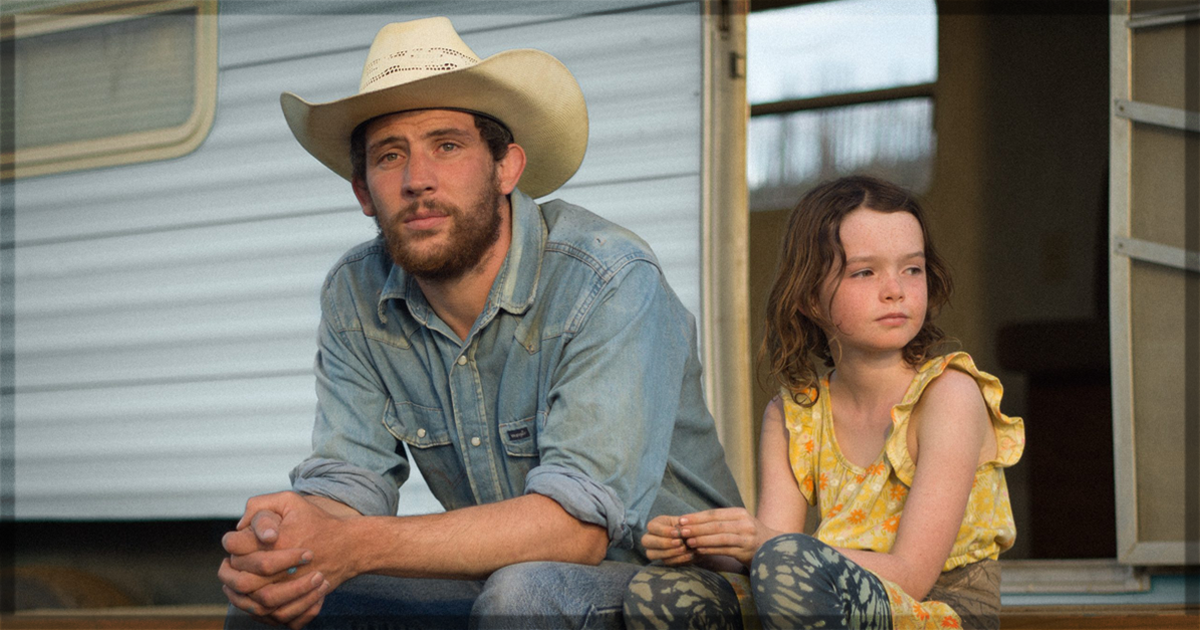
In this sense, in the new Americana tale by the young filmmaker, we follow the opposite of the American dream: the American nightmare. Farmers and cowboys who lost everything: land, animals, homes, and memories. Now, they live in a FEMA (Federal Emergency Management Agency) trailer camp, on land borrowed by the local government. The film narrates the story of Thomas “Dusty” Jr. (Josh O’Connor), a young cowboy who lost everything in the burnings. He has a daughter, Callie Rose (Lily LaTorre), a young child who lives with her mother, Ruby (Meghann Fahy), and grandmother Bess (Amy Madigan). Hence, the film is the aftermath of the tragedy, the reconstruction of Dusty’s life after the worst thing to happen to him. Yet, he is attempting to have Callie Rose around him, even though he lives in a small trailer in a camp, alongside people he affirms are not his real neighbours.
Furthermore, in his new feature, Walker-Silverman maintains his look at the people living in trailers, similar to the already mentioned Love Song. In his first feature, his characters are nomads. They move from place to place, with no attachment to a specific location. Yet, drawing on his personal background, the director, who grew up in rural Colorado, paints a picture of a modern displacement of the American West. It is the tale of the cowboy without a farm, and the landmen without land. Promptly, in the subtext, the young director glimpses the government’s lack of support for those in need of housing. FEMA only assigns a pale-painted trailer in a distant park, whereas they also get an offer to work as traffic managers in the meantime. All of those solutions are temporary; none of them solve the problems of the unleashed fires that have burned more than properties; they have melted memories, perspectives, the past, and the future. Dusty only has a confusing present, unsure where to head.
In this sense, the film is not a narrative-heavy project; most of the plot follows Dusty’s attempt to balance his uncertainty about his future with his desire to be a proper father. In an underdeveloped subplot, Thomas and Ruby respect each other. They grew together, he mentions their first date was when they were twelve years old. Yet, Ruby is predominantly the ex-wife, despite her scenes of involvement in Dusty’s and Callie Rose’s approximation. Although she is an effective actor in the scene, Fahy has little to work with. Consequently, Rebuilding is about Dusty and the reconstruction of his farm and his life as an individual. Inherently, there are blurred lines between the ranch and his personality; he cannot define himself without the farm.
There is too much lost in the fires, aside from the material destruction: photos, moments, and evidence of life. He questions in a conversation: Will I ever remember that? Only time tells, surely. This profoundly existential character works well through the range of a great actor. Josh O’Connor justifies why he is one of the best actors in his generation. Rebuilding is his fourth film in 2025, but he is playing a character completely different from his previous roles. The British performer is a cowboy father from the American West, even though his pale skin denounces the lack of sunburn from the harvests in him. Still, it is impressive how O’Connor chooses small and big projects in his career, balancing the projects he dedicates himself to.
In the scenes featuring the golden-hour flares in Alfonso Herrera Salcedo’s cinematography, Max Walker-Silverman captures the balance between the natural destruction and the human reaction to it. Despite a shallow development in parts, Josh O’Connor justifies why he is one of this generation’s greatest actors.
Rebuilding is now playing in limited theaters.
Learn more about the film, including how to watch, at the Bleecker Street site for the title.
You might also like…