
The greatest glory of Pillion is that its sexual boldness is in service to an important point about self-determination and personal desire. We can watch this for the action, the message, or both. Though don’t get your hopes up too high: not a great deal of ‘action’ is shown, although the implications were plenty shocking to the London Film Festival audience, though anyone who’s been in a gay club or hung out with middle-aged swingers has seen it all before. The final joy of Pillion is that it is very specifically set in a dull suburban part of southeast London (not far from where I live!) in order to emphasize that this is a very ordinary story. But the way it comes together is fairly extraordinary.
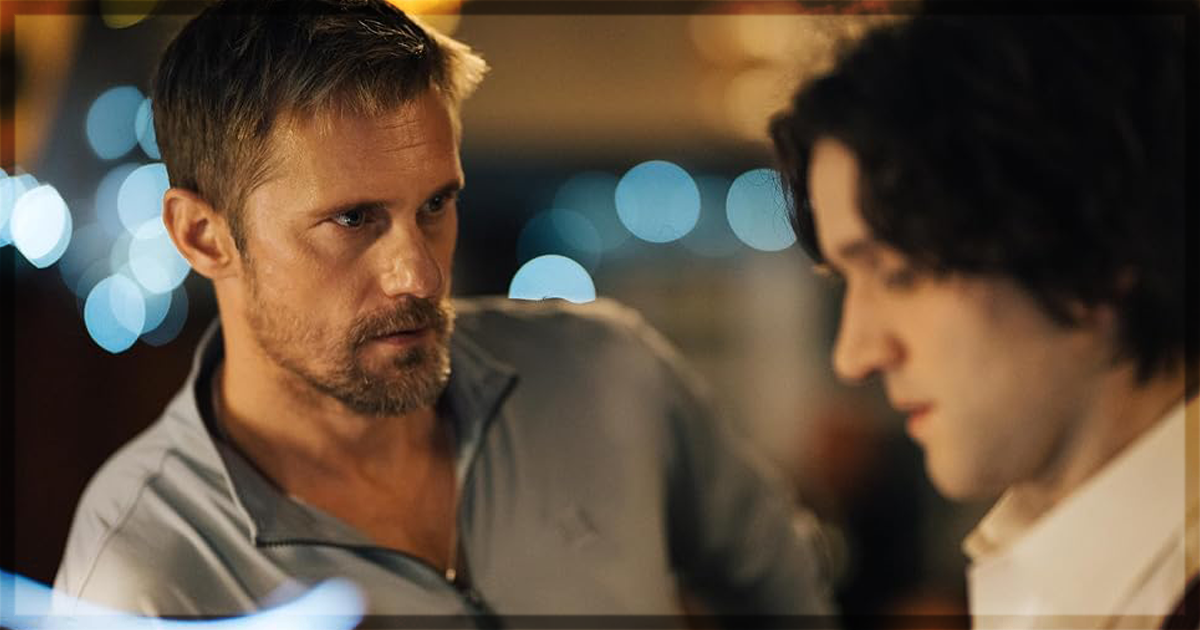
Colin (Harry Melling in a very brave performance) works as a parking officer and spends his days getting screamed at by shoppers unhappy at getting parking tickets. He still lives at home with his suffocatingly supportive and nice parents Peggy (Lesley Sharp) and Pete (Douglas Hodge), and is such a dweeb he is in a barbershop quartet with his dad. They do a performance in their local pub every Christmas Eve, which is where Colin comes under the eye of Ray (Alexander Skarsgård having a wonderful time), a biker Colin has noticed around. Ray leaves a note inviting Colin for a date on Christmas afternoon and the family is so thrilled about this, even though Peggy is visibly unwell, that there’s no question that he’ll go. The date ends up being a sexual encounter in the little alley between the Gail’s and the Pret a Manger on Bromley high street, where the market traders keep their trolleys. This is not necessarily the most solid start to a fulfilling relationship but it’s obviously the best thing that’s happened to Colin in a long time. But what ends up developing between Colin and Ray is solely on Ray’s terms.
It’s completely consensual, so it’s not really anybody’s business that Ray is the dom and Colin the sub, who wears a lock and chain around his neck and sleeps on the floor like a dog. And the thing is that Colin and Ray like each other – though they’re not especially demonstrative, especially after Colin’s attempt at giving Ray a box of chocolates on their second ‘date’ somewhat backfires – so this dynamic suits them very well. The shock most people express at learning the handsome Ray is Colin’s boyfriend does a lot of the work here too. Ray is part of a group of bikers who are also in the lifestyle, and the chat Colin has with another sub, Kevin (Jake Shears, better known as the lead singer of Scissor Sisters), starts him thinking about his own boundaries and preferences. When Ray lounges around his apartment in slutty little glasses reading Karl Ove Knausgård as Colin walks Ray’s dog and does all the housework, there’s also a case to be made that a lot of ordinary relationships are like this, just not officially. The fact this dynamic is between two men seems to have inspired a lot of the early audiences into fainting fits at the number of bare backsides and sexual implications on display. But if Colin was Colleen (or Anastasia Steele, perhaps), the only differences are that the lock and chain would probably be shaped like a diamond engagement ring, and more of the sex would happen indoors.
Director Harry Lighton, who adapted the script from a novel by Adam Mars-Jones and won the Best Screenplay prize at the Cannes Film Festival for it, clearly wanted to have a lot of fun making pointed points about interpersonal dynamics. The scene where Ray meets Pete and Peggy, who confronts him about his treatment of Colin (despite Colin’s protests), ends up with insults thrown on all sides, as Peggy doesn’t think Ray treats her little boy very well, and Ray thinks Peggy is old-fashioned and judgemental. The trouble is of course is that the job of an adult is to be judgemental, making it very easy to look at a relationship set-up and think “that could never work for me.” But as every adult knows, life never stands still and relationships change all the time. The burning question within every relationship always is whether it will be able to stay the same as you change as well.
Mr. Melling’s willingness to look foolish here really is quite bold, and underpins a subtle performance showing how the dweeb turns into a mensch. Mr. Skarsgård has the easier time as his physicality, as it often does, does most of his work for him, but he manages to take a role that’s withholding by definition and still demonstrate Ray’s true depths of feeling. Nick Morris’s cinematography makes the dull English weather a frame around the sexual antics, and all of it is an awful lot funnier than these descriptions sound. And it’s all so grounded in its specific setting that, when Peggy asks about Ray’s accent, he informs her it’s from Chislehurst, an equally dull southeast London suburb but one that’s much posher than Bromley. This is the kind of devastating comment it takes a certain knowledge of English culture to fully appreciate, and it might be that it takes a certain knowledge of queer culture to fully appreciate Pillion. But even if you can’t find London itself on a map, you’ll almost certainly find Pillion one hell of a ride.
One final thing: another very good movie set in Bromley is 2019’s Days of the Bagnold Summer, a howlingly funny story of the relationship between a sullen teenage metalhead and his single mother. It came out during lockdown so never quite found its audience, but it’s recommended, and not just for the contrast in the scenes which also take place in Bromley’s mall and on the high street.
Pillion is now in theaters. It recently played at the London Film Festival.
Learn more about the film at the IMDB site for the title.
You might also like…

‘The Secret Agent’ Film Review