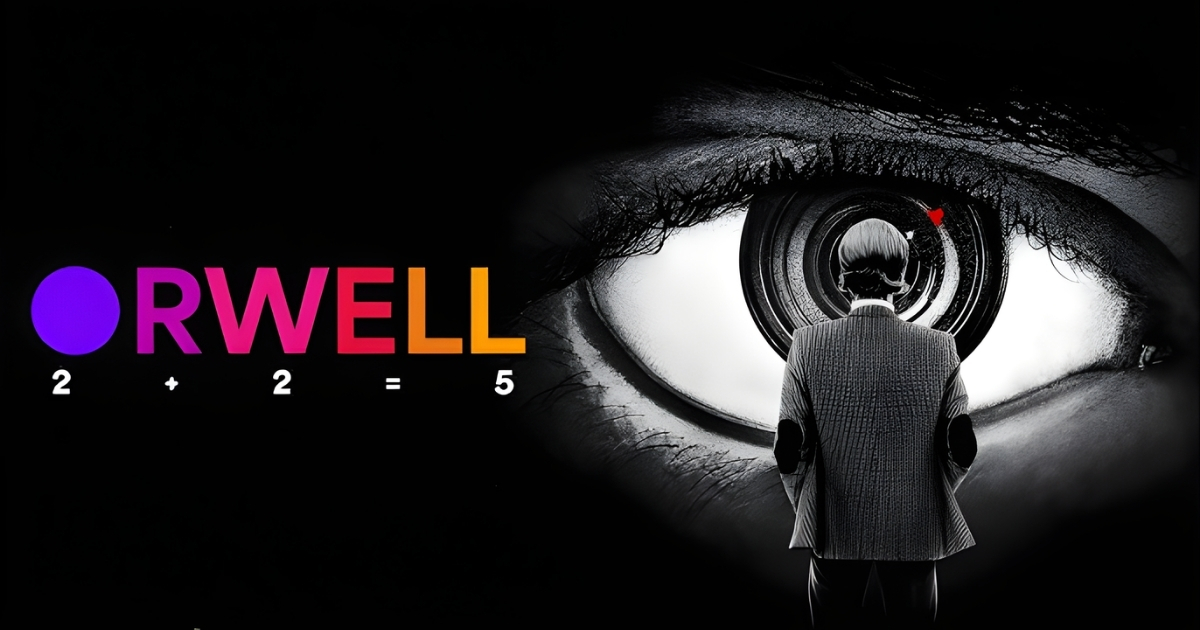
Few documentary filmmakers analyze the political landscape as well as Raoul Peck. Born in a country historically attached to Colonialism and imperialism, the Haitian filmmaker has a broad range of work, from narrating the transatlantic slavery trade and its impact on structural racism to the assassination of Patrice Lumumba. In recent years, the director studied the deep roots of racism in the American South, as seen on Silver Dollar Road, and the colonial ownership of anti-racist art in Ernest Cole: Lost and Found. Yet, Peck finally releases his long-awaited Orwell 2+2 = 5, a hyped project in the documentary community for the last few years. In collaboration with Alex Gibney, another titan of nonfiction, the Haitian master rescues Orwell’s final Diary entries to analyze the rise of authoritarianism worldwide over the past 80 years since his death.
The filmmaker behind I’m Not Your Negro designs an archival political documentary, combining the British author’s diary, the adaptations of his books on cinema and TV, and a compilation of political interviews. It includes press conferences, statements, and even generative artificial intelligence to illustrate sequences. In a sense, the film is a cut of the dangerous statements within political decision-making. Peck juxtaposes the bombings of Berlin at the end of World War II with the Russian invasion in Mauripol, creating a visual rhyme between the events that defined the last century with a crucial conflict of our times. Hence, there is an understanding of George Orwell’s political thinking and his thesis that has not changed in the decades since the publication of his ideas. The British author died in 1950, having crystallized Marxist ideas in his speech and criticizing communism and fascism in equal measure. Yet, his critiques apply to the resurgence of the digital neo-fascism, a result of the post-truth era, and even the 1980s neo-liberal policies, spread by figures like Ronald Reagan and Margaret Thatcher. Thus, even with the separation of time, his reflections may be subject to the materiality of our times, exposing an unchanged political environment on a grander scale.
However, the central theme of the documentary’s holistic structure is the ideas present in Nineteen Eighty-Four (1984), his last work and arguably his magnum opus, particularly in legacy. The same book that provides terms like “Big Brother”, which ironically becomes a franchise of reality TV shows decades later, is the thread that conducts the debate about surveillance and authoritarian policies. Consequently, the film unveils itself through a maximalist approach, in which each word, sentence, and statement becomes a visual statement. In an unjust comparison, we could approximate it to Soundtrack to a Coup d’Etat by Johan Grimonpez, a more robust and developed political thesis about the colonial effort in Africa. The editing by Alexandra Strauss opts for the visual and sonic exuberance, an overwhelming quantity of information to illustrate situations. The film inserts reasonably recent events, such as Elon Musk’s salute and other statements by the second term of Donald Trump in the American presidency.
Furthermore, despite the fascinating discussion of relevant political dichotomies, such as the rise of neo-fascism, predominantly spread through digital media, and the unethical role of media conglomerates in society. Yet the film feels redundant and even prevents it from engaging with the political spectrum. There is a cohesive idea behind George Orwell’s worries about the future of political ideologies and his central idea of government’s distress and control over its citizens. However, the film lacks the same level of commentary present in Peck’s earlier works, such as Ernest Cole: Lost and Found, which is supposedly an art documentary before an analysis of the impact of Apartheid on the artist’s life. There is an evident surface-level discourse on the rise of authoritarianism in the current world; nonetheless, it lacks a more profound stretching of its ideas beyond GenAI imagery of Donald Trump. Despite the accuracy in linking the American president to the hottest tool in financial offices right now, the film has too much information in scenes like this one. Nevertheless, it is obviously a work about the world leaning towards the ideas that ruined the world a century ago. But it circles back to excessive visions in the editing room.
The long-awaited documentary about George Orwell from Raoul Peck unveils how little the world has changed since 1950, when the British legend passed away. Yet it is redundant work in the filmography of a titan of documentary filmmakers, who has discussed the same topics more efficiently in the past.
Orwell 2 + 2 = 5 has recently played at a number of international film festivals, including the Toronto International Film Festival.
Learn more about the film on the official page for the title.
You might also like…