
A clip has recently done the rounds of British social media of a well-known pundit asking a woman who she plans to vote for in an upcoming election. The woman says she doesn’t know, but she certainly won’t be voting for a particular candidate who she recently saw leaving a café with their entourage without closing the door. The woman was trying to make the point that this lack of consideration, especially when the candidate knows they are under the surveillance of the campaign trail, doesn’t speak well for their concern for others and therefore their ability to serve their community. But she was unable to because the pundit laughed in her face. It is quite a thing to see a woman say “Actions speak louder than words” as a man shows naked contempt for her feelings. Everyone reacts to different situations in different ways, but people don’t generally forget how they are made to feel about them, and only a fool would expect those feelings to be ignored. Midwinter Break is a virtual two-hander about a longstanding marriage at breaking point because their different feelings have been ignored for too long. There is frustration and contempt between them where love and understanding ought to be, and the question is whether they can, or should, find their way back to each other. On small moments major decisions are made, and it’s wonderful to see a movie who knows how to give these moments their due.
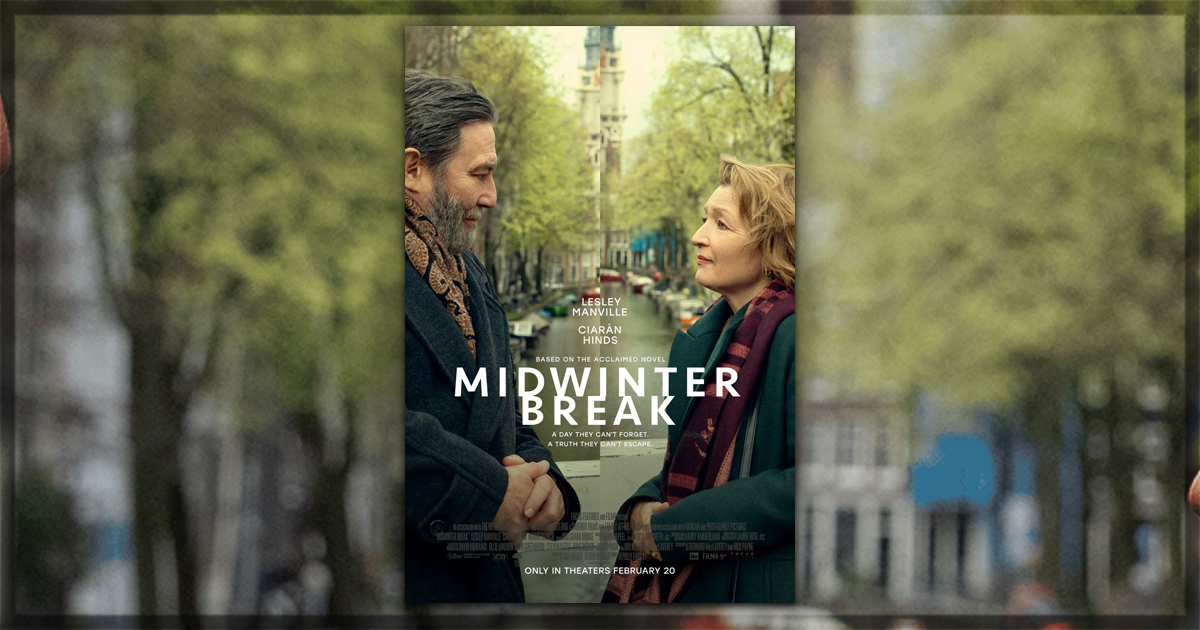
The dates are fuzzy but this is probably set in the 2010s. Stella (Lesley Manville) and Gerry (Ciarán Hinds) are a retired couple, originally from Derry, who have lived in Glasgow for decades. Gerry thinks of it as home, but Stella doesn’t. Their son, a father himself, is grown up and gone, and they have run out of things to say to each other. Stella is so religious she prays every night before bed, and Gerry is such a drinker he thinks he can constantly sneak whiskies without Stella noticing. As a Christmas surprise, Stella books them a few days in Amsterdam, because a change of location might make it easier for them to change how they talk with each other. As they eat the lovely hotel breakfast and potter around the tourist locations in the city – including inside the Rijksmuseum, and an extended tour of Anne Frank’s house – it becomes clear both of them are still badly affected from an incident that happened very early in their marriage. And on this trip, maybe for the first time, they do talk about their feelings. Just not to each other.
The novel by Bernard MacLaverty, who co-wrote the script with Nick Payne, moves steadily between Gerry and Stella’s thoughts, but the movie focuses on Stella. Director Polly Findlay, who makes her movie debut here after establishing herself in British theatre, is very good at capturing the vivid little moments between them that most of our lives are built on. Someone slips in the bath and is shaken up, and their spouse helps but laughs while they do it. In crossing the street one holds out a hand, but the other ignores it. Someone gets caught up in a shirt while getting undressed and help must be asked for before it is offered. Gerry interrupts Stella while she is praying with a foolish question and gets annoyed she waits until she is finished to answer. Stella is deeply upset about Gerry’s constant drinking but doesn’t know how to address it with him without becoming a nag. As all the little moments between them pile up together, you can feel the question Stella can’t stop asking herself: is this all there is?
The answer is of course it is: little moments are indeed all we have. Life is so frustrating, and painful, and complicated the kindnesses stand out. Cinematographer Laurie Rose maximised the location shooting to emphasise doorways and hallways, framing Stella and Gerry as they move between one place to the next in ways that make their thoughts perfectly clear. Hannah Peel’s orchestral score provides a sense of hopeful melancholy, one which seemingly aligns with Gerry’s own taste in music. Mr. Hinds is terrific here as a man whose life has somehow gotten away from him, and who doesn’t understand that constantly verbalising his frustrations to his wife does nothing but make them her problem. For her part Ms. Manville is wonderful as a woman who has internalised her own upset and anxiety, who hates that the world doesn’t value her devotion, and who doesn’t think that asking for what she needs will get it for her. Both of them are unhappy with how things have worked out, both of them are alone in their unhappiness, and neither of them know what to do about it.
The big finale takes place on a bank of seats at the airport during a flight delay. On the surface that’s perhaps not the most dramatic location for a reckoning of one marriage and two lives, but that underestimates the drama in even the most ordinary life. Midwinter Break is extraordinary in its ordinariness. Gerry and Stella have gone through the unthinkable, but this doesn’t make them special. It just makes them human, and being human means they should be kind to each other. Hopefully this will be a lesson learned before it’s too late. You never know what moment will turn out to be the one that makes your mind up for you. It could be as large as a snowstorm or as small as an unclosed door. This gentle, knowing thoughtfulness makes Midwinter Break a movie not to be missed.
Midwinter Break is now in theaters.
Learn more about the film at the Glasgow website for the title.
You might also like…