
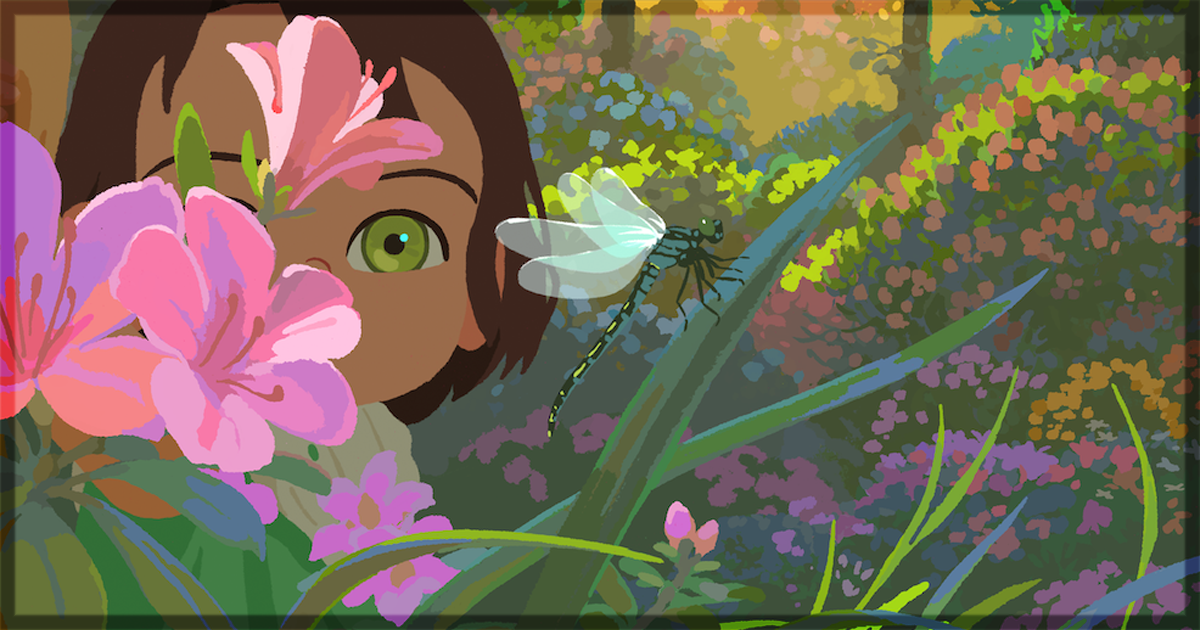
Children under age seven, in Japanese culture, are considered “of the gods,” which means they have the purest connection with the divine, until they inevitably transition into the mortal realm, taking their first few steps into adulthood. Such is the case for the titular protagonist of Little Amélie or the Character of Rain, Maïlys Vallade and Liane-Cho Han’s animated adaptation of the autobiographical novel by the Belgian writer Amélie Nothomb, which tells the story of a French-speaking girl born to Belgian parents but living idly in the Japanese countryside at the tail end of the 1960s.
The youngest in a family of three children, the precocious heroine (whose inner monologue is voiced by Loïse Charpentier) is practically a vegetable, struggling with her motor and language skills, so much so that her parents, Patrick and Danièle (Marc Arnaud and Laetitia Coryn, respectively) are advised by a doctor to keep her in some sort of a safety bubble. A small earthquake one morning in August 1969 somehow helps with Amélie’s condition, only for her to grow frustrated and peevish since, thinking that her body, which her inner self initially reckons as celestial, is more likely a prison. That feeling tersely shifts when her paternal grandmother, Claude (Cathy Cerde), comes to visit the disheveled household and decides to give Amélie a taste of some Belgian white chocolate, during which she levitates and turns into a joyous source of life and energy akin to the feeling of becoming aware of the world around you for the very first time. The movie, in its brief yet marvelous 78-minute runtime, is curious and elemental this way, allowing us to wonder and wander, as its wide-eyed bildungsroman and, by extension, its 2D animation unfold with so much warmth and whimsy.
Amélie’s magpie curiosity is particularly triggered by the arrival of their new housekeeper, Nishio-san (Victoria Grosbois), who just happens to speak French so fluently. Nishio-san gets hired through the suggestion of the enigmatic landlady, Kashima-san (Yumi Fujimori), who keeps her distance from her foreign tenants, and encourages the former to do the same. Yet, Nishio-san can’t help but entertain all of Amélie’s hows and whys: Together they cook, talk about monster tales, imagine ugly carps as men, watch a lantern show by the river, and bask in the gentle rain. And as the little girl grows more attached to her nanny, she discovers in equal measure the beauty and horror life has to offer, and why things aren’t exactly what they seem. Both characters live vicariously through each other: Nishio-san absorbs Amélie’s optimism as she wrestles with the trauma of losing her entire family to the war; Amélie leans on Nishio-san’s grief as she later contends with the shape of her own, following a painful tragedy and upon learning that her family has to leave the country for good.
By heightening this relationship at the movie’s center, Little Amélie not just evokes the reparative power of genuine human connection, it also demonstrates the complex corners of intergenerational and cross-cultural relationships, though the latter commentary doesn’t totally hold water, in that a crucial character here is left underwritten, the Japanese landlord in particular. As much as the screenplay — which is credited to both directors, alongside Aude Py and Eddine Noël — paints Kashima-san as an image of post-war Japan to deepen the narrative’s emotional terrain, it doesn’t necessarily afford the character with any real sense of history; her trauma and pain is mostly implied rather than fleshed-out.
What makes the film undeniably irresistible, though, is how tactile its images are, vividly locating us into the gaze and consciousness of its heroine, moving between dream and waking reality. The way it captures fleeting, quotidian moments through soft, vibrant visual strokes are as impressionistic as a Monet painting. It’s a welcome assault on the senses, one that is softened and made more bubbly by its overall aesthetic.
Little Amélie or the Character of Rain is now available at to purchase or rent at your retailer of choice.
Learn more about the film at the official website for the title.
You might also like…
‘The SpongeBob Movie: Search for SquarePants’ Review: Slight But Humorous and Heartfelt