Latoya Austin sat down with director Suzannah Mirghani over a Zoom call to discuss her feature debut Cotton Queen, and its underlying themes, following a successful festival run. The film had its world premiere at the 82nd Venice International Film Festival’s Critics Week and has been the recipient of several awards such as Best Film at the Thessaloniki International Film Festival. Recently, Cotton Queen was awarded the TV5 Monde Prize first Best Work at the 36th Carthage Film Festival.
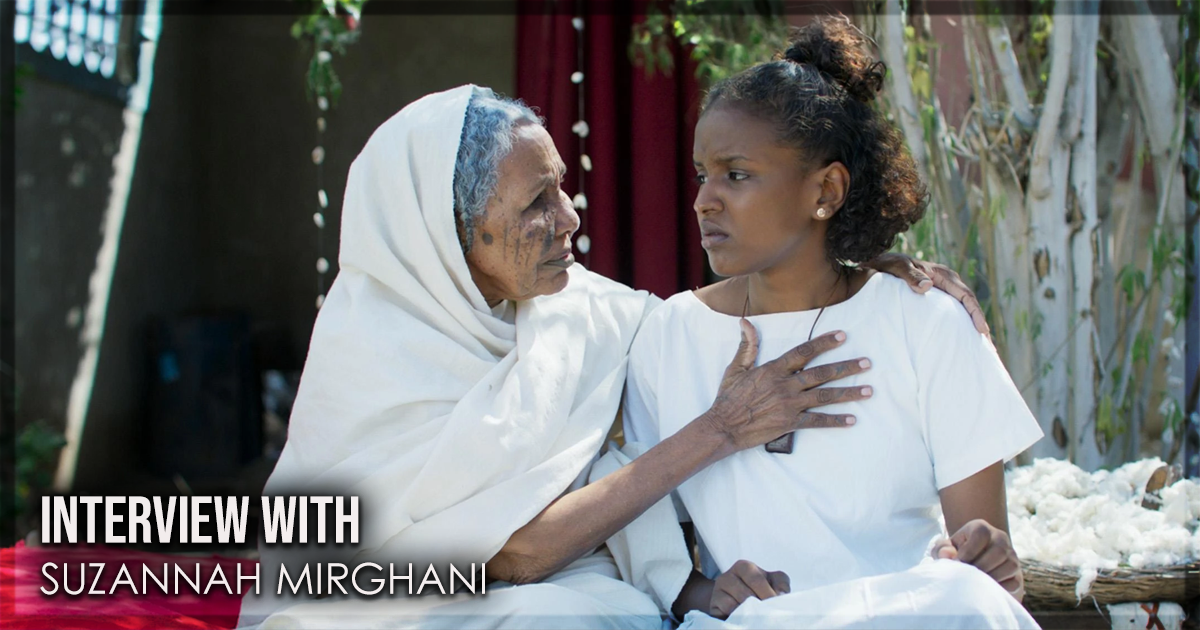
Cotton Queen is set in a cotton farming village in Sudan following the commencement of the war. The film has a teenage girl, Nafisa, at its centre attempting to navigate societal expectations and the threat of modern day modifications to the village’s cotton productions with the omnipresent political, environmental and economic impact. It is an impressive and insightful depiction of the Sudanese way of life within a village, based on Suzannah Mirghani’s award winning short film, Al-Sit, with an intimate, layered portrayal from the cast amongst captivating cinematography of the surrounding landscape.
There is the sense of being permitted to observe a society that remains very private as Cotton Queen provides insights in to the village’s structure for decision making. The film goes beyond merely being a coming of age tale in providing this rich Sudanese perspective which is compelling to watch from start to finish. Cotton Queen is rounded off by a tour de force performance by Mihad Murtada in the lead role of Nafisa, whose fate is not determined by herself but she ultimately learns to find her voice in unexpected ways.
The Interview with Suzannah Mirghani on Cotton Queen
Latoya Austin: Congratulations on your film at the Doha Film Festival, which won the Audience Award. First of all, I was keen to know why the title, Cotton Queen, was chosen as this was based on your short which had a different title?
Suzannah Mirghani: Al-Sit was the short proof of concept that I made way back in 2020 and I always had this long term, five year plan, to make the feature. The themes morphed a little bit – going back into the British colonial history of cotton – for the cotton industry in Sudan. When I was doing my research, I came across this footnote that I latched on to. It was something to do with the annual Cotton Queen beauty competition, and that was it. I grew up in Sudan and I grew up in London as well but I had never heard of the Cotton Queen competition! I started digging deeper and found out that it was something that started in the cotton mills of Northern England in Yorkshire and Manchester, wherever the cotton weaving mills are. It was an annual competition that started around 1930, I believe. It was a way to promote the fabric, to promote this horrible colonial, violent industry, by putting a pretty young girl as the ambassador. I just thought – there is my title. That is one of the themes of my films – I just could not let it go!
It was such a rich and powerful title. I wanted to reclaim the title Cotton Queen to take it away from its context of beauty and looking at that one sided version of a young girl and turn it into real power. What does an actual Cotton Queen mean when she has power beyond beauty and beyond this very patriarchal setting? Looking at some of the photographs from the 1930s, it’s actually quite horrific to see a pretty young girl standing in the sea of men.
Latoya Austin: Exactly.
Suzannah Mirghani: It was a ready made title for me once I found out about the competition. The title works well in Arabic too – the Cotton Queen competition was exported to Sudan due to colonialism! A young Sudanese girl would win and then be flown out to London to parade in cotton fabrics! The history is very rich and needs to be explored more.
Latoya Austin: That is extremely powerful and thought provoking. In relation to that, what was the casting process?
Suzannah Mirghani: Because I had shot my short in 2020, I had cast a lot of the actors then. Nafisa the protagonist, played by Mihad Murtada, was a first time actor and had never been to an audition before. There is no film industry in Sudan, which means you don’t have a pool of actors that you can readily draw from. You always have to look for people and beg them to act. For young girls in Sudan – acting is not a future. Families wouldn’t want their daughter to go into that field, because it’s not seen as a respectable occupation with a future. I was lucky to have met Mihad, and she was brought in by her father, which was really fantastic.
The older actors, like the grandmother, she’s a very well known theatre actor (Rabha Mohamed Mahmoud) in Sudan and was recommended. The other actors were all through auditioning as well. But the father character, Bilal, he’s a retired man living in Germany and it’s his first time. I was seeking a man of his characteristics and a friend recommended him. I’m glad it all worked out in the end!
Latoya Austin: That sounds really good that people as a community are becoming involved in that process to recommend others. Regarding the actual village surroundings, how important was it to have that as a focal point in the story?
Suzannah Mirghani: The village setting, of course, is hugely important, and especially the home, like the Sudanese home, is the heart of the story. When we shot the short in 2020, I wanted to go back to that location. We had already done our location scouting – we found the fields, we made connections with the farmers, we found the house location, which was, luckily, the grandfather’s house of our costume designer. We barely had to make any adjustments to the home itself.
In the meantime, between 2020 and 2024 when we started shooting Cotton Queen, the war broke out in Sudan in 2023. That put paid to all of our plans, and we had to find alternatives. We had to find an alternative Sudan, basically.
Latoya Austin: The film is shot in Egypt, isn’t it?
Suzannah Mirghani: Yes, set in Sudan, but filmed in Egypt. We followed the actors, most of them had fled the war to Egypt and are living there. Everyone is displaced, but most are living as refugees, as opposed to having a real lifeline or work or educational connection to the country. We built the home based on the specifications of the home that we were supposed to use in Sudan. Every Sudanese person that worked on this film, worked with a broken heart because of the situation that they were in, but we were working towards a common purpose, which was to rebuild Sudan, which re-energised us. We had a really great Sudanese community on set!
Latoya Austin: That sounds like a very inspiring and ambitious project.
Why was it important in the film to show that joy amongst the cotton fields that hold such a painful past for many?
Suzannah Mirghani: Even though the cotton industry itself, does have that very dark colonial, violent history that underscores the entire film, the Sudanese community’s relationship to the land and to cotton itself is very intimate, very joyous. Cotton is something that every Sudanese home uses. Old women will weave cotton into thread to make all the household items and beddings etc. There’s a very different relationship for cotton farmers and people living in this as despite being a fictional village, it is, of course, based on some kind of reality. Their relationship to cotton is therefore very different from the colonial history.
I wanted to show that connection between the community and the cotton and that adolescent period in a girl’s life which is full of love and poetry and carefree. Nafisa doesn’t have to think of all of these violences, until she is confronted by them.
Latoya Austin: It’s all really beautifully shot, showing that childhood dream and the coming of age aspects. With the cinematography and the choice to make a lot of that filming so colourful, was that a deliberate choice?
Suzannah Mirghani: That was very deliberate as you can colour a film in many, many different ways. I worked with Frida Marzouk, who is a French Tunisian cinematographer, and her eye is just exquisite. She is a master of handheld camera, so there was a lot of flowing movements in the camera. It’s like poetry following the girls and she brings a lot of natural light into the film. Everything shot during the day is very natural, very bright, giving you a sense of that joyful, natural living. At night, things get less less natural with the lighting, and then there are the magical realism elements.
Latoya Austin: Cotton Queen does really imbue that sense of poetry and magical quality throughout it with the sunlight and type of haziness surrounding the girls within the field. There’s very much that sense of the nature and the earth, and Nafisa herself is very much concerned about the environment. What were you hoping would be takeaway messages in terms of that relationship with the environment?
Suzannah Mirghani: I want people to share my incredulity at learning that Sudan has been flooded with genetically modified seeds since 2012! Sudanese cotton, which was a prized possession in the world, is being replaced by very extractive and scientifically generated in a lab cotton. This is hard to swallow – I wanted to show how this introduction happened and on what terms. Of course, it’s fictionalised but there’s that clash between the natural and the neo-colonial, neo-liberal world entering this little untouched village. It is colonialism in another form, in another mask, as we get to see what happens to a community that falls apart immediately after having now to rely on a foreign power – again, a foreign source. Of course, everyone has to wake up – I want people to see that reality.
Latoya Austin: Do you think that the film has been watched, maybe by various industry bodies, and will then make them realise that there is that huge impact?
Suzannah Mirghani: If film had that power, I would be very grateful!
I think it has more of an impact on people, and on communities, rather than on corporations. I don’t think corporations really care what you say or the little films you make. But, if people get together, that is a much more powerful way of addressing it. This is happening all over Africa and all over the world – it’s not just Sudan. People in those communities and agricultural communities are really reliant on this new mode of seeds – genetically modified seeds – it’s very difficult to put the genie back in the bottle. This film is therefore a document of its time!
Latoya Austin: Whilst it’s not a documentary per se, Cotton Queen will highlight that moment in time where you have had these modern interventions that actually are quite harmful to a lot of the indigenous communities effectively.
The film highlights quite a lot of the Sudanese myths and history and narrative and I know that when we met in Doha, we had touched upon a question where I asked about the small mention of female circumcision in a scene – but it’s not a focal point. I wanted to ask you about its inclusion within the film and and what you hope young girls and other audiences would take away from that?
Suzannah Mirghani: On any side, whether it’s European or Sudanese or in the African context, this is a circumcision. They call it circumcision in Sudan, even though elsewhere it’s called female genital mutilation (FGM). This is a topic that we don’t talk about enough in the Sudanese context, because it’s always something that’s wrapped in celebration. It’s wrapped in adolescence, and it is a rite of passage. To bring up any other kind of negative connotation [re circumcision] is always unwelcomed. Now, it has become a serious conversation that we are having out in the open.
A law was actually instituted after the revolution in 2019 – there was finally the first nationwide law in Sudan outlawing circumcision via female genital mutilation. But of course, a law has to be implemented and it has to be exercised on the ground, which it really wasn’t at the time. At least we’re having this conversation now, this is a generational shift. Parents are now refusing to honour this tradition and this has become an individual family’s choice as well. There are changes but it takes a very long time. One of the types of circumcision is called Pharaonic. That’s how long the tradition [of circumcision] has been around, we’re talking about 1000s of years. Even though it is not the centre of the story, if I’m talking about a young girl, it really informs a kind of underlying trauma that most Sudanese girls have been through in their lives.
Latoya Austin: Yes, that was a really important aspect to show, because it is a coming of age film. Here in the UK, people were mindful that some young girls were actually, during their summer holidays, being taken to their parents’ countries to follow certain traditions, such as the female genital mutilation. This has been a talking point and fairly topical. I mentioned the film exudes joy but it was really quite fascinating to see that element [circumcision] actually touched upon as well.
Suzannah Mirghani: And to be addressed in a kind of fairy tale manner as well. For many young girls, having heard about circumcision or how it happens from their elder sisters or family members, the Daya, the one who performs the circumcision, has become a boogeyman. Daya are often associated with a witch character.
Latoya Austin: There was always that mythology as well [in Cotton Queen] and being a rite of passage. The girls were dressing up and it was almost a rehearsal for their wedding day. Her grandmother was quite keen for her to follow this as a tradition, and it seems that Nafisa has this really close relationship with her grandmother compared to her mother. But, the grandmother has such a pivotal role in the film.
Within your process, how important was showing that presence and influence of an elderly maternal figure?
Suzannah Mirghani: Matriarchy is still alive and well in the Sudanese context. Grandmothers are highly revered and so I always found it to be a curious relationship that the children have to the grandparents – it skips a generation. I always found that to be a really sacred bond.
Latoya Austin: There was that conflict between her [Nafisa] mother and grandmother, which was almost comical, especially various moments with her mother trying to annoy the grandmother and trying to have that one upmanship.
Suzannah Mirghani: And to see the different relationships between three generations of women living within the same household as opposed to just one person’s perspective – you’re seeing all these dynamics at play.
Latoya Austin: That in itself, was very fascinating, seeing how each of those women interpreted the traditions that were still in effect, but also being interspersed with modernity. Nafisa’s mother is trying to encourage her to look towards the future and modernity, but also to keep that attention on the tradition as well, so as not to upset elders.
Finally, what would you like young girls and other audiences to take away from having watched Cotton Queen? What are your future projects, if you’re able to discuss them?
Suzannah Mirghani: For the first part of your question, seeing a young Sudanese girl on screen being represented in a fiction film is very rare in the Sudanese context. I’m not going to give the film away, but just to be able to see ourselves on screen, even though it might not be the most documentary, realistic version of a young girl, is already a very powerful moment in Sudanese history.
What I’m working on next is something that I am taking to be a theme in my filmmaking going forward, which is to look at an industry that has shaped Sudan and place a young girl at the centre of that industry. She would be put in a powerful position in terms of her perspective. Instead of seeing how the industry is affecting the girl, we would see how the girl is affecting the industry.
Cotton Queen recently played at the Doha Film Festival.
Learn more about the film at the IMDB site for the title.
You might also like…