When discussing modern experimental electronic music, Daniel Lopatin, also known as Oneohtrix Point Never or OPN, is a prominent name in the conversation. Despite releasing acclaimed solo records, OPN also produced artists like FKA Twigs, Charli XCX, The Weeknd, and Soccer Mommy, musicians who bring electronic elements to mainstream pop. Lopatin is also a film scorer, having scored Sofia Coppola’s The Bling Ring. However, his film career is highly attached to the Safdies’ (Josh & Benny). He joined them when the NYC-based brothers hit the international acclaim, working together in Good Time, their praised project starring Robert Pattinson. Two years later, the career of the trio reached new heights with the release of the indie hit Uncut Gems.
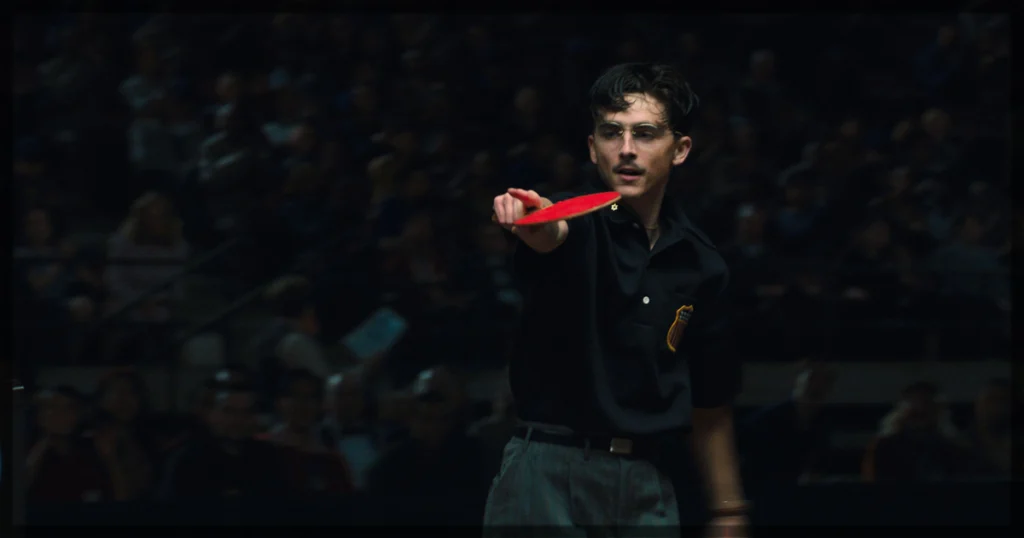
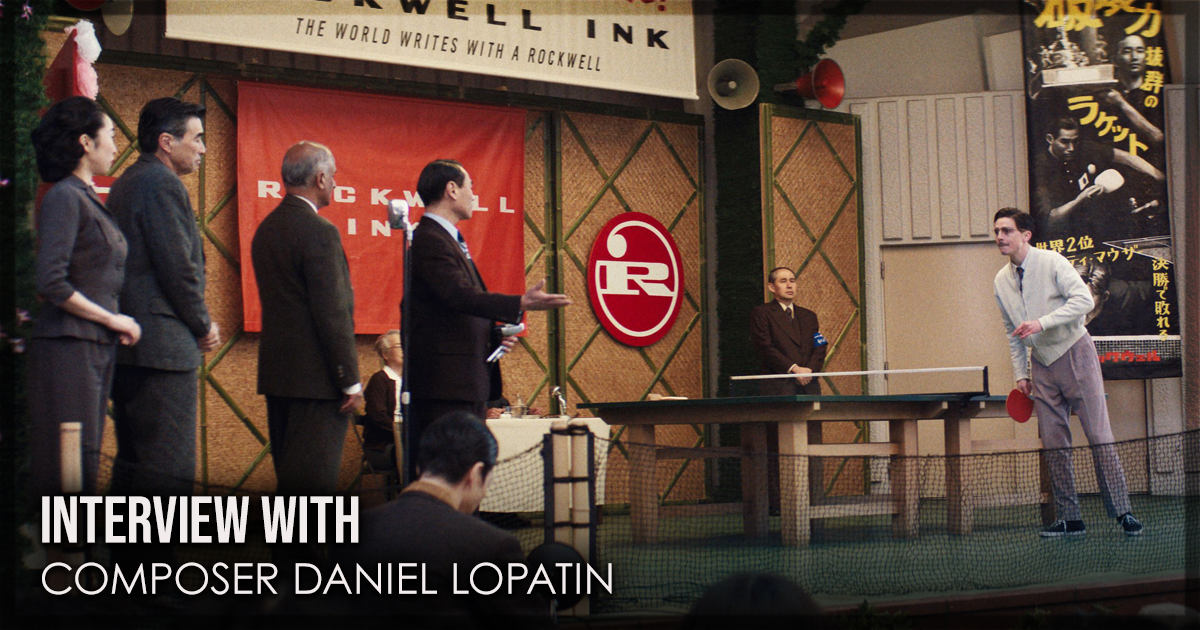
Lopatin now returns to Josh’s Safdie’s solo project, Marty Supreme. The project follows the core of a Safdie film; it is the analysis of a loser who needs to hustle to arrive somewhere. It is epic in scope, with the director’s $70 million dramedy about a ping pong player, Marty Mauser (Timothée Chalamet), in the 1950s, who struggles financially and overrates his confidence. Throughout the adventures of an overconfident player of a rising sport in the United States, Lopatin shines with his melodies that remind one of the electronic legends in film composition, such as Vangelis and Giorgio Moroder. In almost fifty minutes of original score, Lopatin mimics the sounds of mallets, which cadences the ping pong matches. Alongside the excellent editing by Ronald Bronstein and Safdie, he creates a well-paced and kinetic experience throughout the failures of Marty with his 1980s synth-based score, with bouncy and dramatic sounds.
Movies We Texted About had the opportunity to talk with Daniel Lopatin in an exclusive interview on Zoom. Read below for the full chat.
The Interview with Composer Daniel Lopatin of Marty Supreme
Pedro Lima: Hey, Daniel. Pedro Lima from Brazil.
Daniel Lopatin: Hi.
Pedro Lima: It’s really interesting when I first started listening to the film and paying attention to your score because there is a variation of synths and textures of artificial sounds that you use, and it juxtapositions to the fifties, where you have this very electronic and artificial sound that is from the late seventies, early eighties. So how do you choose what synth are you going to use, because there are a lot of variations of them? And how do you find a specific musical texture?
Daniel Lopatin: Well, maybe I can say that the easiest answer would be it hit me really hard, like a ton of bricks, the first time I watched the film, or maybe it was the second spotting session, that’s what it was, it was the second spotting session. I watched, and I was really paying attention to the table tennis aspect of the film, the ping pong. And I was closing my eyes, and I listened to the racket and the ball, and so I closed my eyes and listened to it, and I was like, wait a second, we’re talking about mallets. So we’re talking about a piece of wood with a ball at the end of it. It’s basically this idea. And so once I had that idea that we were really talking about mallets, quick rhythmic, melodic motifs, patterns, sequences.
Daniel Lopatin: I knew I wanted something in that world, vibraphone, mallet-based instruments. And so my mind, when it was a question of, well, how do we do that in a kind of 1980s fashion, DX7 (Yamaha synth), you have all those very, very rich mallet sounds on those early eighties digital synthesizers: Sonic, Yamaha, all of them were. And it’s in the fabric of the needle drops, too. I mean Tears for Fears and Depeche Mode, which is not a needle drop, but it was a big reference for me. Depeche Mode’s short, quick, high, transient mallet sounds are at the heart of it.
Pedro Lima: Also speaking a bit about these needle drops, there’s a fascinating element of the score that is the opening credits track. It’s an unhinged opening sequence, but also the music is ambience to that. And you also follow that with the melody intertwined with your interpretation of Forever Young (by Alphaville), which is an extremely popular song in American culture, but from the eighties, and that in a film set in the fifties.
Pedro Lima: How is it for you to incorporate these exterior elements into the score, like the Forever Young melody to what you’re doing?. And how does your background as a producer influence and help you to incorporate these exterior and existing elements into your freshly composed ones?
Daniel Lopatin: Yeah, I think it’s easy for me, maybe it’s a natural habitat for me because I’m so, and for a long time I’ve been so interested in the materiality of recorded music. So sampling as a kind of act of dematerializing or rematerializing or using recorded music as a kind of putty or a clay to create new things, like an artist might think of as almost like a ready-made object. So for me, moving between someone’s music as a recording to an original piece of music in which the recording is part of or quoted or something like that, it’s very present in my own music as a recording artist. And that’s something that Josh [Safdie] and I always kind of think about anyway.
Daniel Lopatin: And it’s one of the reasons I think he’s attracted to my music is how it plays with pop culture and how it takes more kind of conventional things or even things that are kind of almost background or in bad taste and foregrounds and makes it into almost like a transcendental object of music. Something from the gutter becomes the stars.
Pedro Lima: We already talked a lot about references, but I would like to talk about it again, but upon another lens to it is because when we are talking about your work as a composer, you are usually compared to a few legends such as Vangelis, especially because of your electronic background. And I think it’s a huge honour to be compared to Vangelis.
Daniel Lopatin: Absolutely.
Pedro Lima: Probably the greatest electronic composer ever.
Daniel Lopatin: I agree with you.
Pedro Lima: But when I was listening to your score and watching the film, I got a lot of sonic references from Giorgio Moroder’s film scores from the seventies and the eighties, that kind of bouncy sound, but also dramatic themes and textures. So how do other scores and composers influence you as a composer and as a scorer, but especially for Marty Supreme?
Daniel Lopatin: Well, I think what connects me with them the most is that I really, really think that these were the types of composers for whom a melodic hook was the key to unlocking the entire emotion. And it became very unpopular to have this kind of brash, big melodic hooks and scores. Basically, in the nineties, it was all needle drops, and then in the two thousands, it was like underscore. And then when I met Josh [Safdie], he’s like, we’re overscoring. We’re not underscoring. And what we connect on is this belief that you can have this, you can wear your heart on your sleeve. You can have a really, like you said, a bouncy but dramatic or something like that. I think it’s almost closer to pop music in a way, in its melodicism, not necessarily in its texture, how people use it, but it’s that we don’t really necessarily divide things up between score and song and needle drop and what we like when we listen at home versus what we’re doing when we’re trying to finish the score.
Daniel Lopatin: Everything is just, is it good? Is it the right feeling or is it not? And so I’m very easily connected to Vangelis and [Giorgio] Moroder spiritually because they have a real kind of beautiful, almost naive kind of sense of melodicism that you can’t teach that it’s in your heart. It’s like something to do with who they are. And it’s a signature kind of melodicism that I always connected with. I always wanted to be that kind of composer. I didn’t want to make very intricate, very difficult-to-remember music. I wanted to make music that had a kind of an ability to be a place that you remember that you go back to. So that was important to me.
Pedro Lima: Thank you!
Daniel Lopatin: Thank you.
Marty Supreme is now in theaters.
Learn more about the film at the official website for the title.
You might also like…