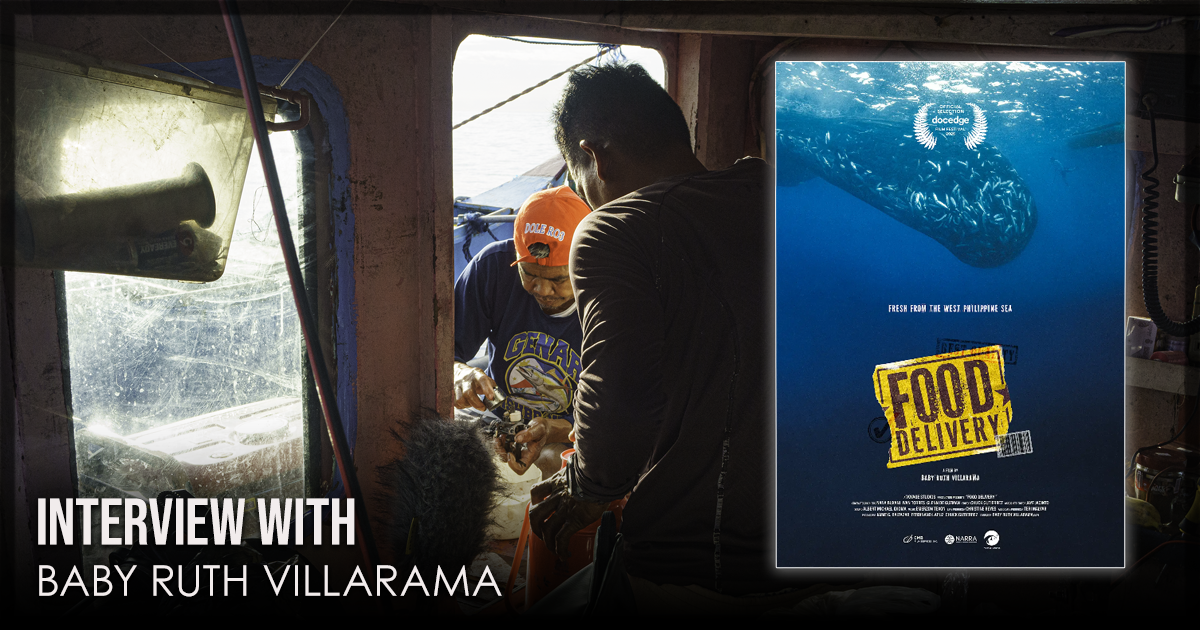
Since its production until its world debut, Food Delivery: Fresh from the West Philippine Sea, the documentary that China tried to ban, has been making national headlines. Days after the film had its world premiere at New Zealand’s Doc Edge Festival, which later recognized the film with the Tides of Change Award, Auckland’s Chinese Consulate reportedly pressured the festival organizers via written and verbal appeal to block Food Delivery’s future screenings “in the interest of public and China-New Zealand relations.”
Beijing said the 82-minute documentary “is rife with disinformation and false propaganda, serving as a political tool for [the] Philippines to pursue illegitimate claims in the South China Sea.” “Its screening would severely mislead the public and send the wrong message internationally,” the Consulate added.
Doc Edge, however, refused to cave in to pressure, stating that it stands by its “Kaupapa (principles) and the festival’s independence and curatorial freedom,” and instead released the written appeal on the festival site “for the sake of transparency and fairness.”
The move follows the film’s shocking exit from the 2025 Puregold CinePanalo Film Festival, where it was scheduled to premiere in March, citing “external factors.” Director Baby Ruth Villarama described the film fest removal as “a form of censorship” in our previous conversation for Rappler.
Produced by Voyage Studios, Food Delivery tells the plight of Filipino fisherfolk and maritime personnel wrestling with Beijing’s aggression in the contested waters — lives so far removed from the archipelago’s mainland. The film banks on its humanist texture, which is also its director’s way of locating the picture in the rest of her oeuvre.
The film’s next stop is in its own shores for an exclusive, one-time screening in the Philippines, where its search for a major distributor continues. I spoke to Villarama about her anchor as a filmmaker, going to Doc Edge, and how she’s dealing with the heightened intimidation from Beijing. The conversation has been slightly edited for clarity.
The Interview with Baby Ruth Villarama on Food Delivery: Fresh from the West Philippine Sea
[Editor’s Note: This interview has been lightly edited for clarity.]
Lé Baltar: How did it feel that Food Delivery finally had its world premiere at this year’s Doc Edge Festival, after all the attempts to censor it?
Baby Ruth Villarama: It felt like a collective exhale. For months, we carried the weight of uncertainty. With emails ignored, permissions withdrawn, whispers that we were being watched; my Facebook and Messenger trolled, reported and cancelled. So, the moment the lights dimmed at Doc Edge and the screen lit up with images from the West Philippine Sea, there was this quiet, defiant joy.
It was as if the sea itself was finally given voice. The film was no longer just ours, it now belongs to every audience who keeps sailing back, every person choosing to stand firm, and every family waiting for their loved one to return. I guess there was also a feeling of vindication, but more than that, it was visibility. We may not win battles with weapons, but I’d like to think that truth shown on a screen is its own kind of resistance.
Lé Baltar: I’m pretty sure you’re well aware that this kind of documentary could be hard to pull off, but what was your anchor as a filmmaker and storyteller from the onset? What was it that so compelled you about telling this geopolitical issue?
Baby Ruth Villarama: We never set out to make a geopolitical film. We set out to understand why ordinary people keep choosing extraordinary courage.
What hooked us wasn’t strategy or sovereignty, it was humanity. We sat across men with sunburnt skin and tired eyes who spoke of the sea like a friend, sometimes calm, sometimes cruel, but always necessary. We followed a father who was chased by foreign vessels, not because he was provoking war, but because he was simply trying to put food on his child’s plate. That’s what pulled us in.
My personal anchor has always been people, and this deep need to make my existence matter. I never got to meet my mother, and maybe that absence created a lifelong longing to find connection, to give meaning to the time I’ve been given. That longing found a home in storytelling.
I was raised by my father’s family. The Villaramas have always believed in doing what’s right, even if it’s risky. One of my grandfather’s brothers joined the guerilla resistance during the Japanese occupation. He disappeared into the mountains of Bulacan and never came back. Our grandparents understood early the great surrender in the name of service. My grandfather became a community doctor for decades. My uncles and aunts chose to work in classrooms, government halls and hospitals, and they hated the limelight. That’s the kind of family tree I was born to, so I chose a path that made sense to me: storytelling. Documenting the lives and truths that might otherwise be forgotten.
When I met people who quietly live out their truth, braving waves, resisting fear, and doing so without fanfare, I knew I had found something sacred. When you follow that kind of truth, the one that is quiet, enduring, and full of grace, you find your way through even the most complex stories.
Lé Baltar: Throughout the movie, there’s a particular fixation on the labor of the subjects, be it the local fisherfolk or the maritime personnel. How significant is that aspect in the story you’re mapping?
Baby Ruth Villarama: Labor, for me, is love made visible. We often glorify battles and borders, but we forget that it’s the quiet, daily labor that keeps a nation alive.
In the film, you’ll see fishermen casting nets, a navy cook packing sacks of food with care, even a soldier sending his last ‘I love you’ message to his loved one. These moments matter. They show us that defending our country isn’t just about confrontation, it’s about contribution.
That’s the deeper narrative of Food Delivery. That amid geopolitical power plays, it’s the ordinary workers, those who serve, who sail, who feed, that carry the nation on their backs. Their labor is not just economic, it’s symbolic. It reminds us what we’re really fighting for: dignity, livelihood, and the right to live in peace.
Lé Baltar: It’s so tempting to discuss the film in terms of the Filipino notion of resilience, which can be a disservice to broader issues at hand, so how can we turn resilience into something more active?
Baby Ruth Villarama: Resilience is often romanticized in the Philippines. We wear it like a badge, and while it’s beautiful, it can also be dangerous when it becomes an excuse to tolerate suffering.
What we need is resilient resistance. The kind that doesn’t just endure but transforms. That means speaking out, creating, changing systems that don’t work, and choosing to move forward even when it’s hard.
With Food Delivery, we didn’t want to just show people surviving, we wanted to show them taking back the narrative. That’s the shift. We don’t have to be martyrs of the sea. We can be makers of our own future.
Lé Baltar: Documentary filmmaking in the Philippines has been increasingly endangered. In the previous year alone, we’ve seen the likes of Alipato at Muog and Lost Sabungeros face censorship. Do you fret over the waning space for this mode of storytelling at home?
Baby Ruth Villarama: Yes, of course I worry. But I also believe this moment is calling us to imagine new ways of showing up, not just as filmmakers, but as nation-builders.
Censorship in the Philippines has made traditional platforms more fragile, but it has also pushed us to be more creative and resilient. During my time in the U.K., I saw how documentaries were treated not just as current affairs or award contenders, but as essential tools for public discourse. Films were screened in cinemas, arthouse venues, town halls, and universities. Audiences were primed to engage deeply with them, not just to watch, but to think, feel, and respond. Documentary, in that context, became a soulful, mind-expanding experience.
That vision became the blueprint for Food Delivery. We’re offering the film as a platform for communities, schools, NGOs, and organizations to use for education, dialogue, and advocacy. They can host their own screenings, set their own ticket prices, and even use the proceeds to fund their own missions. It’s a circular, community-powered model.
My hope is that this kind of filmmaking, rooted in truth, sustainability, and soul, can flourish in the Philippines, not despite the challenges, but because of how we choose to respond to them. Documentary can be both deeply political and profoundly personal. It can be sapiosexual too, a medium that feeds the intellect and stirs the spirit. We’ve learned that when documentaries are done right, they don’t just invite followers, they produce champions. They build an audience that is not only informed, but empowered to carry the message further than the filmmaker ever could. In that sense, even when the screen gets smaller, the impact gets bigger because it spreads in the hearts of those who choose to carry it forward. So, yes, some traditional space may be shrinking but our reach is growing. And that’s where my hope lives.
Food Delivery recently premiered at the Doc Edge festival.
Learn more about the film at the Doc Edge site for the title.
You might also like…
