
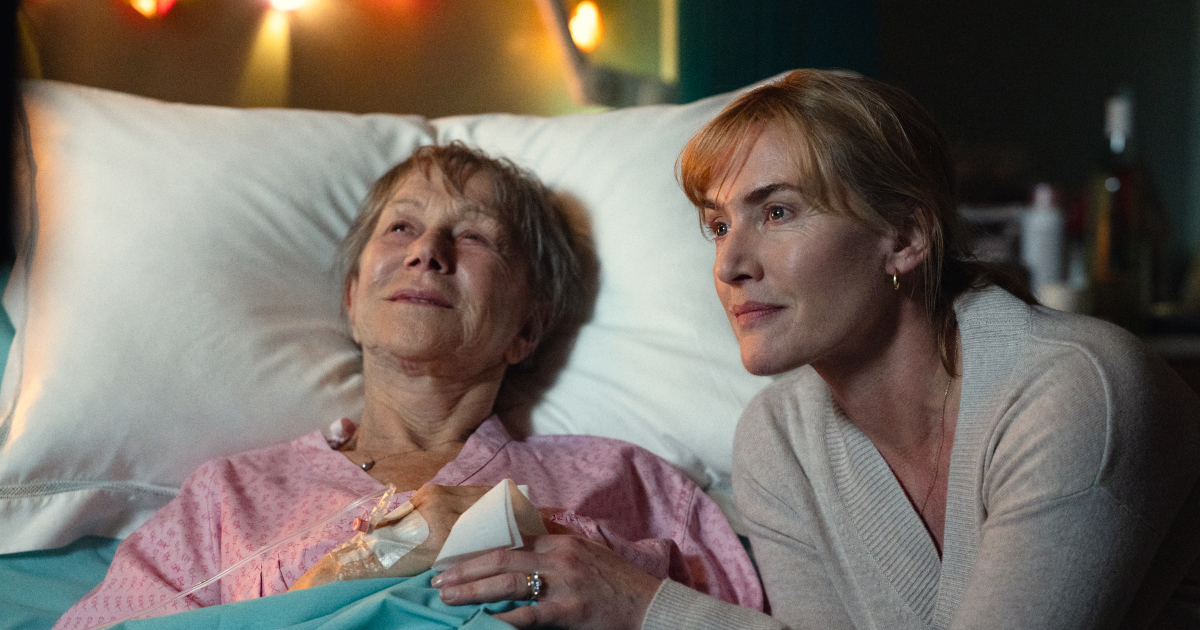
I started my home viewing of Goodbye June with no real expectations, being solely driven by a genuine curiosity about what Kate Winslet (Titanic) could achieve now that she has taken the director’s chair. I didn’t know much about the project, other than it was set during the Christmas season, and Winslet‘s desire to support newcomers in the industry was reflected in her choice of many first-timers for the filmmaking departments. It’s always refreshing and commendable to see a global icon open doors for those just starting out, and that spirit of renewal is felt in the film’s texture, even if the final result fluctuates between acting brilliance and the traps of a more conventional sappiness.
Written by Joe Anders, the story focuses on the final gathering of a dysfunctional family around their matriarch, June (Helen Mirren, The Queen). The heavy-hitting cast also includes Winslet herself, Andrea Riseborough (To Leslie), Toni Collette (Hereditary), Johnny Flynn (Emma), Timothy Spall (Mr. Turner), and Fisayo Akinade (Heartstopper). The premise is simple and direct: faced with the imminence of death, secrets, accumulated grievances, and the roles each person plays within the family structure are placed under an emotional microscope, turning a hospital setting into the central stage of an inevitable farewell.
I’m not exactly the type of viewer who floods into tears easily during sad scenes just because the script says so. If I don’t care about the characters or the story itself, the dramatic moments pass without leaving an impact — except in cases involving animals, especially dogs. However, it serves as a sort of “rule of thumb” for me: even if a movie is formulaic, generic, or predictable, if I get emotional and reach the point of crying, it means the film achieved the most important thing: making me feel something real. It means that, for a few hours, those people on screen became important to me.
That’s precisely what happens in Goodbye June. The movie doesn’t reinvent the wheel, and the ending can be anticipated from the very first minutes, but the point lies in the study of family dynamics when faced with a goodbye. It’s a deep dive into (pre-)grief and reflecting on what’s truly important when time is running out. This isn’t just about the end of a life, but about the “architecture of the good goodbye,” exploring how a sterile hospital room can be transformed into a theater of reconciliation through blunt honesty and biting humor.
The narrative sharply explores how siblings often get stuck in the identities they formed throughout their lives, whether it’s the responsible yet absent eldest daughter, the undervalued rebel, or the “black sheep” who fled far away. When June’s health crisis takes hold, these predefined roles no longer work, forcing them to finally see each other as imperfect adults rather than the archetypes they’ve been playing for decades. It’s a painful deconstruction of the masks we wear to survive our own families, and Winslet captures the friction of these shifting roles with a naturalistic eye.
This process of deconstruction is, at times, emotionally torturous, presenting several sequences of uncomfortable moments that serve to step on the gas of sentimentality. Goodbye June doesn’t fully justify its nearly two-hour runtime, featuring a set of characters that feels too vast for a family whirlwind that’s already quite dense on its own, making the experience occasionally demanding. There are moments where the film leans too heavily into the “tearjerker” tropes, stretching out scenes that perhaps would have been more powerful if they were leaner.
Despite some figures being drawn as archetypes, the performances are so powerful that I ended up surrendering. Riseborough is the standout as Molly, the most vocal and resentful sister, transmitting the energy of someone who’s permanently on the verge of breaking. Winslet follows close behind with a magnificent display of restraint as Julia, the daughter who tries to manage death like it’s a work project; when she finally lets her guard down, the impact is devastating. Flynn and Spall also shine, with the latter balancing the initial comic relief with a raw and painful masculine denial that hits hard in the final act.
As for Mirren, the actress is always impeccable, serving as the sun around which everyone orbits. Even while confined to a hospital bed, she exerts a gravitational pull that keeps the narrative grounded. A special mention must go to Akinade as the nurse, Angel. His performance is one of such genuine kindness and presence that I found myself wishing for everything good in the world to happen to that man. He represents the institutional empathy that validates the family’s chaos without offering false hope, proving that sometimes, being present is the most radical act of care.
Regarding the direction, I was positively impressed with Winslet‘s work. The actress-turned-filmmaker demonstrates a natural care for creating intimate atmospheres, using long, static takes that allow the actors to truly inhabit the space and silence. The way she captures the “waiting” — the sound of a whistling kettle or the sterile hum of a hospital corridor — reveals a sensitivity that avoids a more melodramatic register. There’s a clear understanding of family roles that she films with patience, focusing on faces and silent reactions, which gives Goodbye June a palpable honesty.
The conclusion, while expected, is elevated by a beautiful final scene where the harmony between all the technical departments is evident, proving that the collaboration between the newcomers and the veterans bore visible fruit. It’s a moment of union that encapsulates the idea that families don’t need to be perfect to be complete. I wouldn’t recommend watching this movie on Christmas Day itself, given the story’s gloomy weight. However, it’s a film that should be seen whenever you have the chance, especially if you’re in a moment of reflection about your own family ties and the importance of making amends with the past while the present still allows us the touch and the word.
Final Thoughts on Goodbye June
Goodbye June presents itself as an intimate study of the fragility of family ties, balancing Kate Winslet‘s sensitive and atmospheric direction with overwhelming performances from a cast that elevates archetypes into deeply human figures. Although the narrative follows conventional paths, the movie triumphs by transforming loss into an emotional laboratory where pain becomes the raw material for the discovery of inner peace. In the end, it leaves the lesson that death isn’t just the abrupt closing of a book, but the final chapter of a life that deserves to be read with the courage of someone who knows that love is the only thing that survives the eternal silence.
Rating: B-
Goodbye June is now playing on Netflix.
Learn more about the film, including how to watch it, at the official website for the title.
You might also like…