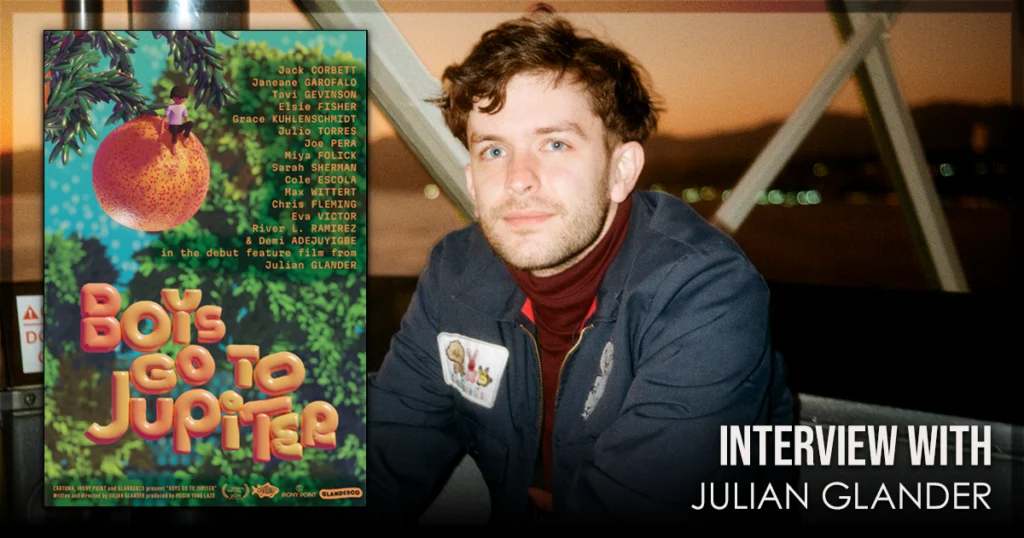

Pittsburgh-based filmmaker and 3D animator Julian Glander plots his own Florida project in the whimsical coming-of-age movie Boys Go to Jupiter, an animated debut feature now playing in U.S. select theaters that inventively blends the allure of a retro mobile game with the disarming monotony of a sleepy suburb against a vibrant neon palette. The result is an idiosyncratic world where humans and extraterrestrial beings live together in harmony, and where characters constantly converse about sentient blobs, the best spaghetti in town, an evil orange juice factory, and hacks to making more moolah.
Set during the weird interval between Christmas and New Year’s Eve, the story follows Billy 5000 (voiced by Jack Corbett, host of NPR’s economy explainer, Planet Money, on TikTok), a 16-year-old math prodigy who opts to ditch school, unbeknown to his older sister, Gail 5000 (Eva Victor, director of the new indie hit Sorry, Baby), and trade casual beach hangouts with his ragtag, hiphop-loving group of friends — Freckles (Grace Kuhlenschmidt), Beatbox (Elsie Fisher), and Peanut (J. R Phillips) — for a shot at economic and existential independence.
Sleep-deprived and fueled by hustle culture podcasts he regularly consumes more than his own breakfast, Billy dedicates most of his energy earning money through Grubster, a food delivery service app, which delightfully presents a loophole that he’s bent on exploiting. The app glitch, which confuses Czech Koruna for Swedish Krona upon conversion, allows Billy to pocket a bloated amount of his original earnings. So on he goes accepting orders left and right, wandering through the pastel Floridian landscape, and delivering food from one residence to another, complete with the soulless “Have a Grubby Day” catchphrase, to fulfill his 5,000-dollar goal, move out, and have some sort of a life restart.
Like Flow, the Oscar-winning animated feature from Latvian director Gints Zilbalodis, Boys Go to Jupiter is brought to life via the free and open-source 3D software Blender and its real-time rendering engine, Eevee. Though the resulting pictures are visually and tonally different, Glander’s vision also turns into a kind of adventure movie, where the protagonist, as with the central feline in Flow, meets new characters, customers and food service laborers alike, as the story progresses. Each transactional encounter gives Billy and, by extension, the audience access to a kind of capitalist, soul-sucking griefscape that informs the narrative in contrast to the 3D animator’s joyous, candy-hued visual grammar. The mostly stationary scenes also contradict the frantic, restless reality of a life rendered on-demand. Oftentimes, Billy pays no need to these people’s sad musings, chiefly because he has more deliveries to complete; other times, he entertains them only if it means more bucks for him, like chewing up an entire hotdog before a customer eats it completely. Which unveils a kind of labor that the capitalist structure often obscures but greatly thrives on: emotional labor.
Through this torrent of deliveries, Billy comes across the faux radical Rozebud (musician Miya Folick), daughter of orange business tycoon Dr. Dolphin (comedian Janeane Garofalo), a perfectionist whose entire life is spent on experimenting with eccentric fruit pairings and tracking amorphous, colorful species of alien blobs whose rare radiation power she intends to harness for her dream citrus empire. (One of which, the endearing creature named Donut, befriends and shadows Billy wherever he goes.) Rozebud gives Billy a book on capitalism, which the former pretends to have read and later becomes useful for the latter’s negotiation with Dr. Dolphin, who offers him a $5,000 payout in exchange for Donut. Thus begins the real dilemma: Is Billy’s working-class reality enough reason to betray his sweet, newfound friend?
Apart from Glander’s computer-generated aesthetic that shifts between rubbery and geometric, ably aided by the director’s wry humor (“Nobody invented Gatorade, it’s a liquid, like milk”) and overhead, widescreen compositions that reflect the movie’s articulations about how capitalism treats human lives as solely granular, as mere source of cheap labor, Boys Go to Jupiter doubles as a rousing musical piece, where even its alien creatures get to have their moment. The musical interludes are a particular highlight as it deviates from the monotonous emotional defaults of the characters, and because the sonic palette — with its DIY synth appeal running the gamut, from mournful to upbeat — just sounds so good, which Glander helped craft as the film’s composer.
Propelled by a distinct world-building and a poignant exploration of the myriad ways capitalism erodes our lives, Boys Go to Jupiter is a vivid vaporwave sight that makes a solid case for a micro-budget indie that unabashedly embraces its own quirks and still comes up with searing candor. It’s an anxiously fascinating piece of niche cinema that perhaps could only come from an artistic voice as organic as Glander’s.
Boys Go to Jupiter is now playing in select theaters.
Learn more about the film at the IMDB site for the title.
You might also like…