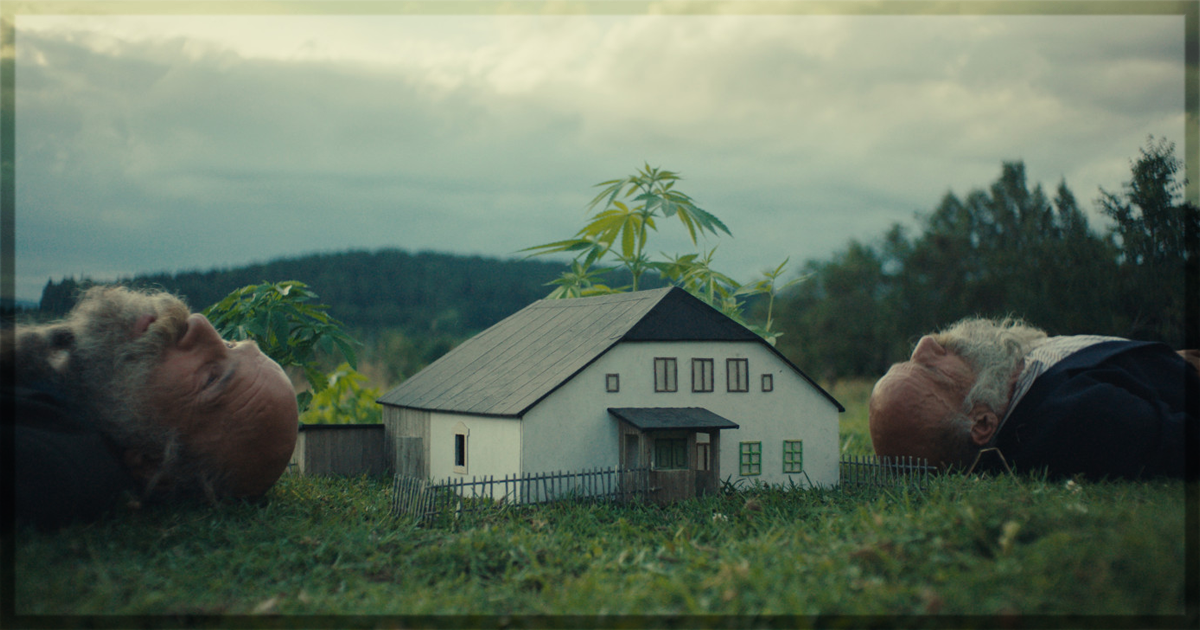
The Slovak director Miro Remo presents an alternative way of living in his film Better Go Mad in the Wild. In his fifth feature-length film, the director closely observes the twin brothers František and Ondřej Klišík. They live in the inner countryside of the Czech Republic, in the Sumava. The Klišík brothers are farmers and live in solitary company with each other. Far from the modern city, they cut wood, fish in their pond, and have pigs, roosters, and cows. The latter are even the narrators of this story, which searches for personification in the cows to create a sense of closeness to the subjects. Therefore, Remo analyzes the psychological effects of their self-imposed reclusion, using their hermit natures to study their codependence relationship and how they observe the world around them.
The director finds his story through the contradictions of two identical but completely different individuals. In its introduction, the film has an adventurous approach to this further venue. The first minutes feature one of the men screaming his lungs off on top of a cut tree. The upcoming scenes present the absurdity of the duo, who are getting older and questioning their lives. Consequently, Remo frames their daily routine with a raw but inspired visual composition. The cinematography by Dušan Husár and Remo uses a wide lens to capture the violence of living in nature. The cameras record the necessity of cutting the rooster’s neck off and how they use their teeth as a knife to take off parts of the dead animal. The directing takes a naturalistic framing of their usual activities: the dirty feet in the mood, the woodcutting, and the cutting of a rooster. It is an immersive experience of the routine and how farm life works for them.
Hence, the film finds its most inspired moments in the structure of absurdism. Ondřej tries to fly out of his barn with flight goggles and his open arms, simulating wings. Another scene draws the comic and goofy spirit of the twins through a mirror frame, where they pose shirtless and drinking liquor. These instances of humor and diversification of their mundane activities are a central factor in the second half, which borrows from the wrongdoings of each one. Usually, František is happier and willing to talk when drunk, which becomes a problematic behavior for him. He abuses it as a form of escaping the boredom and the questioning of their lifestyle. The director records each activity for seconds or minutes, but some of those actions took years and years. For example, Franta, his nickname, has been building a perpetuum motion machine for the past twenty years. Each of their hobbies features a repetitive action, either jumping off the barn, building a motion machine, or playing the archodeon. The nature of each activity merges with their maintenance of their land, leading them to question their mental faculties.
Deepening from the title, there is a destructive core to the behaviors of each of the twins. Franta, who lost an arm axing, finds comfort in the day drinking, and the infinite building of a perpetuum that is not going to have a final version. Ondřej searches for the relationships lost among the trajectory, the women he could not love properly, and the life they left behind. Even though it allows a reflective proposition when swimming in the pond and admiring the wilderness around him, he appreciates the beauty and the freedom, but feels stuck in it. Consequently, the twins suffocate in their bad habits, their dependence on Franta to drink, and how they envision themselves differently. Remo composes an emblematic combative framing of the brothers through circles in the cabin walls, which they axe to represent their frustration, and encapsulated anger. Better than words, it expresses the rage in each other’s sins, and how tired of it they are.
Better Go Mad in the Wild studies the psychological distress of twins when they disagree on the lifestyle they have chosen. It finds the beauty in the absurdity of their actions and the goofiness of the hermits. The film won the Crystal Globe Grand Prix of the Karlovy Vary International Film Festival. Sadly, in the morning after the prize announcement, František was found dead in a pond in the Czech Republic. Ultimately, the film is a portrayal of their feelings at the moment of filming, but it becomes a final recording of a unique human being. Finally, Miro Remo presents a heartbreaking final letter on the twins’ brothers’ love, even though it was not designed that way.
Better Go Mad in the Wild recently screened at the Karlovy Vary International Film Festival.
Learn more about the film at the official Karlovy Vary site for the title.
You might also like…