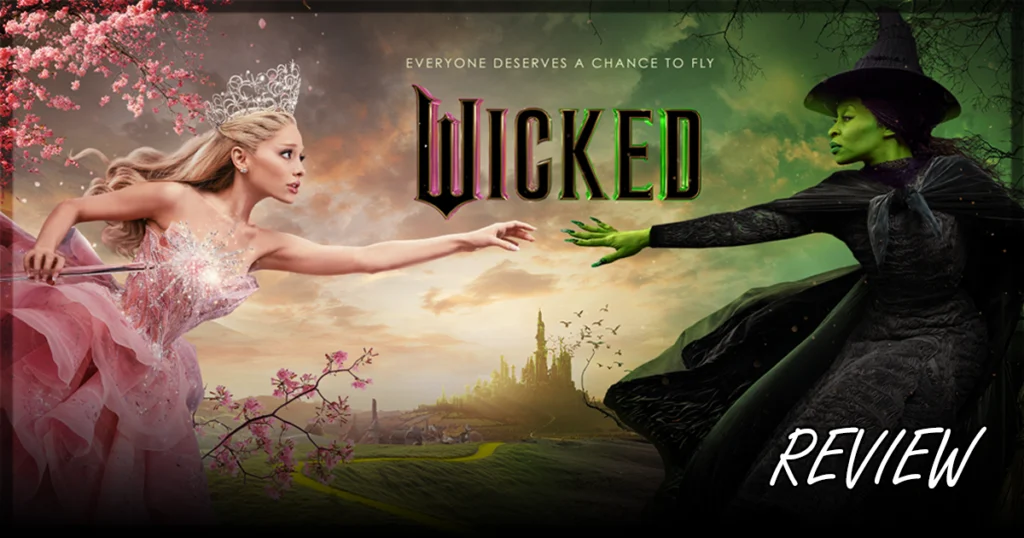
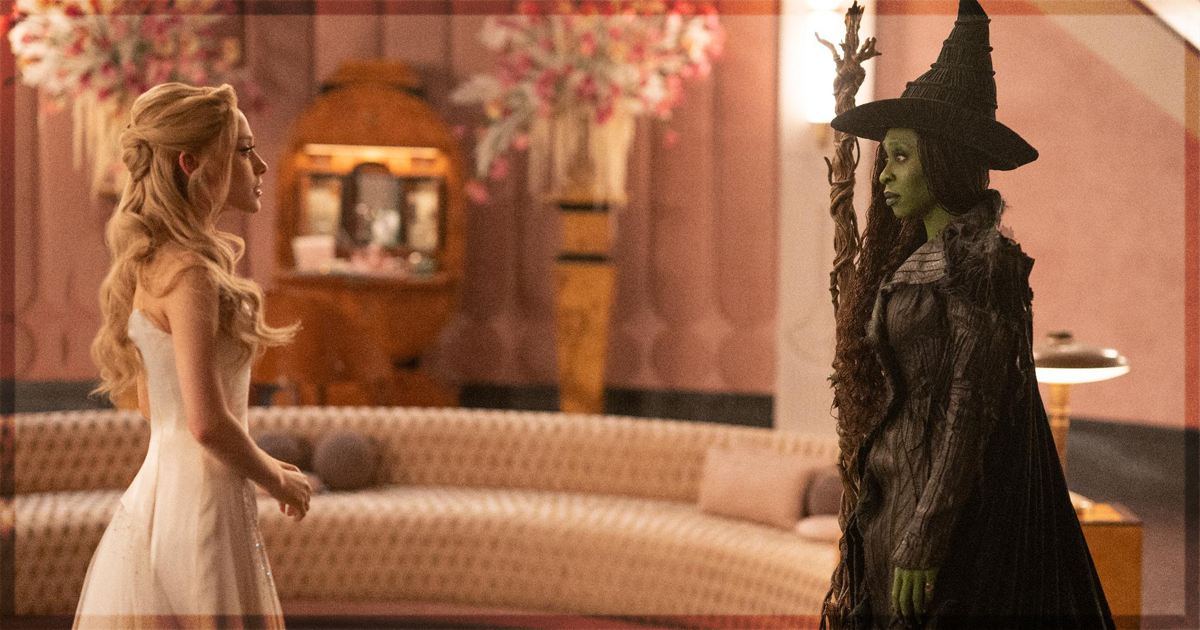
After one year of waiting with bated breath to view the powerhouses of Ariana Grande and Cynthia Erivo respectively reprising their roles as Glinda and Elphaba on the big screen, it almost seemed unbearable for fans and converted audiences alike. Audiences need not have feared as the Wicked: For Good immersed audiences fully within the seemingly colourful world of Oz but also transports the audiences into a key theme of appearances being deceiving.
To all of the citizens of Oz, a gleaming, sparkling new Yellow Brick Road is being constructed for the good of all. Jon M Chu’s vision highlights the colourful spectacular with vibrant yellow colours peeling through the pink and green saturated lens that the film inhabits. But, from the outset, the sinister underbelly of Oz is exposed with the cruelty meted out to the animals being exploited for their labour who remain the invisible, the powerless and the voiceless. This duality is a concept that is dissected on numerous occasions throughout this incarnation of the much loved musical stage play which invokes a darker, sinister tone and also embeds its icy grip within the heartwarming friendship between the beloved characters Elphaba and Glinda.
These opening scenes demonstrate elements that the propaganda machine operating behind the Wizard’s facade preferred to retain behind closed doors whilst simultaneously manufacturing a publicly evil persona for Elphaba. It is a truth acknowledged and sadly accepted by Elphaba who mentions that she must be perceived as evil in order for Glinda to be good; Glinda herself utters to her followers that having a patent over the word ‘good’ would also be useful as an illustration of the surface level display if such quality. Both of these women have essentially settled in to the public perceptions of their personas on opposite sides of the spectrum which do not fully align with their own individual thoughts.
Such scenarios also call into question notions of destiny and ultimately the agency of both Elphaba and Glinda. Their youthful exuberance, hope and innocence from the first part is acutely replaced by hopelessness and despair, whilst emphasising Glinda’s back story more on this occasion, which Jon M. Chu seems to be keen to highlight with excerpts from both the musical and the book furthering this message. The emotional angst within both of Erivo and Grande’s face is palpably felt as their characters articulate their lack of agency in given moments either through their continuously impressive vocals within new songs such as There’s No Place Like Home and Girl In the Bubble, although there is that missed opportunity for literally seeing Glinda burst her bubble in that poignant moment, or through the lingering glances of defeat levelled towards each other.
As such, both characters are products of their environment and whilst Elphaba resists this glamorous appearance and many of the shiny easy trappings of keeping up appearances, Glinda, as Fiyero points out, continues to be seduced by the shiny veneer of being ‘good’ and receiving the trimmings.
Their parallels of light and darkness are therefore never clearer than in this second edition but equally as clear is that undercurrent of manipulation as their destinies are created by Madam Morrible and the Wizard, to an extent. The use of split screens, in emotive scenes, for Elphaba and Glinda when they hope to have found their hearts desire further emphasises this notion of an altered perception. Glinda’s momentous day for her wedding is the epitome of a Disney princess’ transformation à la Cinderella being prepared for a ball with similar birds and animals helping her dress for the occasion. On the other hand, Elphaba’s moment of finding freedom and love is expressed by dark shadows and fireflies à la Maleficent, where she pronounces that she truly feels ‘wicked’. Yet, those moments serve to illustrate the constructed reality in which they operate and that they are merely puppets within an orchestrated play lacking any agency. The film’s stunning visuals fully accentuates those diametrically opposed social worlds surrounding both Elphaba and Glinda, who are in essence the two sides of the same coin.
Yet, Jon M. Chu’s direction further underlines the female voice via a frustrating lack of choice available to both Elphaba and Glinda. Elphaba’s power manifested itself in her strong need to assist the oppressed animals to find their voices but her powers appears to diminish once she allows herself to soften and succumbs to the male gaze. By contrast, Glinda in an emotional outburst during a perceived moment of betrayal by love seemingly finds her voice. However, these moments do feel disappointing for the characters as they are driven by the reactions of a man at its core and therefore substantiate the lack of agency available.
Effectively, a key line mentioned by Madame Morrible, as a withering put down towards Glinda, serves as a key illustration of that sense of appearances being the key component throughout the film. Glinda is solely perceived as that public statesman to provide that positive hope irrespective of whether she is truly in possession of a modicum of goodness. Glinda is told to ‘smile, wave and shut up’ as a blunt tool encapsulating this notion of perception.
Indeed, Wicked: For Good is unsubtle in revealing the significance of pretty privilege and playing a role upon the world’s stage. There are many mirrors strewn in the locations that Glinda frequents as a reminder of how she is pleasing to the eye and yet whenever Elphaba appears, as she emerges from the shadows, glass breaks on each occasion reminiscent of the role of mirrors within other fairytales such as Snow White.
Ultimately, Wicked: For Good with its slower, mature meaningful pacing is compelling viewing which takes its time to focus on world building but also injects slight humour and questions life choices throughout. The costumes remain dazzling and the love between Elphaba and Glinda is heartbreaking to watch as soul mates having to make devastating sacrifices. The first film’s themes of othering remain but are neatly interwoven within this narrative of the female voice and having the freedom to create our own destiny. The spectacular performances and chorus numbers are crowd pleasers but the sombre tone may be jarring for some after the euphoric highs and lows within part one, with its focus on Elphaba’s tale. Yet, Wicked: For Good reminds us of the strength in breaking conventions to allow alternate versions of a fairytale for the voiceless but that ultimately, characters such as Glinda and Elphaba work best in tandem where they can ultimately have their own agency, be in charge of their own destiny and change each other for good.
Rating : 4 stars
Wicked: For Good will be in theaters on November 21, 2025.
Learn more, including how to buy tickets, at the official website for the title.
You might also like…