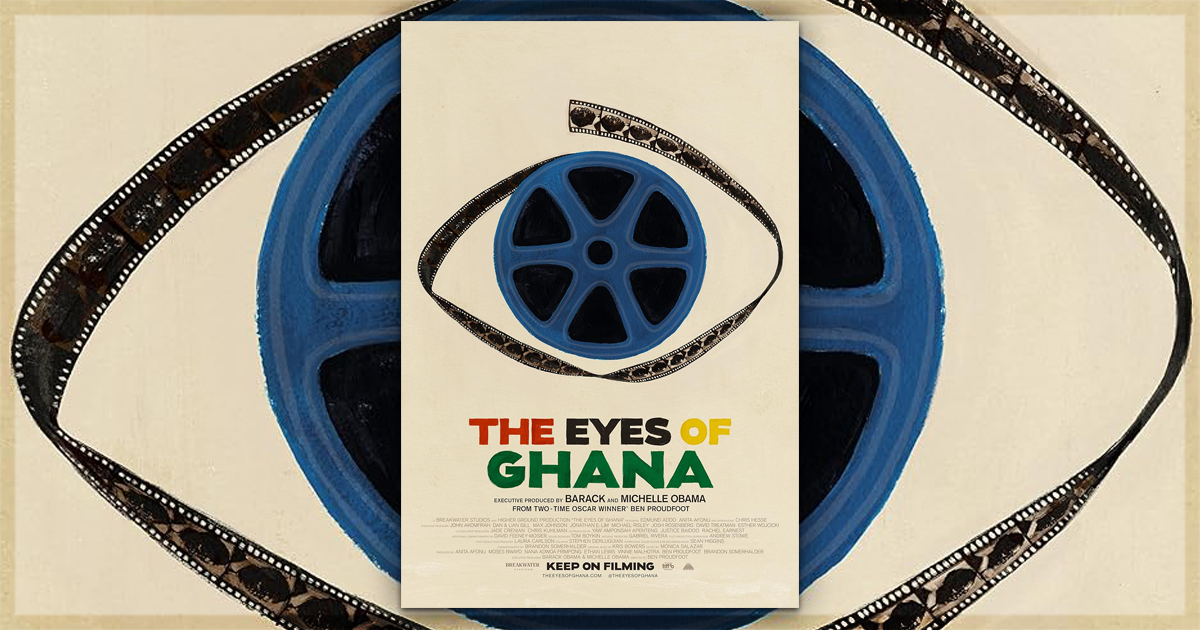
The young Canadian director Ben Proudfoot is one of the most prominent names in the documentary short film community. Through his Breakwater Studios, Proudfoot releases two shorts each year, which premiere in major festival venues such as the Tribeca Film Festival or Telluride Film Festival. In 2021, he won his first Academy Award for documentary short with The Queen of Basketball, a New York Times op-ed film. Three years later, the director won his second Academy Award in the category with The Last Repair Shop, alongside Kris Bowers. Bowers, a composer, collaborated with Proudfoot previously in A Concerto is a Conversation, also nominated for the Academy Award. Now, the prolific young documentary filmmaker shifts his focus to features with The Eyes of Ghana, his first full-length project in almost a decade, which he premiered with Rwanda & Juliet in 2016. Likewise, he is back analyzing the African continent, now with the lens pointed to Ghana and its film production after the independence declaration.
In his new project, Proudfoot tells the story of Chris Hesse, the cameraman to Kwame Nkrumah, the revolutionary leader who was Ghana’s first president. Following the steps of the country’s commander, Hesse shot more than a thousand rolls of film that had never seen by anyone before. In this sense, the filmmaker is ninety years old. Therefore, he decides to process and remaster those materials to exhibit in the country, an event that never happened before. Initially, Proudfoot and Hesse met through Justice Baidoo, a Ghanaian journalist. Throughout that first interaction, the legendary cameraman mentioned his archive of a thousand film rolls and asked for help to digitize them. Then, Moses Bwayo, the Academy Award-nominated director of Bobi Wine: The People’s President, joined the project and convinced him to turn it into a feature film, rather than Proudfoot’s initial instinct to format it as a short.
Firstly, Hesse perfectly fits the typical hero in the director’s shorts. They are usually people with massive achievements; however, they generally get overshadowed by other individuals. While their contributions stay, their names fade away. Lusia Harris from the The Queen of Basketball, who is the only woman to get drafted by an NBA team in history. Ilon Specht, the central subject of The Final Copy of Ilon Specht, is the mind behind the historic L’Oréal motto Because I’m Worth It. Hence, the director constantly looks at figures that feel underseen in the popular culture. There is no better description of his work than the ability to showcase those who did not receive their flowers. Both Lusia and Ilon passed away a few months after the filming wrapped. Consequently, Hesse has the chance to take a lifelong project out of the paper; preserve the rolls he put his life at risk to shoot during the 1950s and 1960s.
Despite the typical “Proudfoot framing”, which is a medium close-up, usually with a light background behind it, instead of the plain white-ish backdrop, it is usually pastel colors. In most of Proudfoot’s recent works, except for Ilon Specht, which uses her voice as a guideline due to her illness, his films follow this visual recipe. Yet, the new project is also a showcase of the digitized reels shot by the subject. While the historical cameraman narrates the history of the recently established nation, injecting personal anecdotes that provide an overly emotional experience about the construction of a state attempting to escape colonization. Intertwined with his accounts, the film presents excerpts of the subject’s works. In a moment, Hesse narrates about the administration of the new country, and in the following scene, we watch Freedom for Ghana, a remastered extract from his reels.
In a sense, the most fascinating aspect of The Eyes of Ghana is the presentation of freshly remastered work shot in the 1950s and 1960s, material that was in a vault for the last sixty years due to the danger of being destroyed by opposition forces. Analyzing it as a talking-head documentary, despite the charming framing by the director, it is a fairly exhausting experience. Still, the importance of restoring revolutionary imagery is hugely appreciated. More than a conventional documentary, formally, it is a 90-minute Proudfoot short, but it provides a fascinating exercise in remastering and rediscovering unknown work.
It is an exercise to invite the documentary community to explore the shot material around the world and the possibilities of discovering crucial historical documents. As long as the film production and documentary filmmaking continue to think with a Eurocentric vision, works such as those by Hesse will probably need to wait fifty years to get the deserved remaster.
The Eyes of Ghana recently played at DOC NYC.
Learn more about the film at the DOC NYC site for the title.
You might also like…
‘Aqui Não Entra Luz’ Documentary Film Review – Karol Maia on the Housemaids of Brazil