
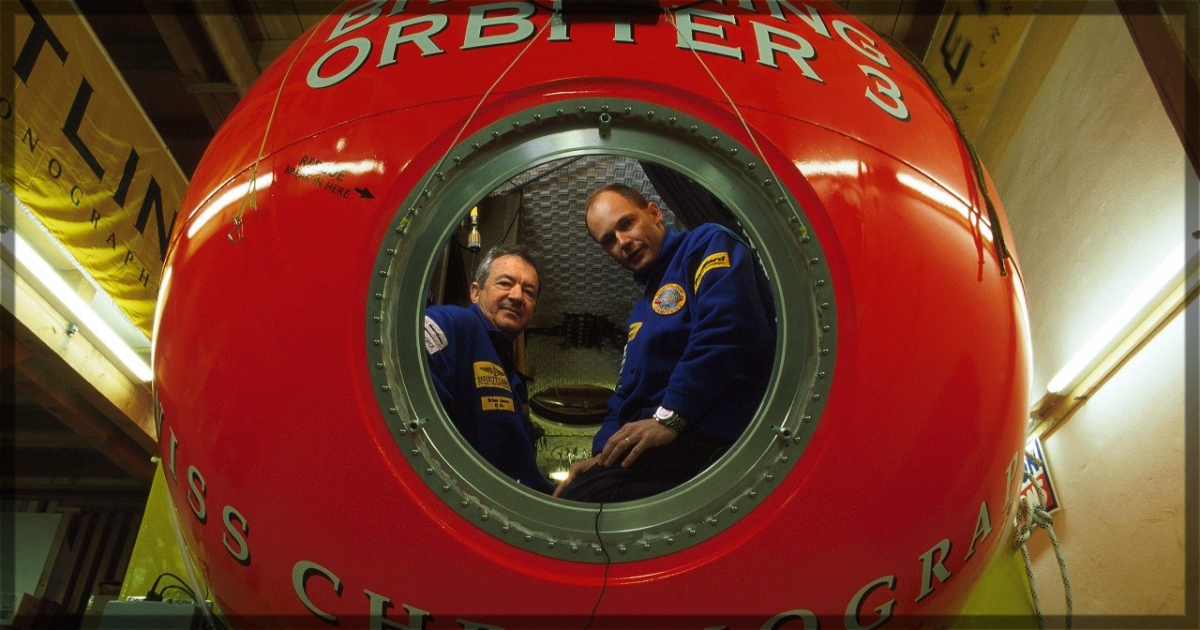
Airplanes are a relatively new technology and type of transportation. Igniting in the 1900s, aviation quickly developed, taking less than 40 years from the first flights to their use as war machinery in World War II. However, at the end of the 1700s, the creation of balloons occurred. Even after two centuries of their inventions, no human had accomplished the adventure of traveling the whole world in a balloon. Despite many attempts, it would remain an unaccomplished feature. In this sense, there is an irony in humans reaching the moon but never crossing the planet in an aeronautic vehicle. In The Balloonists, the veteran documentary director John Dower (My Scientology Movie) tells the story of Bertrand Piccard and Brian Jones, the first duo to achieve the impressive feat.
Consequently, the film narrates from the perspective of Piccard’s fascination with balloons. He is the grandson of Auguste Piccard, the Swiss physicist who used hydrogen balloons to reach the stratosphere. Hence, it is in his blood both the connection with flying objects and the appetite for breaking records. The film demonstrates the relation between Bertrand and his family’s impressive achievements. He grew up watching his father, Jacques, an undersea explorer, push the limits of the human body. Likewise, the already-mentioned stunt by his grandfather, which he continued long past his record-breaking feat. Although the film says little, Bertrand’s feat feels predestined. His family has a history of inventors and record-breakers who advanced their fields and wrote their names in history. However, his memories suggest he did not believe he would be in the same tier as the Piccards. Yet, although he had a passion for planes, he found the beauty of balloons while observing them as they crossed the Swiss Alps.
In a sense, the director does not want to diminish his subject’s history. Similar to the sports heroes in other films, his familiar background does not matter much to the final achievement. Inherently, there is an underlying irony in mentioning his rivals to the world crusade as antagonistic billionaires and Piccard himself as an underdog. It lacks a contextualization between his childhood dreams of toy planes and the first balloon flights. Furthermore, Dower’s approach feels off-key, particularly when the principal subject has a distinguished history in his field. Yet, his partner, Brian Jones, does not have any significant history presentation like him. Despite what the poster suggests, The Ballonists centers around a single figure: Bertrand. It is a fine creative choice; still, Jones’s history feels diminished. It is like a hierarchy of importance to the contribution in this specific event. The director explains his frustration with his first two attempts on the Breitling Orbiter.
In this sense, the Breitling Orbiter 3 became the first to achieve the unprecedented goal of traveling around the world. Using footage from 1999, the film registers the duo’s historical success, which took nineteen days. Promptly, Dower is not that successful in creating tension to reach the central scene. In this sense, the film lacks substance to evoke emotion in the audience; ironically, there is not enough footage of the flight, despite it occurring in a period with multiple recordings of each event. Hence, it relies primarily on Piccard’s perspective, similarly to the rest of the film. In a sense, The Ballonists, contrary to what the title suggests, is predominantly about a singular ballonist and not the duo of them. Even though Jones is quoted as a masterful engineer and pilot, he is on the sidelines of this story. Hence, Piccard’s story becomes repetitive, particularly in the way the director tells it. It is an overly conventional documentary, similar to the majority of sports non-fiction projects, fearful of experimentation with the format and with the interviews of their subjects more boldly. Thus, it never scratches beyond the surface of the subject, serving as a basic documentary on ballooning.
In the end, John Dower’s project about an unprecedented event is not inventive enough or sufficiently unconventional to engage as much as the story it attempts to tell. Hence, The Balloonists is another example of the mixed curatorial job from the TIFF Docs, a section of the Toronto International Film Festival dedicated to non-fiction. Despite featuring bold works like There Are No Words and While The Green Grass Grows – A Diary in Seven Parts, the program also includes conventional documentaries, such as Dower’s.
The Balloonists recently played at the DOC NYC Festival.
Learn more about the film at the DOC NYC site for the title.
You might also like…
