Filipino filmmaker Jerrold Tarog’s historical biopic trilogy, which began a decade ago, may just have run its course with Quezon, notwithstanding the latest installment’s prescient coda. The movie first played in Philippine theaters in October last year and screened in the Limelight program of the 2026 International Film Festival Rotterdam, alongside festival hits such as Kleber Mendonça Filho’s The Secret Agent and Mona Fastvold’s The Testament of Ann Lee — a remarkable feat considering that the project almost did not come to fruition following an unrealized funding deal with Amazon Prime Video, which scaled back original productions in Southeast Asia in early 2024.
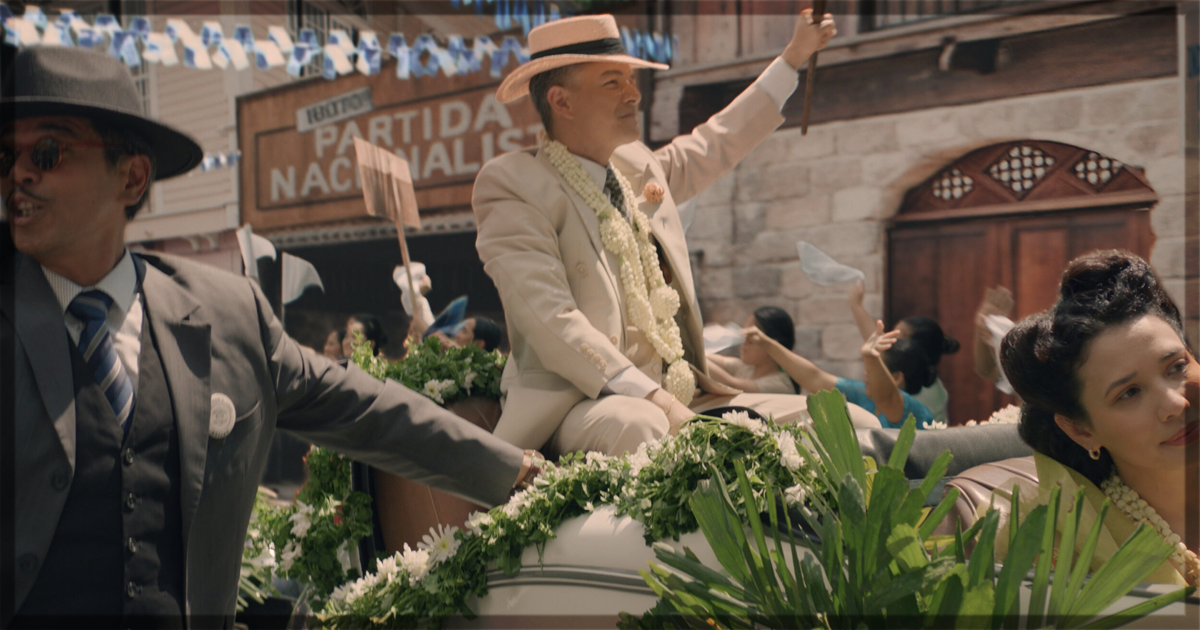
Whereas its predecessors — 2015’s word-of-mouth hit Heneral Luna and 2018’s Goyo: Ang Batang Heneral — are action movies, chiefly concerned with the bloodshed spectacle they often find their titular heroes in, Quezon is more of a consequence movie, one that is less ambitious in scale, shifting the battlefield from steep, rough terrains into assembly corridors and smoke-filled chambers in which history convenes, and focusing on the political exploits of the eponymous Philippine Commonwealth president to rise and remain in power, which also makes this story partially one of man against himself, and how his story holds up a mirror to an entire nation. And as with his exuberantly layered, though sometimes sensationalist, depictions of his first two heroes, Tarog does not temper his portrayal of Manuel L. Quezon, who is first presented at a remove, then later with affecting intimacy — like how the director curiously sublimates an event as momentous as the 1935 election into a small-town affair — and, finally, with scathing criticality.
Played so methodically by Jericho Rosales, Quezon is a man of great charisma and cunning; he yaps and laughs with you, well-aware that that too is part of the performance; he shows no loyalty to anyone or anything except the language of power — character attributes that did not sit well with Quezon’s relatives, one of whom reportedly lashed out at the cast and crew of the film during a post-screening talkback session over the material’s supposed lack of historical accuracy (which is particularly tricky to invoke in what is clearly a fictional, non-documentary work, in a medium that’s susceptible to omissions); while another, who calls himself “The Explainer,” wrote a review of the film, viewing it as a horror akin to Frankenstein “because it conjures a spectacular monster named Quezon being thrillingly bad” (though that isn’t strictly the case here), and a historical fiction that is “more about the present rather than the past” and depicts “people in the past mouthing what those living in the present actually feel” (which is a pretty insular and didactic understanding of historical fiction as a genre, ignoring its sense of positionality, and the possibilities of cinematic form to transcend time; if anything, Quezon, though certainly not flawless, is deeply attuned to how the specters of history converse with the anxieties of the present).
While chapters serve as the movie’s narrative coordinates, its structure feels far more delirious than straightforward, as it temporally lopes forwards and backwards and goes in and out of celluloid — the world of the propagandistic silent, black-and-white movies Quezon commissions from Nadia (Therese Malvar), the daughter of the journalist Joven Hernando (played alternately by Arron Villaflor and Cris Villanueva), the fictional character doubling as audience surrogate who is present in the entire trilogy. Although the film-within-a-film setup can at times be tonally jarring, it gives Quezon its most interesting texture: whereas Quezon hopes to immortalize his heroic image on celluloid, reminiscent of the Marcosian playbook, Tarog proceeds to counter it with an unheroic portrayal of his life outside of the magic of movies, which also functions as a metacommentary on the trilogy itself and what its entirety says about nationhood and heroism. “Being a hero is all about perception,” says Quezon at one point, instantly echoing Imelda Marcos’s “Perception is real, the truth is not” maxim in Lauren Greenfield’s The Kingmaker (2019); in turn, allowing the film to call into question the role that cultural work and mass entertainment plays in the making of a nation’s hero. Disinformation, the film argues, was already part of the local political parlance way before we became aware of it.
Over the course of the movie, we witness how Quezon has gamified Philippine politics to satisfy his grand ambitions, orchestrating alliances and outplaying both his friends and foes, or more precisely, friends turned foes, including Romnick Sarmenta’s Sergio Osmeña (in an effectively cacklesome turn) and Mon Confiado’s Emilio Aguinaldo, who’s also a recurring character in the trilogy. An overhead shot depicting statesmen as pawns in Quezon’s game as he makes use of every little trick up his sleeve, heightened by a frantic editing, strongly captures such thirst for power and the culture of patronage that would later encroach every aspect of leadership in the country. This game, undeniably an offshoot of years of colonial rule, surely wasn’t invented by Quezon, yet he mastered the cards so well to the point that it no longer mattered how it started. He did not just peddle the Filipinos ideas and images; he shaped the machinery for it and perfected the cogs so that it becomes as well-oiled as it is now. Quezon contends with the sovereignty the Philippines supposedly gained and the severity of the compromises taken for it to materialize.
But while the director deconstructs our notion of a Great Man here as in the previous pictures, his and co-writer Rody Vera’s tendency to reveal exposition through dialogue, coupled with a trite narrative device to warrant its flashbacks, admittedly kneecaps Quezon’s most powerful implications. “I would rather have a country run like hell by Filipinos than a country run like heaven by the Americans, because however bad a Filipino government might be, we can always change it,” Quezon intones, clearly hinting at the imperialist project that continues to fracture the country’s identity and generations of its people’s lives, as with other territories under American influence. This anti-colonialist and anti-imperialist perspective would have accrued more emotional power had the film not project the White Man — Iain Glen’s Leonard Wood, one of Quezon’s political rivals — as the voice of reason, who reckons that Philippine independence is something to be earned from and granted by the American empire.
By Tarog’s standards, Quezon is the most formally experimental across the trilogy, and while it doesn’t necessarily result in a porous viewing experience, at times the rough edges begin to seem revelatory, in that deepens the sense of contradiction at the movie’s center — how history is not without textures or inconsistencies. It’s also the talkiest picture of the three, so much so that it doesn’t just wonder aloud but spells out its very subtext, perhaps a consequence of Heneral Luna’s perceived contribution to glorifying a strongman, coinciding with Rodrigo Duterte’s ascent to national power at the time of the film’s release. Quezon is less a movie about greatness than it is about the performance of that very greatness, and Filipino politicians sure love to perform so desperately it’s almost funny. Yet again, it’s all about perception.
Quezon recently premiered at the International Film Festival Rotterdam.
Learn more about the film at the IFFR site for the title.
You might also like…