I confess my expectations for a new entry in this saga were modest before Predator: Badlands, despite Dan Trachtenberg (Prey) returning. While Prey excelled at simplifying the formula and returning to basics, the ambition to completely shift the franchise’s point of view — transforming the antagonist into the protagonist — raised some legitimate doubts. Could they humanize such an iconic creature without draining its menacing aura? My fear was that this daring premise would prove to be merely a screenplay trick. However, my curiosity was strong, given how Trachtenberg has previously demonstrated his ability to subvert genres and deliver unexpectedly thrilling narratives.
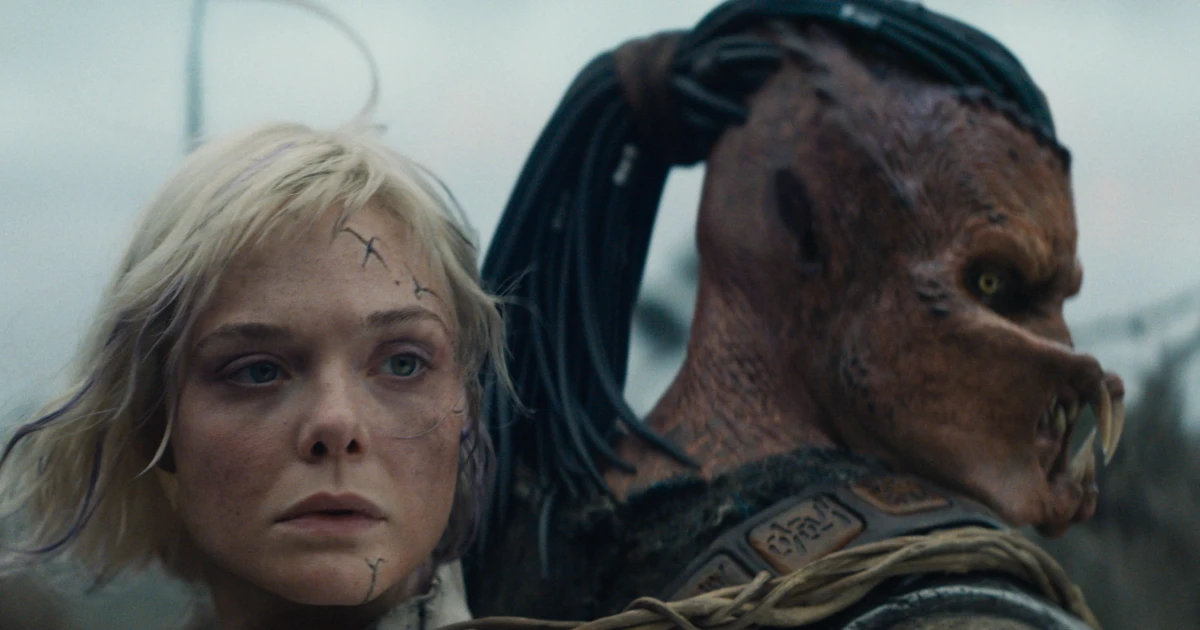
Predator: Badlands is written by Patrick Aison (Prey) from a story he conceived alongside Trachtenberg. The film follows Dek (Dimitrius Schuster-Koloamatangi, Mad Max: Fury Road), a young Yautja rejected by his clan for failing to adhere to their ruthless, solitary hunting code. On a mission to prove his value on the galaxy’s deadliest planet, Genna, Dek finds an unexpected ally: Thia (Elle Fanning, Sentimental Value), a faulty synthetic (synth).
The first and most notable feat of this movie is its courage to radically alter the saga’s angle. The move is, no doubt, potentially controversial for purists. For the first time, the Predator is the protagonist of its own adventure, moving even further away from the franchise’s sacred formula than Prey did. For some, this focus on an individual Yautja might feel like an undesirable “humanization” of a classic villain, transforming him, on the surface, into a “good guy.” Yet, the script here is much richer than a simple moral inversion. Trachtenberg and Aison directly confront the traditional, relentless Yautja rule, which regards physical power and solitary hunting as the only path. Dek is excluded because, in his father’s eyes, he’s “weak.” However, his arc suggests that masculine vigor can also be found in other qualities, such as cooperation and compassion. This is his true hero’s journey: the monster who must relearn what it means to be powerful, challenging the barbaric culture of his own people, where fragility is punished with exile or worse.
This thematic deepening of Predator: Badlands is anchored in the unlikely relationship Dek establishes with Thia. Here, themes of found family, solidarity, and friendship are skillfully developed through this partnership. The chemistry between Schuster-Koloamatangi and Fanning is surprising, especially considering Dimitrius‘ performance relies solely on body language and an alien vocabulary developed specifically for the project by Britton Watkins — the same linguist who created the Na’vi language in Avatar. His skills as a stunt performer are fully utilized in choreographed sequences, filled with atrocious ferocity and a great variety of alien gadgets. Fanning, in turn, is having a stellar year, and her performance is proof of an actress at the top of her game, lending Thia striking complexity and presence. Both actors hold dual roles, as they also portray, respectively, Njohrr — Dek’s father and clan leader — and Tessa — another synth from the Weyland-Yutani corporation.
Fanning unfolds a fascinating contrast by playing two poles of the same robotic “species.” Thia, her main character (and the one with more valuable screen time), serves as an emotional and intellectual counterpoint to Dek, injecting elements of humanity and humor into the expedition. Tessa, her “twin,” is the opposite mirror: purely amoral and focused, embodying the soullessness of corporate machination. This duality intensifies the central thematic conflict, showing that coldness can originate anywhere, human or otherwise. The friendly dynamic between Dek, Thia, and Bud — an alien animal that joins the duo halfway through the saga — offers fun moments, but its true impact resides in how it reinforces the themes of union and acceptance.
In technical and visual terms, Predator: Badlands is a resounding triumph. The world-building is remarkable; the planet Genna emerges with monumental scale and visual beauty that matches the dangers it hides. The cinematography by Jeff Cutter (10 Cloverfield Lane) is breathtaking, with many gorgeous wide shots that capture the richness, mortality, and creativity of the organisms and flora. The creature design (of Dek in particular) is a multi-departmental accomplishment, from motion-capture work to the use of practical creature suits. The makeup and visual effects are excellent, submerging the audience in visually immersive worlds. The attention to detail is such that it’s impossible not to appreciate the effort invested.
Predator: Badlands also stands out for its original score, composed by Sarah Schachner (Assassin’s Creed Valhalla) and Benjamin Wallfisch (Blade Runner 2049), and the overall sound design, which makes the IMAX experience a justifiable investment. However, it’s important to clarify any doubts about the violence: there’s no softness in the combat elements. The feature film has a PG-13 rating, but only due to the absence of red human blood. Believe me: there’s an industrial quantity of blood, just not the conventional color. The killings are brutal, and the title doesn’t shy away from presenting graphic cruelty.
Despite its consistency and ambition, the screenplay stumbles slightly in a few areas. In certain parts, the story becomes a bit lore-heavy, dumping too much information that doesn’t feel entirely necessary. The final act, though electrifying, suffers a break in visual coherence, with the mix of CGI and practical elements getting a bit shaky, and the excessive darkness of the climax hindering a few moments. And while it’s surprising for the way it subverts expectations and completely changes the franchise, the narrative itself isn’t, in its essence, particularly inventive; it’s a hero’s journey that, despite being unique in the saga’s context, follows an admittedly formulaic structure of overcoming and adaptation.
Final Thoughts on Predator: Badlands
Predator: Badlands is an audacious exercise in reinvention that takes a risk and triumphs. The movie excels in every technical department, featuring a spectacle of creature design and sound work, and offering a new thematic vision for the saga’s longevity. Elle Fanning‘s superb performance and Dimitrius Schuster-Koloamatangi‘s powerful physicality ensure Dek’s journey — the creature who forgoes the Yautja code of honor in search of a deeper, collective capability — won’t leave anyone indifferent. If there were still doubts that Dan Trachtenberg deserves the keys to the franchise, they’ve been dissipated once again. It leaves us with the important message that even in the most lethal and solitary of cultures, cooperation and compassion can be the most powerful forms of survival.
Rating: B+
Predator: Badlands is now playing in theaters.
Learn more about the film, including how to buy tickets, at the official website for the title.
You might also like…