
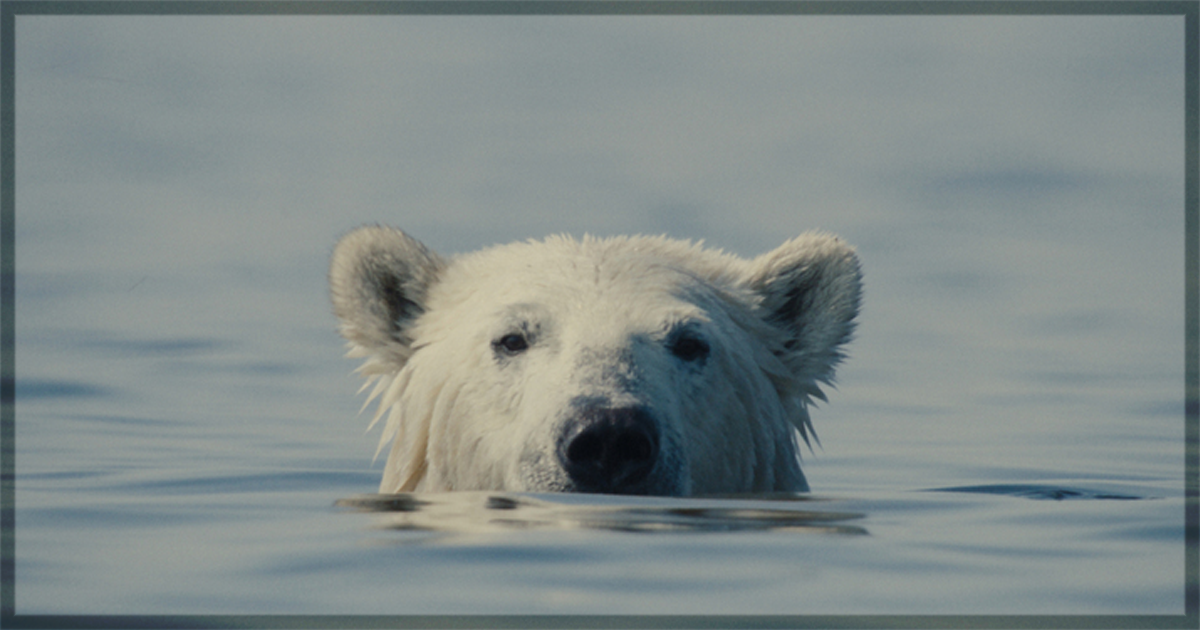
It is no surprise that Nuisance Bear won the Grand Jury Prize for Documentary at this year’s Sundance Film Festival, because it does what all good movies should, and even fewer documentaries achieve: it is not really about what it’s about. The ability to succeed on a double level is a valuable purpose for art. But this hardly ever happens, especially in documentary! When it does, it should be garlanded to the skies, so let’s hope this is only the beginning for the praise for Nuisance Bear.
But what is a nuisance bear? In eastern Canada, it’s what the white communities call the bears which have lost their fear of human contact and developed a taste for human food. So, instead of hunting like bears normally do, nuisance bears prowl the towns, looking for yummy garbage or other delicious things to eat. The town of Churchill in Manitoba has capitalised on this, calling itself the Polar Bear Capital of the World and catering to tourists keen to see bears in the wild, or at least the wild’s suburbs. The town rangers are well resourced with guns and trucks and all kinds of high-quality equipment. Directors Gabriela Osio Vanden and Jack Weisman, who also shot the footage along with four other cinematographers, are able to show the recklessness of some tourists who seem to think a camera tripod is something they could hide behind. But they also show the journey one captured bear, who is radio-tagged and also marked with green paint on the neck by the Churchill rangers, takes after it wanders into a trap. In an jaw-dropping sequence it is drugged and then helicoptered north, out of easy range of Churchill, but much closer to Arviat, a smaller town in Nunavut which is almost entirely Inuit. And indigenous Canadians have a very different relationship with their bears, as the narration in Eastern Canadian Inuktitut by the late Mike Tunalaaq Gibbons makes clear.
For one thing, the Inuit name for nuisance bears is ‘avinnaarjuk,’ which has a sense closer to ‘sulky teenager.’ From this perspective these immature bears don’t quite have their own place in the world yet and are therefore here to make mischief. In Arviat the town is patrolled by volunteers, who have hi-vis jackets and disco lights for their ATVs, and who can honk their horns when the bears get too close. The contrast between the white and the indigenous communities is shown without comment, but some information revealed by Mr. Gibbons makes it heart-rendingly clear how that shocking contrast is only the start.
The way Canada is reckoning with its shameful history towards its indigenous citizens is not a minute before time, and it’s impressive that everyone involved in Nuisance Bear understood the significance of both this story and its metaphor. As a viewer you can both be astonished by the incredible wildlife filmwork (editor Andres Landau had 700 hours of footage to work with) and be impressed by how the layers of meaning here knock you flat. Composer Cristóbal Tapia de Veer’s unusual sonic landscape also helps us sense what the bears and other animals might have been feelings as they go about their business. It’s also equally wonderful to hear people conducting life’s ordinary business in their own indigenous language, especially when the right to use that language has been so hard fought. (We must never forget that one of the residential schools where indigenous Canadian children were forced to live and where they were punished for speaking their own language had its own electric chair.) Nuisance Bear is more than an insightful documentary. It is also a document of the importance of human kindness and understanding for each other, as well as for the animal kingdom. It’s the kind of movie that makes you go outside to taste the rain and wonder if other people and creatures feel it the same.
Nuisance Bear recently played at the Sundance Film Festival.
Learn more about the film at the Sundance site for the title.
You might also like…

‘Shame and Money’ Review – Film Will Resonate the World Over