
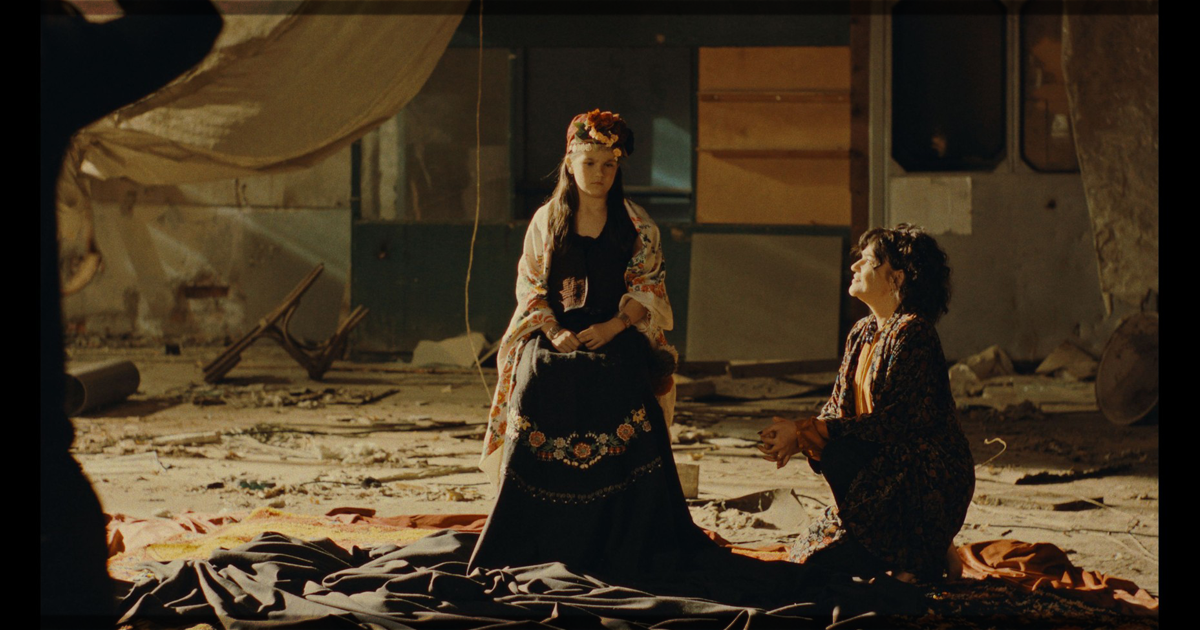
The ways in which adults make decisions on behalf of children, and how those decisions are, or aren’t, in the child’s best interests are the stuff of life. This wonderful movie begins with questioning what it takes to be an artist, and ends by questioning what it means to be a parent. Nina Roza is one man’s reckoning with the decisions he made on behalf of his daughter, and whether it’s possible to get a second chance. It is kind, gentle, extremely smart, and uses multiple languages in clever real-life ways that films have only recently begun to reflect. It was my favourite from this year’s Berlinale.
Michel (a wonderful Galin Stoev) is an art curator in Montreal shown a video of excellent abstract paintings allegedly made by an eight-year-old Bulgarian girl named Nina (twins Sofia Stanina and Ekaterina Stanina). If Nina really painted the work like the video claims, she would be a gold mine for the gallery where he works, but that’s deeply unlikely. But Michel was born Mihail, who immigrated to Canada from Bulgaria with his daughter thirty years ago, and who therefore has the language and societal skills to play Sherlock Holmes. Mihail has not returned to Bulgaria once since then, but with this career-altering news at stake of course he cannot refuse.
On arrival in Nina’s remote and impoverished village Mihail meets Nina’s mother, a widowed farmer who paints ceramics in her spare time for extra money. She speaks of Nina lovingly but with irritation, as anyone does about someone they love and care about but don’t understand. Mihail walks past Nina’s school but doesn’t meet her until the next day, when she asks if he is a dirty spy and he unhesitatingly says yes. Their rapport is immediate and surprising to both of them, though it becomes clear that since the paintings were discovered no one is being fully honest with Nina anymore. Mihail’s instinctive choice to be frank with her enables him to learn things about Nina no one else knows, and the friendly welcome of the village gives Mihail a chance to reconnect with his home culture in ways he hadn’t realised he needed. And when they left for Canada, Mihail’s struggling adult daughter Rose (Michelle Tzonchev) was the same age Nina is now.
Writer-director Geneviève Dulude-De Celles won the Silver Bear for Best Screenplay at this year’s Berlinale for the ways in which she balances the memories of the past with the possibilities of the future. Giulia (Chiara Caselli), the Italian gallerist who discovered Nina and has a partnership with Michel’s gallery, has promised to move Nina and her mother to Italy and pay for Nina’s education. All Giulia wants in return is to manage Nina’s art career. This is an incredible opportunity, much more than what village life can provide, except Nina is happy at home and doesn’t want to leave. She’s mad that playing around with her mother’s old paints has changed her life, and the Stanina twins do a great job of showing someone at the start of a rollercoaster trying to get off. But Nina is only eight. It’s not up to her.
As Mihail considers the decisions being made on Nina’s behalf, he is also overwhelmed with memories of the life he and Rose left behind. A reunion with his sister (Svetlana Yancheva, making an enormous impression) does not go well either. Instead of being welcoming, she is absolutely furious he dropped by for dinner without calling first. She might have gotten a haircut! But no, her bigshot big brother decided to act like nothing had changed, and like the distance and time between them meant nothing. How do you reconnect after so much time apart? How does being away from the place where you were born change you? If you settle somewhere else, can you ever truly belong, or will your heart always yearn for another home?
Mr. Stoev is a Bulgarian actor who has built a theatre career in Brussels, who clearly knows a great deal about how people move between cultures and languages, and who obviously was chosen for his wounded intelligence that underpins Mihail’s every move. The sequence of him drunk at the bonfire, singing songs he hasn’t heard since childhood while astonished that he still knows the words, is a gorgeously vivid depiction of a question pretty much every immigrant has had to ask themselves. Who am I, since I left? And who would I have been, if I’d stayed?
Alexandre Nour Desjardins’ handheld cinematography provides the movie with a comfortable lived-in feel with a close attention to the scenery and the world around Mihail. Doors and gates are often used as metaphors, too. The quietness of the sound reflects Mihail’s thought processes as he, for maybe the first time in his life, wonders if he is doing the right things. That quietness also adds to the huge power of the ending, which lean hard into the power of love to fix things which felt broken beyond repair. Nina Roza is a beautiful movie which knows the best art comes out of love, and is an incredibly moving experience.
Nina Roza recently played at the Berlin International Film Festival.
Learn more about the show at the Berlinale site for the title.
You might also like…
‘Queen at Sea’ Film Review – Not for Sissies (Berlinale 2026)