
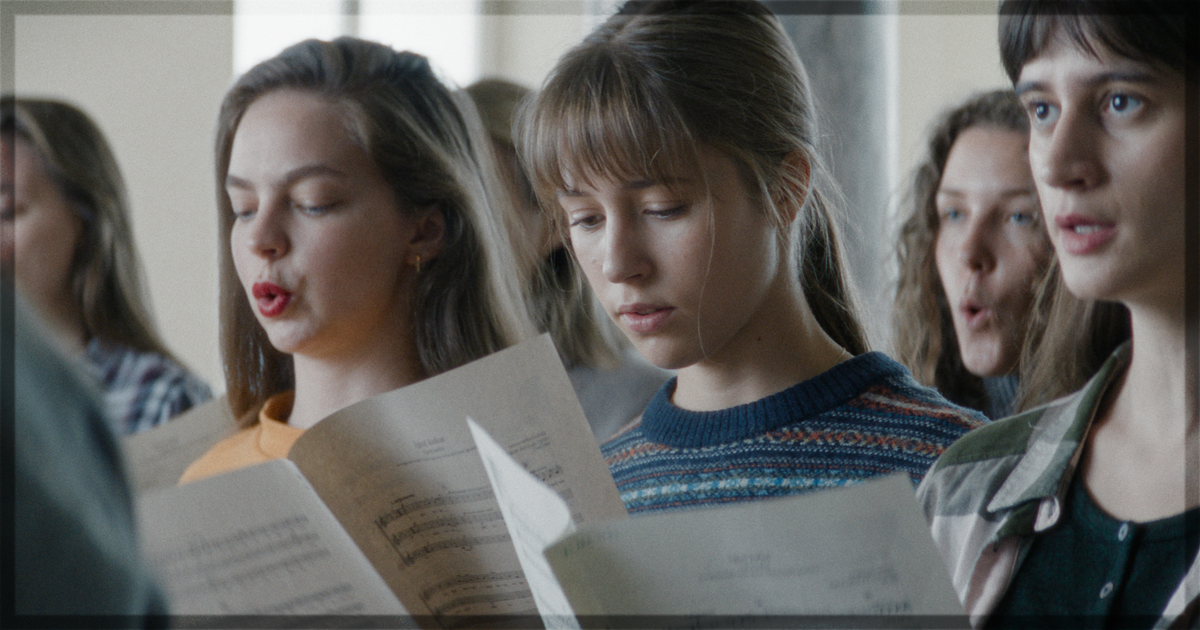
Catholic guilt is the monster that constantly rears its ugly head in Little Trouble Girls, a feature debut by Slovenian director Urška Djukić about an introverted choir girl who grapples with a sexual awakening and a renewed identity amidst pervasive conservatism and social pressures. The coming-of-age drama won the FIPRESCI prize at the 75th Berlin Film Festival and went on to be selected as the Slovenian entry to this year’s Oscar foreign film derby, though it wasn’t nominated.
Titled after a Sonic Youth song, the movie follows Lucia (newcomer Jara Sofija Ostan), a reserved, virginal 16-year-old who discovers the transcendent power of queer desire as she joins her Catholic school’s all-girls choir, where she finds herself immediately drawn to the confident and mercurial Ana-Marija (Mina Švajger), who, alongside her friend Klara (Popovic Stasa), tersely welcomes Lucia into the fold, as with most teenagers who grow curious at the sight of something (or someone) unfamiliar. It isn’t long until Lucia gets the attention of their male choirmaster (Sasa Tabakovic), who praises her vocals during the opening rehearsal, but later berates her and aggressively corrects her singing posture in front of the group in another intensive training. As it turns out, the conductor’s generosity conceals something dirtier and meaner. Tabakovic’s character here is the latest addition to a list of terrible music teachers in cinema, including Isabelle Huppert’s stern keyboard genius in Michael Haneke’s The Piano Teacher and Cate Blanchett’s abusive conductor in Todd Field’s Tár. If a celebrated mentor, the film warns, asks you to sit next to and confide in them in a room in which there are no others, you better run.
Much of the story, which is co-written by Djukić with Maria Bohr, takes place at a serene convent in the Slovenian countryside. There, in the dreamily photographed nunnery, Lucia experiences some form of freedom, away from the overbearing presence of her conservative mother, who, at one point, scolds her over some lipstick she puts on after choir practice; and, at another, eagerly skips a sex scene being shown on television that the two of them watch over ice cream. There, Lucia daydreams, hangs out and plays spin-the-bottle with other girls, spies on semi-clothed renovation workers as they take a dip in the nearby lake, or experiences her first kiss. That freedom, however, is pretty short-lived, precisely because there are still watchful eyes in the spiritual site. “God touches your heart and spills over your body,” a nun tells Lucia. And it’s the kind of chest-heavy reminder that complicates the young heroine’s psychology and journey to discovering her sense of self, hormones running wild and all. Djukić depicts this discovery as both dirty and divine, best portrayed, and perhaps literalized, in a scene in which Lucia, during a game of truth-or-dare, passionately kisses a transfixing marble statue of the Virgin Mary, an image the director is particularly fond of.
The sound design, with its ASMR-esque concoction of sensual moans, indecipherable whispers, and vocal warmups, renders Lucia’s inner turmoil particularly arresting and tactile, which the camerawork — through tight shots of hesitant hands, wide-open mouths, and vibrant flowers — lifts to a greater level of erotic and aesthetic delight, even as some of the images are undeniably go-to images of blossoming desire. Djukić’s artistic flourishes also give the film a sense of mystical allure, the kind that mirrors queer desire as an experience that’s often potently inexplicable, something that happens without warning, beyond reason. Which makes Lucia’s foray into the forest and the enigmatic cave towards the film’s coda especially mesmerizing and transformative.
Djukić’s direction is at once slippery and straightforward; whereas the film feels openly familiar, it doesn’t neatly explain everything to us; in turn, making Little Trouble Girls a fascinating portrait of queer and lesbian yearning in a world where it is awfully repressed by religious expectations. It’s a pretty amiable way to spend 90 minutes, even if you only intend to listen to and be immersed in its beautifully textured soundscape.
Little Trouble Girls was recently in limited theaters. It is now available to purchase or rent at your retailer of choice.
Learn more about the film at the official website for the title.
You might also like…
‘Bonjour Tristesse’ Movie Review: A Modern, Feminist Take on a Coming-of-Age Classic Set on The French Riviera