Since his debut feature in 2006 with Reprise, Joachim Trier has become a relevant author in the arthouse circuit. His films gathered attention for the humanity, but centered on the use of Oslo, Norway, as a prominent character. Hence, Trier is mainly associated with his “Oslo Trilogy”, composed by Reprise, Oslo, August 31st, and The Worst Person in the World. The latter put the filmmaker on a different level in the international cinema, amassing a passionate reaction at the Cannes Film Festival, followed by the audience love, and two Academy Awards nominations, including Best Original Screenplay for Trier and his writing partner, Eskil Vogt. Yet, the project launched Renate Reinsve’s career to an international tier, getting roles in films like A Different Man, Armand, and the upcoming Fjord by Cristian Mungiu.
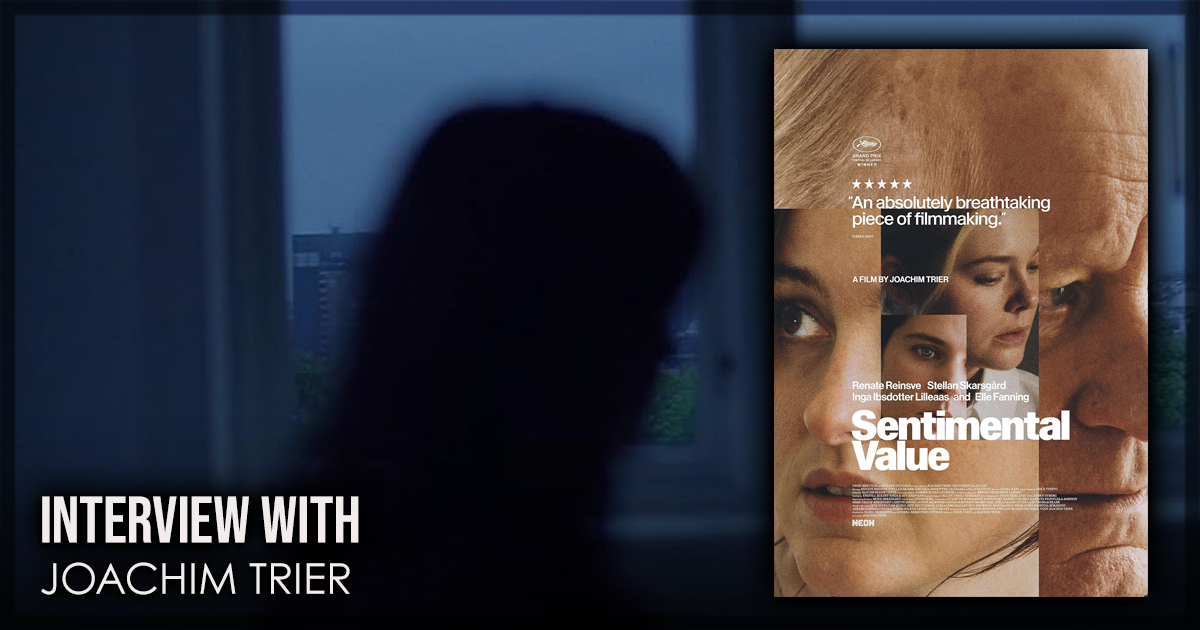
After the immense reception for The Worst Person in the World, all attention was on Trier’s next project. Four years later, he returned to the Cannes competition with Sentimental Value (Affeksjonsverdi). The director narrates the story of a broken family gathering around the family house, which is now empty after the matriarch’s passing. Now it faces the return of the absent father. Another clashing point is the family’s artistry; the father (Stellan Skarsgard) is a reputable director, and the oldest daughter (Renate Reinsve) is a rising star in Norwegian theater. The writing of a project about the house opens unhealed wounds that provoke pain in each of the family’s members. The elements that made the director internationally recognized return, such as his unreal ability to cast his ensemble, including the casting of Inga Ibsdotter Lilleaas, an absolute star in the making. Also, he combines the core of his Norwegian cast with American actors, such as Ella Fanning. Thus, Sentimental Value is a fascinating exercise of trauma and drama upon a broken family.
Movies We Texted About had the honor to talk with the director Joachim Trier in an exclusive interview on Zoom. Read our conversation with him below.
The Interview with Co-Writer and Director Joachim Trier of ‘Sentimental Value’
Pedro Lima: Hey Joachim, it’s a pleasure to talk to you.
Pedro Lima: And first, I would like to ask you about Sentimental Value. It was shot on 35mm with also scenes in 16mm. In a context of dominance of digital filmmaking, what brings you back to shooting on film? What is the spark that gets you?
Joachim Trier: Thank you for that question, Pedro.
Joachim Trier: I am still old enough that I actually shot on 35mm and 16mm when I did short films. I like the process of it, but I do also love the fact that it conveys the skin tones of humans in a very detailed, beautiful way. So all the details of the performances and the acting are captured, as well as the light situations. It’s almost as if it’s a language I grew up with, and I like to continue. This film was 99% in 35mm, some of the 16mm was from some of the material from the past, the period stuff.
Joachim Trier: But I also think there’s something about the process of me sitting next to the camera with a handheld monitor, and no one has a better view than the DP (Director of Photography) and me. Him through the glass, and me looking with my eye. There’s not this ideal of a big monitor on set where everyone is kind of already seeing the result. I like that process because I’m accustomed to it. So, I love that. I’m a bit old school.
Pedro Lima: Yeah, it’s fascinating because even in The Worst Person in the World. It was also a fact that really got me, the texture. And here in this film, you also do this, and I think it’s really important for filmmakers to continue shooting on film even though the digital is the new format.
Pedro Lima: And another aspect of your filmography that is really fascinating is your cast, because you precisely cast each actor, and you always present someone new to the global stage. So every time you go to Cannes or another big festival, there’s an actor that you bring to “Oh, you should see this new actor”. It happened to Anders Danielsen Lie, to Renate Reinsve, and now to Inga Ibsdotter Lilleaas. So, how does the casting process work for each of your projects, and how do you manage to find these gems like every time?
Joachim Trier: Oh, thank you. It’s a long process of work, and the casting department very often helps me. For this last film, Yngvill Kolset Haga, who’s been casting with me for a couple of a few films, has these long processes of meeting hundreds of people, and she really spends time with each of them, and she videotapes them, and then she shows me the highlights.
Joachim Trier: And Inga is someone that I just found fascinating in her honesty. In the rushes, there was not one false take, almost. She has this grounded, earthly kind of truthfulness about her. And when we brought it together with Renate, it was like it clicked. It’s like their hair color, their behavior. It felt like two sisters. So I’m very grateful that you say that she’s a discovery because one of the most beautiful moments I had at Cannes was after the screening, we got this long ovation, this applause, and the camera, you know, goes around from the faces of the crew and the cast, and it’s projected on a big screen, so 2,000 people see you. And when the camera came to Inga’s face for the first time after the film had stopped, there was a roar of applause, and we all got very moved that she got the recognition that we felt she deserved, you know.
Pedro Lima: Yeah, Inga is a star.
Pedro Lima: And also it connects to my next question because Inga is a part of the crucial scene that I would like to ask you. The funniest scene in the film is the one where Stellan Skarsgård’s character gives two DVDs of films that are not for children to his grandson that he doesn’t see. So if you were to give a DVD, a Blu-ray, I don’t know, whatever format to a kid, what films would you choose? What do you think they need to see in the future?
Joachim Trier: I have small children, so I have three suggestions. I would say My Neighbor Totoro: It’s a magic masterpiece. I would say Modern Timesby Charlie Chaplin because kids just crack up, it’s so funny. And I would say, I recently showed my eldest daughter, who’s almost five, The Wizard of Oz, and she was mesmerized. It shows us the magic of imagination in cinema. So, between the social comments of Charlie Chaplin, the imagined fantasy of The Wizard of Oz, and the poetry of Miyazaki, I think you have some good films to show kids.
Pedro Lima: Thank you so much, Joachim. Congratulations on Sentimental Value, it’s another great film. I really appreciate talking to you. Thank you so much for your films and for this conversation.
Joachim Trier: Oh, thank you. You’re Brazilian, right?
Pedro Lima: Yeah, I’m from Brazil, yeah.
Joachim Trier: I love it. I’ve been to Rio a few times, and I love Brazilian music; it’s my favorite. So, good talking to you, my friend.
Sentimental Value is now available to purchase or stream at your retailer of choice.
Learn more about the film at the IMDB site for the title.
You might also like…
