
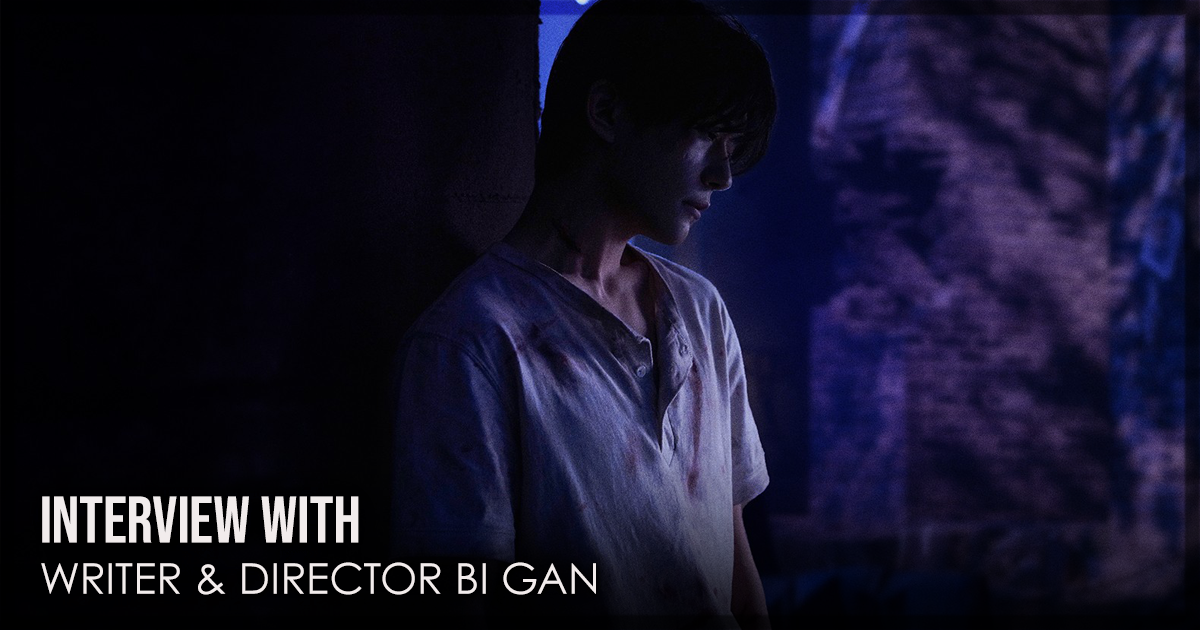
The young Chinese filmmaker Bi Gan is already a well-loved personality in the arthouse community. Despite his brief filmography, the director has already produced remarkable works in his career, such as Kaili Blues, Long Day’s Journey into Night, and his short film, A Short Story. Employing a poetic approach to filmmaking, a project by him feels like cinematic poetry. Fans have been waiting for a new feature; it’s been seven years since he presented Long Day’s at the Cannes Un Certain Regard. In the last batch of announcements for this year’s festival, Resurrection, his highly anticipated new project, was the last addition to the competition.
Resurrection is a hypnotic journey through a reality where people are unable to dream. We accompany an individual who occupies different realities, displaying a dream-like scenario in them. The result is two hours and forty minutes of pure hypnosis. Throughout the dive into the dreamy reality, the director gifts us with visual luxury and sonic profundity of the excellent score by the group M83. Resurrection is a 160-minute illusion, showcasing the possibilities of the media and the poetry of filmmakers bold enough to push boundaries.
Upon the limited release of the film on December 12th of last year in the United States, Movies We Texted About had the privilege to talk exclusively with Bi Gan about the gigantic scenarios, the score by M83, and the poetry in the camerawork.
The Interview with Bi Gan of Resurrection
Pedro Lima: First, congratulations on the film. It’s a wonderful tale of time. And I would like to ask you, the film is about multiple centuries and multiple realities, and one of the most fascinating things is the different scenarios. Could you tell me a bit about the art direction of the film? Because there are a lot of scenarios that are very beautiful and very detailed, that helps to tell this complicated story in such a fascinating way.
Bi Gan: So, our two art directors, Liu Chang and Tu Nan, they did a lot of work, during pre-production and also including during production, to really find a way to get the level of details and also authenticity, with not only the props, with the space, or with the specially designed prop as well, to, to really reflect the feelings of the different chapters, and also the different eras that they represent.
Bi Gan: And not only that, they spend a lot of a lot of efforts and research to… in order for them to create that. Even more challenging is because my film and the way I make and tell stories is to have this sort of dreamlike quality to it, and therefore, they cannot just use the stock props or stock design. They have to find a way to change it in such a way to create the kind of dreamlike feelings that I want to have for each part of the storytelling, so it’s definitely a lot of work, and they did such a wonderful job to pull it off.
Pedro Lima: Another element that fascinates me a lot about Resurrection is how, similar to A Short Story as well, your short film from 2022 is how your camera moves like a ballet. It’s like a dance. The camera moves in a way that… It’s not conventional in some sort, so there are a lot of long takes that you go through, like, a lot of minutes, I don’t know even how many minutes, but the camera feels very free. So how do you decide how to shoot these long scenes, and how do you prepare the actors and your crew for this… for these moments?
Bi Gan: For me, a signature or a hallmark of my filmmaking is the Misé-en-Scene. And that, along with the camera movements, that is something that I already thought about it as I was writing the script. So within the script, I already have a very clear idea in terms of how camera will move, and the mess of sand that will happen. And therefore, I need to convey that to my actors as well, and through a lot of rehearsals on locations, and how, you know, how they relate to the camera movement.
Bi Gan: It’s a process of combining something that is very, very old school in terms of the the way people used to make film, but also something that is very contemporary, that is very modern in terms of how we’re going to re-envision, how films can be made. So it is this kind of process of thinking about, not only as long takes as the sum of the small parts. I want to find a way to have each part have some sort of texture to it, and some kind of emotions attached to that. So, it’s not so much about just trying to accomplish a feat or a stunt for each part and connecting them together. I think in order to make that… this long take sing, I will need to find a way to have textures and emotions every step of the way, and then cumulatively, it suddenly becomes this particular emotional climax towards the end of the film as a result of this particular long take.
Pedro Lima: I would like to know how was the process to, invite, M83 to score, the film, which is a very incredible, work? Could you tell me a bit?
Bi Gan: One of our producers, Charles [Gillibert]…this is a China-France co-production. So, when I was talking to Charles about the films and the scoring, and he asked me whether or not, you know, I have certain musicians in mind to collaborate, and I just so happened that I’m a big fan of M83, so they reached out to M83, and they seem to be very willing and eager to collaborate, and so there was the history.
Pedro Lima: Thank you so much, Bi Gan. Thank you so much to the translator!
Resurrection (Kuangye shidai) is now in theaters.
Learn more about the film at the IMDB site for the title.
You might also like…
‘Resurrection’ Review: An Enormous, Sumptuous and Magnificent Movie from Bi Gan