
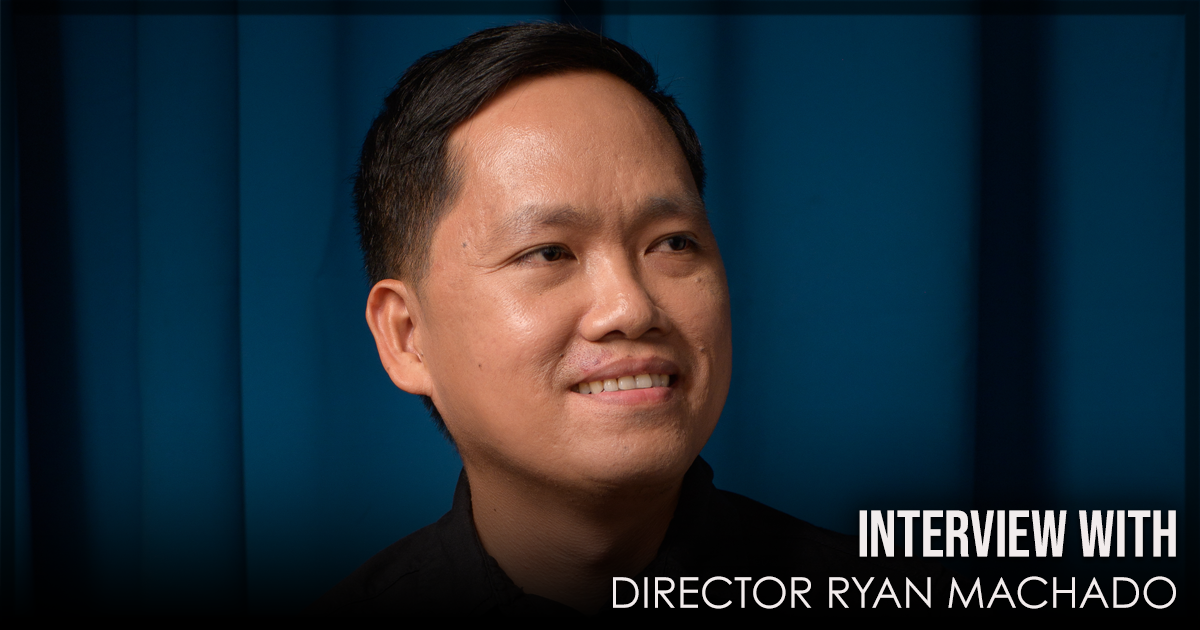
Another small-town story set in its director’s hometown, Romblon island, Filipino filmmaker Ryan Machado’s sophomore feature Raging follows a young man (played by Elijah Canlas) in the aftermath of sexual abuse. Unfolding in the mid-1990s, the film is pensive and unhurriedly paced, portraying its central character’s conflicts as more inward and private, stripped of expected catharsis and all the torturous rehearsing that has come to define movies about sexual violence. The result is altogether sobering and silently moving.
Screened for the first time at last year’s Cinemalaya Independent Film Festival, Raging played in the Panorama programme of the 76th Berlin International Film Festival, where the director’s first feature Huling Palabas (Fin) also screened under Generation 14plus two years ago. Ahead of the film’s international premiere, I spoke with Machado to discuss his fascination with small-town stories and analog technology, silence and restraint as cinematic language, and filming under unfavorable weather.
The Interview with Ryan Machado of Raging
Lé Baltar: How did the concept of Raging come to be?
Ryan Machado: Raging started from a very personal place, spaces and memories that I carry with me. I’ve long been interested in how violence, especially abuse, lingers quietly in bodies and environments long after the act itself has passed. The initial spark wasn’t a single incident, but a composite of stories and news that unfolded in our islands, creating a feeling of calm suffocation and oppressive silence. I wanted to explore rage not as something explosive, but as something that simmers, corrodes, and reshapes a person from within. The film grew out of that tension between what is felt intensely and what is never fully expressed.
Lé Baltar: Where does your proclivity for small-town stories come from?
Ryan Machado: I grew up in a small island province, and that landscape has always been part of my experiences and memories — it never really left me. In small towns like ours, things can be intimate, suffocating, and inescapable. That closeness creates a particular pressure that fascinates me as a storyteller. While small towns can be tender and nurturing, they can also be complicit in harm through silence, familiarity, and fear of disruption. That duality continues to preoccupy me.
Lé Baltar: As in Huling Palabas, location is really important in the way you compose your images, often through sweeping wide shots. Did you actually shoot Raging in Romblon? And what was it like to figure out the film’s visual language with cinematographer Theo Lozada?
Ryan Machado: Yes, we intentionally shot Raging on an island in Romblon. The place isn’t just a passive backdrop — Sibuyan Island is an emotional landscape. Theo and I were very conscious of using wide shots not for spectacle or to romanticize the beauty of the place, but to convey isolation. We talked a lot about how the environment could dwarf Eli, how nature could feel indifferent and quietly oppressive, yet also strangely empathic to his emotional state. Our visual language grew out of restraint: controlled camera movement, patient framing, and allowing space to hold as much emotional weight as the actors. It was a very intuitive collaboration — less about imposing style and more about listening to what the place was already offering.
Lé Baltar: As a follow-up to that, how long did actual production take? Any challenges?
Ryan Machado: The shoot itself was relatively short. We could only afford less than six days of filming, so it was quite intense. Working on an island always comes with logistical challenges — bringing the entire crew in from Manila, dealing with unpredictable weather, and having to adapt quickly. Working with a limited budget and shooting under storms took an emotional toll on everyone. While the material required rain and weather disturbances, these were things we couldn’t control at will. Still, I trusted my collaborators, and we made things work against all odds.
Lé Baltar: Contrary to its title, the movie is actually steeped in restraint. You’d think the confrontation between Eli and his abuser would feel much more explosive, but that’s not exactly the case here. Can you talk about that take on the character?
Ryan Machado: That restraint was very deliberate. I didn’t want to offer catharsis in the conventional sense. For someone like Eli, rage isn’t something that erupts cleanly — it’s something he has learned to suppress in order to survive. By subduing his outward expression, I wanted to heighten the internal weight of what he’s carrying. The confrontation isn’t about release; it’s about endurance and living through it.
Lé Baltar: What specific instructions did you give Elijah Canlas for Eli?
Ryan Machado: It helped that our assistant director, Jerom, is also Elijah’s older brother, so they already had a personal relationship. Jerom worked closely with him, and we talked a lot about what Eli doesn’t say and how he communicates mainly through body language. But honestly, I didn’t have to direct Elijah much — he understood the character deeply from the start. He has a remarkable sensitivity as an actor, and once we aligned on restraint as strength, he brought so much depth to the role without ever pushing.
Lé Baltar: Films as atmospheric as Raging are also dependent on good shooting weather. Were the scenes under heavy downpour actually filmed during a storm or staged or done in post?
Ryan Machado: Most of those scenes were filmed during actual downpours. Weather became an unpredictable collaborator. There were moments when we had to wait, and moments when we had no choice but to shoot through the rain. The storm added a physical texture to Eli’s inner turmoil — it wasn’t planned beat for beat, but it felt honest to the world of the film. For the rest of the scenes that required a heavy downpour, we had to do them in post.
Lé Baltar: Music is scarcely used in the film. Instead, you mostly harnessed ambient sound. Tell me how you went about the soundscape with Lamberto Casas Jr.
Ryan Machado: From the beginning, we agreed that silence and ambient sound would do most of the emotional work. It was a close collaboration among myself, the sound designer Lamberto Casas Jr., and the musical scorer Erwin Fajardo. We approached music not as something that should be clearly heard or felt, but as something that could dissolve into the natural environment — melding with textures like wind, water, the distant river current, and the low hum of Sibuyan itself. These sounds were meant to externalize Eli’s inner pain and thoughts. They aren’t neutral; they carry tension and directly affect the character. By avoiding a traditional score, we allowed the audience to sit with discomfort, to experience the quiet rage of the film without being emotionally guided.
Lé Baltar: Analog media is becoming a fixture in your films: VHS tapes in Huling Palabas, then the Walkman here. Apart from being signifiers of time, why do you incorporate this technology in your stories?
Ryan Machado: Analog media was part of my childhood. They fascinate me because they’re tactile and fragile. These objects require care because they can be damaged, erased, or lost, just like memory. In Raging, the Walkman isn’t just nostalgic; it’s intimate. It creates a private world for Eli, a way of listening inward when speaking outward isn’t possible. Analog technology slows things down, and that slowness mirrors how my characters process grief, desire, and trauma.
Lé Baltar: Were there particular films or filmmakers you were drawing inspiration from while putting Raging together?
Ryan Machado: I was drawn to filmmakers who understand restraint — those who trust atmosphere and silence. Directors like Apichatpong Weerasethakul, Lav Diaz, and more recently Pham Thien An (Inside the Yellow Cocoon Shell) were touchstones for me, not in terms of plot, but in their sensitivity to space, time, and interiority. The inspiration wasn’t about imitation, but about dialogue — how silence, nature, and memory can be universal themes while remaining deeply rooted in one’s place and experience.
Lé Baltar: How does it feel to be returning to Berlinale after screening your first feature at the same festival? Will you be attending the fest?
Ryan Machado: Returning to Berlinale feels both grounding and surreal. It’s a festival that welcomed my first feature, so there’s a sense of coming full circle — but I’m also arriving as a different filmmaker now, carrying new questions and deeper convictions. It feels less about validation and more about conversation. Yes, I’ll be attending with my producers, musical scorer and an actor who’s also an environmentalist. Of course, I’m looking forward to experiencing the film alongside audiences — and listening to how the work resonates, unsettles, or opens new dialogues.
Raging recently played at the 2026 Berlin International Film Festival.
Learn more about the film at the Berlinale website for the title.
You might also like…
‘58TH’ Movie Review: Rotoscoped Carnage