
There are other directors who are better, there are others who are more stylish, but there is no director anywhere in the world who is more interesting than Werner Herzog. He was once shot on camera during an interview for British television and actually called the wound “insignificant” as the presenter and camera crew bugged out. He can slide into acting in cameo roles for a bracing dash of weirdness in pretty much any TV show he chooses. And he is very prepared to go film in remote, inhospitable locations all over the world for months at a time, occasionally dragging entire riverboats with him. (The homage to Fitzcarraldo in Paddington in Peru is sadly the best thing about that movie.) So what has Mr. Herzog, whose mere name on a title card prompts Venice Film Festival audiences to burst into applause, done now?
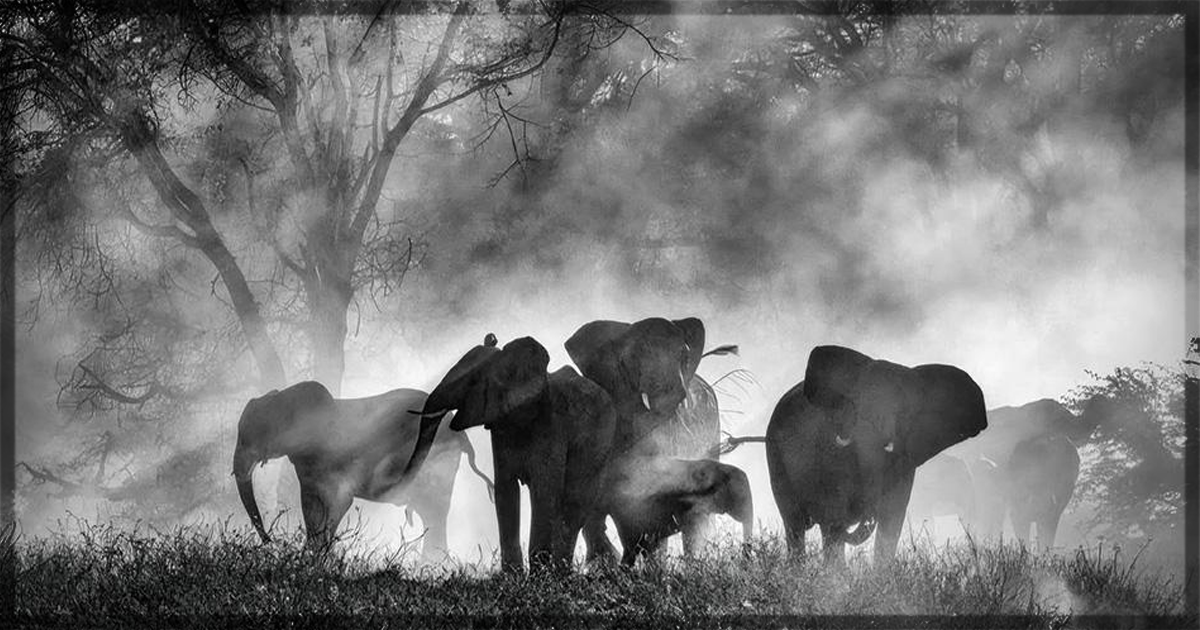
Well. He has worked with the National Geographic channel to follow a South African scientist named Dr. Steve Boyes into a remote plateau in Angola, a place the size of England without permanent human residents. The goal is to see if the elephants that seem to live up there but who have never been seen by human eyes can finally be seen. It is hard to imagine that an elephant could be a mystery, but it equally hard to imagine a land mass the size of a country where sixty million people live could be utterly devoid of human life. So what Mr. Herzog and his crew are keen to show are firstly the people who do live there, secondly the work that needs to be done in order to chase the elephants, and finally the amount of scientific work goes into learning about the elephants.
The hook is Henry, the largest elephant ever known to have exist, who was shot for sport by a Hungarian in 1955 and whose skin now stands guard to the American Museum of Natural History. Dr. Boyes wonders whether its great size might make it a specific sub-species, and we are allowed access to the storage areas of museums and the research labs of several different universities to ponder as the scientists discuss the possibilities. But Mr. Herzog is happier in the field, going with Dr. Boyes and his colleagues to meet the local kings, whose permission is essential for making contact with the elephants on their lands, and learning about hunting techniques from some San trackers. They are so good they can identify individual hoofprints in a field of dust. The fascination Mr. Herzog has with the San – also known as Bushmen – goes right up to the line between anthropology and poverty tourism, but then his voiceover makes clear that he is jealous of how they are not ruled by the clock. One of Dr. Boyes’ colleagues, despite being a child during the Angolan civil war, was often in his father’s helicopter while his father fought, and is therefore able to provide first-hand context for the more human-focused parts of local history.
But mainly we are in the now. The journey across the plateau, which requires porting motorbikes across countless rivers before the terrain becomes so impassable they can only continue on foot, is done with the heart in the mouth. The question Mr. Herzog repeatedly asks Dr. Boyes, and which Dr. Boyes repeatedly asks himself, is if it is better to know for certain there are elephants up there. Is it preferable to keep them as a dream forever? Do we really want our dreams to come true?
Well, that depends on the answer, of course, and Mr. Herzog’s solid work here provides a very satisfying and not to be spoiled ending. He has a capacity for discomfort which makes him an ideal nature documentarian, and a gift for ensuring the scientific data is felt through human experience. Something about Mr. Herzog, maybe his curiosity, enables him to cut through the noise to the heart of things. If he wished to pivot into nature documentaries full-time the world would be very happy to follow.
Ghost Elephants recently played at the Venice Film Festival.
Learn more about the film at the Venice site for the title.
You might also like…
