
The Malaysian/Taiwanese director Tsai Ming-Liang is one of the most prominent figures in slow cinema. This philosophy of filmmaking contradicts the modern postulates of the commercial cinema, where the film features multiple cuts and plenty of scenarios to compose its story. As the name suggests, this form of filmmaking contemplates what the imagery offers through the director’s compositions. The audience has plenty of time to reflect on what is on the screen. Hence, throughout Ming-Liang’s filmography, there are classics like Vive L’Amour, The River, and Goodbye, Dragon Inn, films that won major awards at festivals, and also get a place in the canon when discussing lists of the most crucial films. However, the most recent of the director’s productions consists of sixty-minute documentaries and projects from his Walker series, which was filming its eleventh part at the Donostia-San Sebastian festival. In 2025, he released Hui Jia (Back Home) at the Bienalle di Venezia in the non-fiction section of the festival.
In his new effort, the filmmaker goes to Laos, the homeland of his lead actor in previous films, Anong Houngheuangsy. In the first scene, the director shoots his actor closely while he is sleeping on the bus. Its imagery showcases a homevideo aesthetic, a small camera that Ming-Liang carries around. Instead of massive cinema cameras, the director chooses the portable one, a comfortable model to help him navigate the inner sides of Laos. Right in the following scene, the legendary author projects the most aesthetically pleasing excerpt of his new project in an amusement park, where children spin on a carousel, and a dog barks at them. As the dog runs throughout the spiral, red-ish, almost neon lights illuminate a simple, but amusing park for the citizens of that village. Those few minutes embody the small glimpses of joy for a community in a rural area.
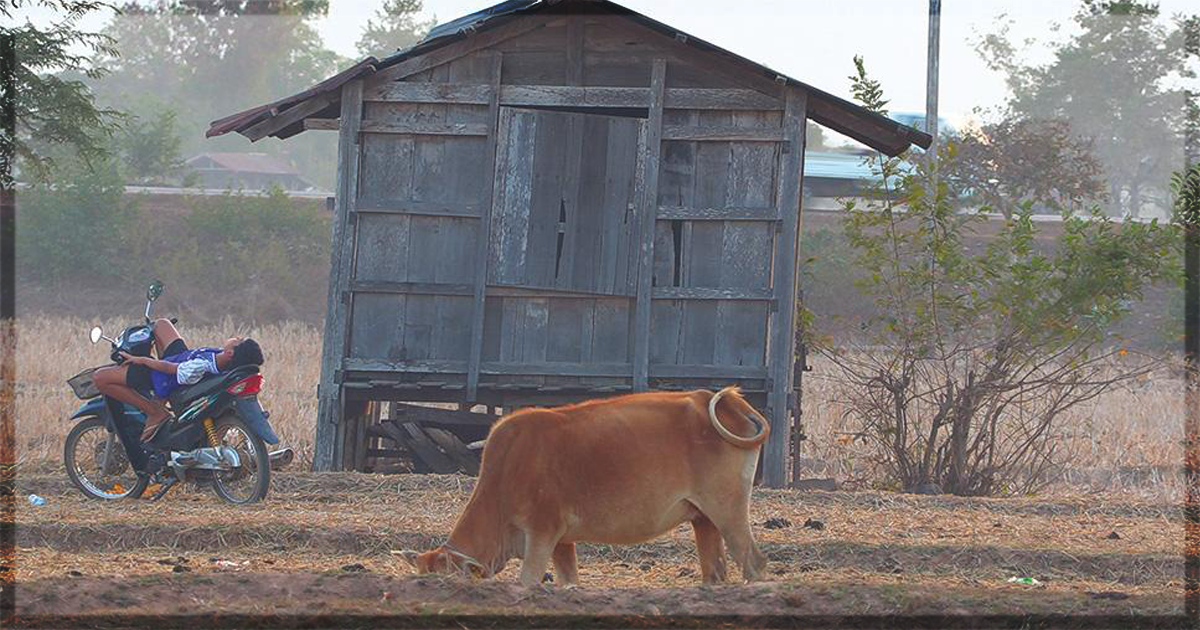
The film is a chilled and calm representation of rural life, similar to the Walker series in how it presents the ambiance and scenarios surrounding him. In a sense, the director has no rush; despite the short duration of an hour and five minutes, it features multiple scenes where the lens focuses on an object and stays there for a while. The protagonists of the film are the scenic elements captured by Ming-Liang’s small camera. He shoots the large fields, which contrast the green of grass and weeds with the brown of the mud, and the simple wooden house that represents the central human pillar of that environment. The slightly crooked residence shares space with the cows and animals living in that area. The farm is the life of many in that region of Laos and many countries in the Southeast Asia, whose residents depend on the farming activity as their central source of livelihood.
Another central point of Back Home is the opposition in setting to the director’s eleventh-part series. In those films, the filmmaker positions the monk figure as a contrasting element to the towns around him, where he walks through the cities wearing his red garments, polarizing the religious figure, the monk, and the urbanization surrounding him. It is a dynamic that positions the century-long tradition of Buddhism in the new wave of economic development from the Southeast Asia, anchored by investment in the individual’s knowledge, the communal well-being, and distancing from religion as the philosophy of leadership. Hence, this new film contrasts the formal approach of the series, as Ming-Liang dives into the rural rather than the urban center. Furthermore, he decides to use the land as the central element, and not a figure like the walking monk. Hence, Anong Houngheuangsy is an introductory element to Laos, the setting of this film.
This new effort is a slice of life from a specific region of Asia with its codes and traditions. More importantly, it is an exploration of the village of a frequent collaborator of the director, which fascinates the director in understanding his background. Alike the masterful Chris Marker, Tsai Ming-Liang positions himself as a champion of the travelogue format, which transports the audience to watch specific areas of a region. Opposed to Marker, who had an Eurocentric interest in Asia, and seeks to comprehend the continent through his filmmaking, generating works like the magnum opus Sans Soleil, Ming-Liang searches for the neighboring ground, and represents through the filmic tool, the land of his brothers, those sharing with him the journey of producing a film. Hence, Back Home combines all of the elements of Tsai Ming-Liang’s recent production: the slow cinema, the travelogue format, and the search to represent the places he is in.
Back Home was recently in theaters.
Learn more about the documentary film at the IMDB site for the title.
You might also like…
