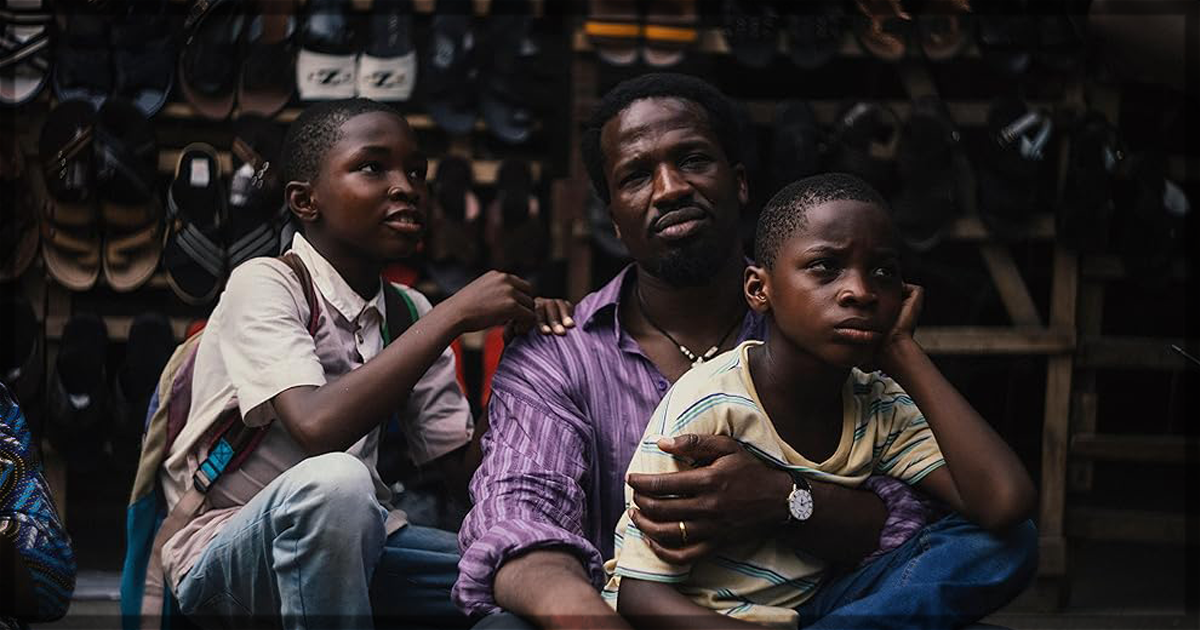
Anyone who will discuss Akinola Davies Jr’s My Father’s Shadow will immediately recognize – and laud – that its politics are morally sound and cogent. It might even be an angrier film than you think, even if it mainly focuses on the distant relationship two young brothers, Akinola (Godwin Egbo), and Olaremi (Chibuike Marvellous Egbo) have with their father, Folarin (Ṣọpẹ́ Dìrísù). Loosely based on the filmmaker’s own childhood, Davies Jr. gives a child’s eye view of one of the most harrowing moments of Nigeria’s military dictatorship, as its regime annulled the democratic results of its 1993 presidential election, where M.K.O. Abiola overwhelmingly won, in a free, fair, and democratic process, and promised to put an end to the tyrannical reign Nigerians had faced since Ibrahim Babangida’s military coup.
Even audiences who aren’t familiar with the sociopolitical context behind the movie – set during a time where the military ruled the country for an uninterrupted period of eight years, and the social unrest that led to his decision to annul the results of the election – will feel the scorching urgency behind Davies Jr’s depiction of the events, through the perspective of the brothers. The camera, which at times flourishes in striking dolly-zooms or crash-zooms, is always at their level as they explore the city of Lagos with their father, who agrees to take them to his work after they beg to spend more time with him. It also strikingly blurs the line between vérité authenticity and a work of fiction, as the movie frequently intersperses real-life, documentary footage of the unrest that led to the annulment of the election with sequences shot for the film, in a seamless fashion.
While Folarin attempts to show them around and make them learn about the history of the country – and city – they live in, something’s boiling inside him that he can’t fully repress. His nose constantly bleeds – a primer for a terrifying event to come later during the movie – and the loud and vehement support he holds for Abiola puts him at risk of being a target by the military. He believes that once Abiola wins, everything will go back to normal, and Nigeria will flourish again, never registering in his mind that the dictators in power will stop at nothing to hold their rule and could undoubtedly commit the unthinkable. Inadvertently, while not the primary intention of Davies Jr. ‘s film, this acts as a cautionary tale to the current dictatorship held by the United States government, i.e., if you think you’re going to have a normal election after Donald Trump’s second win, think again.
When democracy cripples, humanity doesn’t necessarily recognize this inextricable fact until it’s far too late, and this is sadly what occurs, almost in real-time, in My Father’s Shadow. The innocent children, who are watching their father teach them life’s values and tell fairly sad stories about his past, while not fully recognizing him or knowing his true nature, begin to realize who he might be beyond what little they know about him. It’s implied that Akinola and Olaremi spend most of their time with their mother and see Folarin only rarely. Near the end of the picture, you will understand why, but it still doesn’t make the cut to a devastating final sequence less impactful as a result.
Instead of documenting the brothers’ day with their father in a relatively social-realist way, à la Jean-Pierre and Luc Dardenne, Davies Jr. takes a more impressionistic approach, with the aesthetic and thematic structure of My Father’s Shadow. This gives the movie a tangible, singular artistic feel, which, in turn, makes Ṣọpẹ́ Dìrísù’s central performance hit even harder. The British/Nigerian actor gives his best portrayal of a father torn between his love for the children he hasn’t seen in years and his activism, which will likely save lives in the long term, even if it means risking his own life for the sake of future generations. It’s an impassioned plea that grows much angrier as the film reaches its sobering – and telegraphed – conclusion, but one that sticks with you long after its final image has washed away…
And yet, there’s something that feels strangely distant about a film like this. We never fully connect with the characters at a cellular level, despite the amazing music giving the material a textured atmosphere, and the on-the-fly, almost experimental aesthetic pulling us into a lived-in Lagos brought into turmoil. The relationship between the children doesn’t register as intimate as it should, despite both giving impassioned performances. The resulting emotional impact, thus, feels slightly stunted, even though one can’t overstate how important a film like this is: it captures a moment in history that few outside of Nigeria knew the real-world impacts of, and one whose parallels to the current-day times we live in are clearer by the day.
My Father’s Shadow is slightly flawed, but one can’t overstate how cogent and powerfully told it is. Even though Dìrísù has been acting for a considerable amount of time, his performance here feels like his first step into the next evolution of his career, and one he’s been wanting to reveal for a long time. His next role is a lead performance in Gareth Evans’ remake of Takashi Nomura’s A Colt is My Passport. One can’t wait to see what he will bring to the table here, and beyond…
My Father’s Shadow is now in theaters.
Learn more about the film at the IMDB site for the title.
You might also like…
‘Yunan’ Film Review: A Powerfully Told and Patient Drama