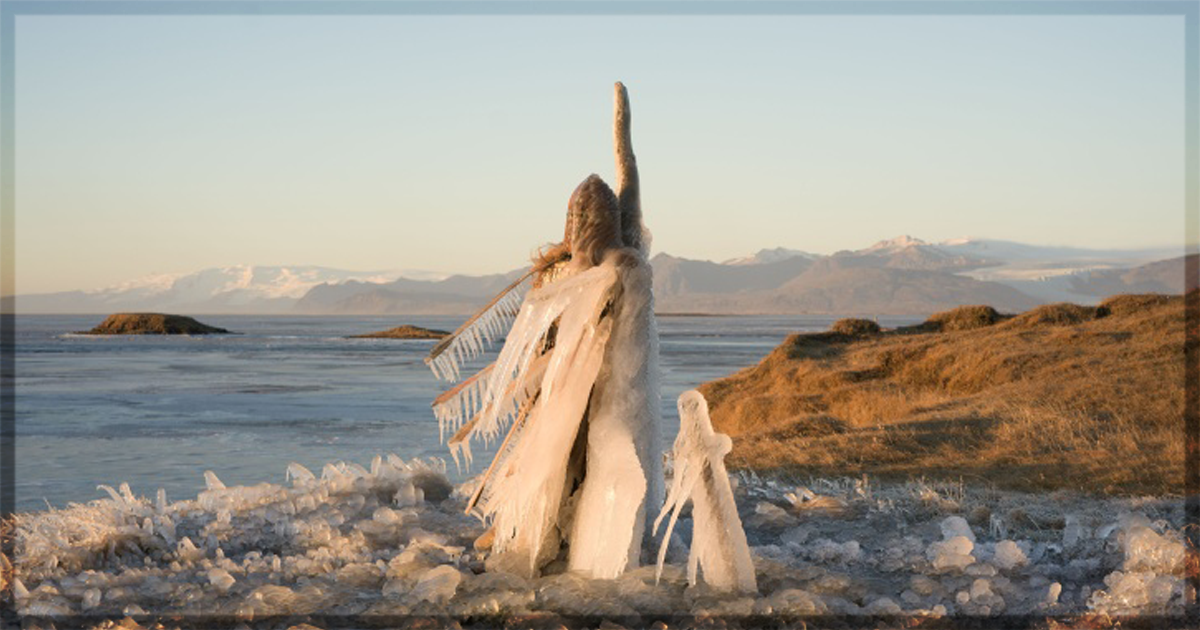
Despite the small territorial space, Iceland has been a potent force for cinema in recent decades. The little island in the Arctic gave us names like Rúnar Rúnarsson and Hylnur Pálmason. Both of them are popular presences at events like the Cannes Film Festival. Rúnarsson presented his When The Light Breaks at last year’s Un Certain Regard, and Pálmason took his The Love that Remains to the Cannes Premiere section. The latest is an absurdist reflection on the impact of divorce in a family, where the children and the couple suffer from the breakup. Besides the fable about separation, the director shot a parallel project that derives from the main story. In the film, the couple’s children built a statue on their land, an armored bust that they built throughout the seasons of the year. The whole construction of this statue is the focus of Joan of Arc (Jóhanna af Örk), the director’s parallel project to the same story.
Firstly, Pálmason charmed the arthouse circuit with his style. Observing the gorgeous Icelandic landscapes around him, the director reflects on the human being and the land, utilizing the cinematic form to question life. Visually, he attempts to capture a particular realistic nature, using the illusionism of the media to impress, notably due to his preference for shooting his works on film. Yet, the filmmaker documents the interactions of individuals, predominantly children, in his work, the relationship between nature and men. Godland tackles the difficulties of a priest with the environment around him; meanwhile, Nest is a glance at children building a tree house with their father. Ultimately, Joan of Arc feels a combination of both: the endurance against the severe Nordic weather and the ritual of exploring the childish curiosity in the wild.
For an hour, we watch the three children, Ída, Þorgils, and Grímur, build a statue, later named Joan of Arc. As we observe their effort, we watch three children in the natural curiosity of childhood. They throw rocks at each other, run around the island, and dig the circle for the statue. Pálmason, who is also the cinematographer, positions his camera at a fixed placement, having his characters surround that period. It is theatrical, the three of them (four, if you include Joan), running around at a rehearsed perimeter, the circle as the stage, and the camera as the audience. However, the subtle editing of Julius Krebs Damsbo juxtaposes the images that converse with each other. We observe the grass growing, the snow falling, but the ocean moving in the background creates an unisound, which echoes beautifully with the childish screams and euphoria. Therefore, it is a collage, a representation of the children’s manufacturing their source of fun. It is a filmed theatrical experience that invites us to observe the naturalism, which clashes with the absurdism, the creature coming to life, and deciding for itself. Contrary to The Love that Remains, it is a fascinating process of accessing a subplot that gets few scenes in the first project, but it is an entirely new work from a specific vision.
Furthermore, Pálmason presents the best aspects of works like Nest, which favors the observation of the nature and the creation process. Similar to the historical figure, this Joan was condemned to the eternal prison, staying in that circle forever. Yet, the director leans towards the absurdism of The Love that Remains, which relies heavily on the visual metaphors to transpose the emotions from the divorce. Contrary to the one burnt by the catholic church for blasphemy, this one is free in the cold Icelandic Ocean, freeing itself from energetic children who throw arrows at their own creation. The pair of works between Love/Joan is an expansion of the director’s canon, stretching topics, visual formalities, and a style from his past works, such as A White, White Day and Winter Brothers. Pálmason reaches beyond the the structures of his former films and embraces the absurd, the nonsensical, and illogical.
By expanding what he introduces in The Love that Remains, Pálmason plays with his own creation, precisely like the siblings in his one-hour filmed theatrical experience. The meticulous editing and the construction of a cohesive, timely adventure deliver a fascinating work in Joan of Arc. Throughout his exploration of childhood experiences and the clash with nature, the director delves into the seasons, reflecting on the passage of time and life through the cinematic format. The director summarizes multiple months of the childish effort that juxtaposes and illustrates how time goes by quickly.
Joan of Arc (Jóhanna af Örk) recently played at the San Sebastian Film Festival.
Learn more about the film at the San Sebastian site for the title.
You might also like…