
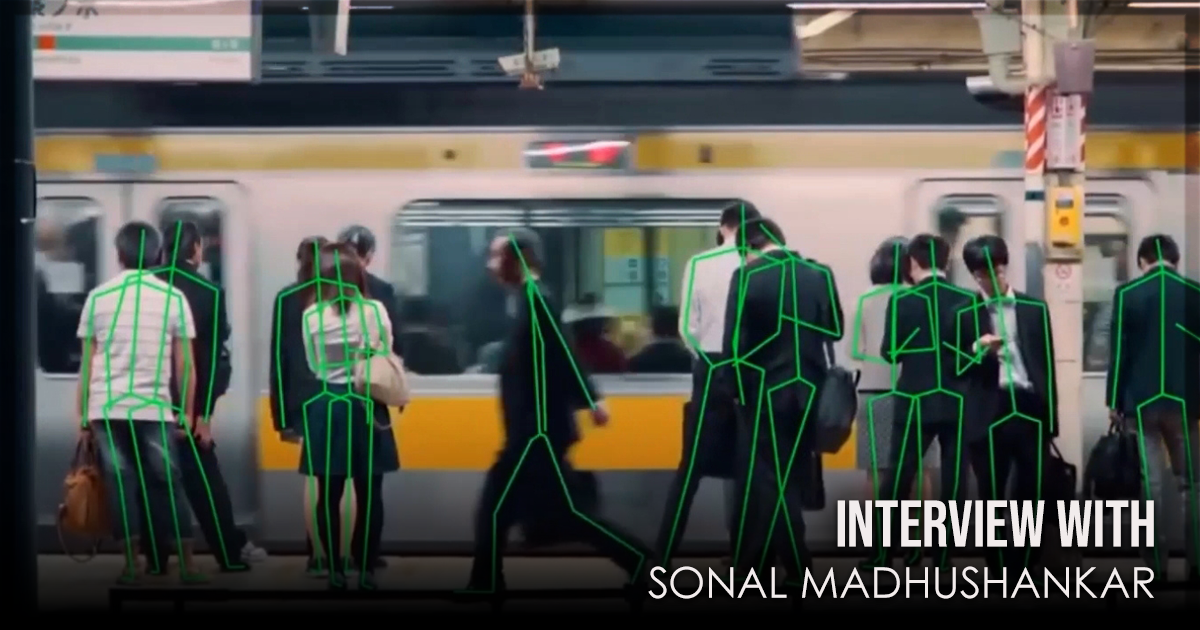
In Aranya Sahay’s Humans in the Loop, technology and morality collide in a gripping story about the fine line between human judgment and artificial intelligence. The film follows Nehma, a woman deeply passionate about innovation but forced to confront ethical dilemmas that shake her sense of purpose and identity. At its heart, the movie is not just about algorithms or systems—it’s about humanity, responsibility, and the personal cost of progress.
Bringing Nehma to life is actor Sonal Madhushankar, who delivers a superlative performance that is as raw as it is layered. Through her, we see the conflict of ambition clashing with conscience, and the pain of navigating tradition while dreaming of a future shaped by technology. In this candid conversation, the actress opens up about her unusual journey from engineering to acting, the skills that shaped her craft, and how her own upbringing in Chandrapur helped her connect with Nehma’s struggles. She also reflects on the lessons of Humans in the Loop and what she hopes audiences take away from the film.
The Interview with Sonal Madhushankar on Humans in the Loop
[Editor’s Note: This interview has been lightly edited for clarity.]
Aayush Sharma: Congratulations on ‘Humans in the Loop.’ Before we discuss the film, I would like to ask you about your journey in the entertainment industry.
Sonal Madhushankar: It was a wonderful journey. I mean, I have entertainment or acting. I was an engineer, and while doing my job, I was doing theater in Pune. When I came to Mumbai because I got transferred, I was doing machine learning at Infosys. It was very difficult for me, and I was not able to enjoy it, so I resigned and eventually started my dream job — acting.
Aayush Sharma: But you have a fascinating history. First, you did engineering, then clowning, and pistol shooting. All these things are so different from one another. How, after doing these three, did you decide to take up acting?
Sonal Madhushankar: So, for an actor, I think he needs to upskill his skill set every time. Whenever I used to get time, I used to do whatever was required. For example, when I was doing theater, my husband directed the play The Last Audience, and that clowning was required. So I joined Amrita Mapuskar’s class. It was a wonderful journey because when you do clowning, you are very free. I mean, you need to think of yourself as if you’re stupid. And yeah, that’s how you need to accept yourself. That journey was very nice working with her. With respect to pistol shooting, because I come from Chandrapur and there are no classes or medium to do such stuff, when I came to know that pistol shooting is happening, and that there are classes in Mumbai, I joined without giving a second thought.
Aayush Sharma: Were they crucial in pushing you towards the love for your craft of acting?
Sonal Madhushankar: I knew that I wanted to become an actor. With respect to craft, reading was important, and doing theater was important, which I didn’t have any idea about. In Chandrapur, we used to watch plays with my parents, but I didn’t know how to become an actor. For that, I came to know that you need to learn acting, so I started doing theatre in Pune. In the process, I came to know that you need to upskill. It helped me a lot. Pistol shooting, clowning, they helped me a lot to be free. Most of the time, actors think from here, but what about the body? The body is not secondary; it is as crucial as the brain. I think your body speaks more than words. When I came to know about that, I started exploring various skills. So ya, it really helped me.
Aayush Sharma: Now, coming to ‘Humans in the Loop,’ Your character, Nehma, is deeply passionate about technology but is also forced to confront ethical dilemmas that challenge her sense of purpose. How did you prepare emotionally to portray the conflict between ambition and moral responsibility, especially in scenes where the weight of the system’s consequences falls on her shoulders?
Sonal Madhushankar: Before being an actor, I’m a human being also. I have gone through such experiences in my life where you need to report to your manager, and at times, he or she will scold you. You cannot take action against it sometimes because there are stakes. Your job is important, you need to take care of your family, and sometimes you just need to take a back foot and be there. As far as ethics are concerned, you’re always dealing with that in your family, personal life, and professional life. It’s not that I will follow this path all the time. You need to reach a consensus, and whatever is convenient for you, you take that action. I think it helped me in building a character when I was building Nehma. She’s very ethical and rooted, and she loves her city the way I love mine. The way she is, she’s very pure, no? Whatever our parents taught us — this is what my parents told me, this is the religion, this is the caste, this is how we do all the rituals, we follow that and pass it to the next generation. But when there is friction, you question your upbringing, your conscience, what is right and wrong. That questioning is very important, and Nehma can question. It’s as normal as any human being can do. Aranya [Sahay] has written so beautifully that it was easy to understand.
Aayush Sharma: You come from Chandrapur, a region with a unique history—once part of Madhya Pradesh and later integrated into Maharashtra—where traditional mindsets continue to shape everyday life. Did your personal experiences growing up there influence how you connected with Nehma’s emotions and struggles, especially as she returns to her village after many years and confronts the clash between progress and tradition?
Sonal Madhushankar: When I read the script and auditioned, there was this scene where Aranya asks me, “Are you from the Oraon community?” and he’s from another community. I relate to it because I’m from the Dalit community. Even though tribals are from the indigenous community, I understand the hesitation and where they come from. There is discrimination and treatment from society; they’re outcasts. Even though my upbringing was very privileged — my father is educated and has given us a privileged upbringing – I knew where we had come from. I knew his struggles also. It’s innate, you know? It’s in the eyes — coming out as a Dalit or any lower caste people is very difficult when you talk to people and look into their eyes. I knew where she was coming from, and at that moment, I knew where this breath was coming from.
Chandrapur has shaped me. There wasn’t any explicit discrimination, but I had a few experiences where people asked, “Oh, you can speak English?” or “Your color doesn’t look like that,” or “Didn’t you get a reservation?” I didn’t take a reservation, but people still asked, “Oh, you still finished your education.” These minor things had happened, but these minor things actually shape you.
Aayush Sharma: The story of Humans In The Loop is built around the tension between human judgment and algorithmic decision-making, especially in high-stakes situations. How did you feel about the story when you first read it? After reading it, did you think about your own relationship with technology?
Sonal Madhushankar: When I was doing machine learning, I was not convinced to do it, even though I was coding and doing my job. I was on the client side and working for Axis Bank. I used to think, “Arre, I’m doing this automation and then people’s jobs will be gone. What am I doing?” At that point, I was thinking. As far as the script is concerned, when I read it, I started thinking about manifestation first. Sometimes it happens, “I just imagined and it happened. There is god.” We say, “Arre, Bhagwan hai. Our willpower is working. Keep manifesting, keep journaling, write it down again and again.” I found the resemblances between AI, also, whatever we think, at times, it just gets real. I got scared about it. I don’t want to share my data. It’s so personal. There is no trust in AI. It’s a machine created by engineers and data labelers. I don’t know where the trust comes into the picture. That thinking was going on. AI is very dangerous, so we should not rely on it — that’s what I was thinking.
There were too many things I was thinking about, Aayush, where the ethical point will come into the picture. When I was studying engineering, there was ethical hacking going on. Hacking is very dangerous, but what is ethical hacking? To prevent, right? I used to correlate that there can be ethical programming also. It’s in our hands. Then I thought about many things. When the Vedas were written or when the Manusmriti was written, whoever had the pen wrote it, and we are following it. In a way, we are following it, right? So is this the way AI will also work? Those who have the programming, those who write the design, use cases, or test cases, are they going to have our future? I was thinking in those terms, yeah.
Aayush Sharma: Did you get to meet Adivasi women to know more about how they live and their relationship with advanced technology? What did you learn about them?
Sonal Madhushankar: I’m from Chandrapur, and we have the tribal region Gachiroli. I’ve been living with them, even though I didn’t have direct contact, but they are in our proximity, in our vicinity. To prepare for this role, of course, I met Adivasi people, tribal women. If you observe whatever we shot in that artificial intelligence center, I had so many girls surrounding me — they are tribal women. When we had a one-day workshop with them, they came and shared their struggles and stories without taking a moment. They were just telling me stories continuously without breathing. So much was in their hearts that you just connect at that point. You have no option but to listen and surrender. They told their stories.
With respect to technology, I didn’t learn anything about its relation to them. But in the process, I came to know they are just like us. We think they are not like us, but they are. They celebrate like us. We had called them for a shoot, and they were so beautiful. They got ready, put on flowers, these are things we do. There is this relatability. Of course, they’re tribal people, and we have different communities, but they are just like us. We just need to be with them, eat with them, and have a conversation. When I understood that, we shouldn’t segregate them from society but include them, that understanding came directly.
Aayush Sharma: Nehma’s journey isn’t just about technology—it’s about revisiting a troubled past and facing regressive societal mindsets. How did you connect your own experiences or observations with her struggle to navigate between professional aspirations and personal guilt?
Sonal Madhushankar: There is this scene wherein she puts Nehma, beautiful Nehma. At that point, I couldn’t breathe. I don’t know why. When you’re acting, your whole imagination, your whole journey comes together — it’s an amalgamation of everything. You cannot just channelize, “ke iske baad ye, ye, ye.” It’s an amalgamation of each and every experience you had in your past. At the same time, you cannot segregate Nehma either. Both of us were there when I was doing that performance, Sonal as well as Nehma. I’ve been listening to many stories, going through news channels, and going through Brut. I’m not discarded from real life. We see every day what women are going through, what women from the unprivileged caste are going through in general — in society, at home, with dowry systems, everything. You just need empathy and open your ears and eyes to receive that information and feel for it. You can’t close the doors and just move the page. You stay there. The way Aranya directed and gave me time, and the team as a whole, we stayed with the script, with Nehma’s journey, and the hardships she’s going through. The script has given me more power, and the people around me.
Aayush Sharma: What was it like working with Aranya Sahay, and how is he as a director on the set?
Sonal Madhushankar: He’s brilliant and very calm. On the set, usually, there is chaos for some reason, but he’s so calm and will guide you. He’ll be patient with you, understand you. If there’s a fight, he’ll go there, listen to everyone, and make sure there’s a middle path. There’s one scene, as an actor, I’m sometimes very lazy and didn’t want to give what he expected. I was tired of doing the scene again and again, and he just sat with me. He shared his memory with me. It wasn’t a conversation between a director and a character; it was between two people. I just sat there. I think if you want to build trust, you share your memories and past with the other person. The way he shared and thought I was that person to listen, and that I wouldn’t share it with anyone else, sharing that memory was overwhelming for me. After that conversation, I could give that shot. That kind of direction, how you deal with your actor, co-actors, and team in between scenes and shots, is important. The story is very important for a director, and the unit is important, but how you deal with your team in between is also important. It’s beautiful. He has so much wisdom to give. I think he lived there for one year and knows everything. We used to travel with him, and after the shoot, he’d take us home and make sure everything was fine, food and everything. It’s very difficult, and he has done it. He has done it.
Aayush Sharma: And now for some rapid fire questions. Three favorite films of all time?
Sonal Madhushankar: Interstellar, Perfumes, and Kuch Kuch Hota Hai.
Aayush Sharma: Three filmmakers you want to work with?
Sonal Madhushankar: Christopher Nolan, Aranya Sahay again, and Rohan Kanawade.
Aayush Sharma: Three actors you would want to share screen with?
Sonal Madhushankar: Olivia Colman, Raghubir Yadav, and Owen Cooper.
Aayush Sharma: If you weren’t an actor, which profession would you have chosen?
Sonal Madhushankar: I’d be a cook because I love to cook.
Aayush Sharma: You have worked in TV shows as well, like Delhi Crime and Duranga, and in movies such as Gangubai Kathiawadi. Which medium gives you space to explore more of your creativity?
Sonal Madhushankar: Now that you’ve asked this question, I’m thinking I don’t need space. When you get space, you think too much. I’m on that line, I’m telling you. When I was working on Gangubai Kathiawadi, I understood filmmaking and how rigorous it is. Every time, you need to be centered. Coming back to your character again and again was very difficult. That centering is very important for me. If you give me space, I’ll go haywire, my thoughts will go haywire. I think in every field, I don’t want to stop. While I’m working, I don’t want to stop. Of course, after that, I can read, get references, and everything. But when I’m working on set or stage, I just don’t want space — space when I’m performing. Yeah.
Aayush Sharma: So, my last question for you, Sonal — now that Humans in the Loop is in theaters and receiving the love it deserves, what do you hope audiences take away from this story? Is there one specific message or lesson you want people to learn through it?
Sonal Madhushankar: Specific thing to learn from the story? There could be many answers, but as a human being, I think… I don’t know. The last scene where I apologize to my daughter because of the miscommunication, or there isn’t any communication between parent and child. With respect to AI, we communicate and give so much information on chat that this is what I am. I think we need to build trust between people. We think they are unapproachable, that we won’t be able to share because of what they’ll think. Let them think whatever they want, but just share, apologize, and understand people. When that happens, I think reliance on technology will be eradicated. Nowadays, people rely so much on that that whatever we feel, we just put in — “I’m feeling nervous, what should I do?” — and it takes us to some gruesome steps. It’s better to talk to a person. We are very closed. I think we should just open up. That’s what human touch is. That’s what I think Karishma Mehrotra, Aranya, I, or Gita ma’am want to tell. Just open up with people.
Humans in the Loop was recently in theaters.
Learn more about the film at the official IMDB site for the title.
You might also like…
